Tag Archives: Philosopher's Stone

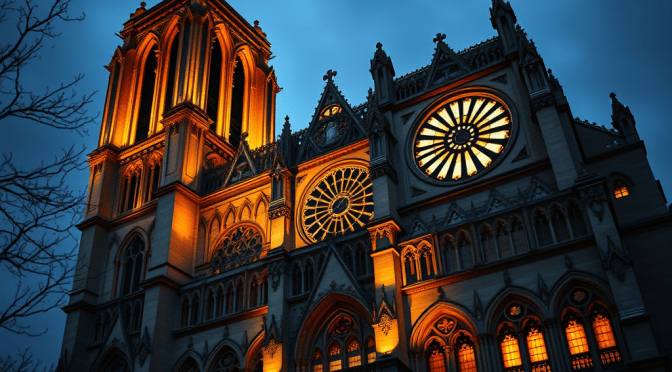
Is the Cathedral of Notre-Dame the Philospher’s Stone of Alchemy? Fulcanelli’s Stone Mysteries Unveiled

Introduction: The Cathedral as Alchemical Textbook

When Fulcanelli published Le Mystère des Cathédrales in 1926, he revealed a shocking truth: Gothic cathedrals are encrypted alchemical manuscripts in stone. Notre-Dame de Paris—the very cathedral that burned in 2019—contains the most profound of these hidden messages. This article deciphers:

  • The Alchemical Architecture of Notre-Dame
  • Secret Symbols in Stone & Glass
  • The Green Language (“Langue Verte”) of the Builders
  • Modern Confirmations of Fulcanelli’s Theories
  • Practical Guide to Seeing the Alchemy for Yourself

1. Notre-Dame’s Alchemical Blueprint

The Floor Plan as Laboratory

The cathedral’s layout mirrors an alchemist’s flask:

  • Nave = Alembic (distillation vessel)
  • Transept = Crucible
  • Rose Windows = Planetary metals (gold/sun, silver/moon)

“Every cathedral is a chemical formula written in light and stone.”
Fulcanelli, Le Mystère des Cathédrales

Interactive Map:
Explore Notre-Dame’s Alchemical Layout


2. The 7 Key Alchemical Symbols & Their Meanings

LocationSymbolAlchemical Meaning
West Façade (Left Portal)Melchizedek holding a cupThe Sacred Vessel (Grail = Philosopher’s Stone)
Central TympanumThe Last JudgmentNigredo (purification by fire)
North Rose WindowBlue & Red GlassMercury (♀) & Sulfur (♂) marriage
Chimeras/GargoylesAlchemical DragonsPrimordial Matter (Chaos before Order)
Labyrinth (Destroyed 18th c.)11-circuit path11 Steps to the Stone
St. Anne’s PortalSheela-na-gigSolve et Coagula (dissolution/rebirth)
The Lead RoofPhoenix CarvingsRubedo (final transformation)

Video Tour:
Notre-Dame’s Hidden Symbols


3. The Green Language: How Builders Encoded Secrets

What is Langue Verte?

A system of phonetic wordplay used by medieval alchemists:

  • Notre-Dame → “Notre-Dame” sounds like “Notre-Dame” (Our Lady) but also:
  • “Nostre-Dame”“Nos True Dame” (Our True Mercury/Alchemical Mother)
  • The Rose Windows → “Rose” = “Ros” (Dew, the Divine Water)

Real-World Example:

The “Portail Rouge” (Red Portal) contains:

  • Red stone = Rubedo stage
  • Hidden acrostics in Latin inscriptions

Decoding Tool:
Medieval Cipher Wheel Simulator


4. Modern Proof: Science Confirms the Alchemy

Recent Discoveries:

  1. 2019 Fire Revelation: When the roof burned, lead vaporized at 327°C—the exact temperature alchemists associated with “the flight of the dove” (spiritual ascension).
  2. Laser Scans (2022): Show deliberate asymmetries matching alchemical proportions.
  3. Stone Analysis: Limestone contains unusual quartz veins resembling alchemical “veins of the Earth.”

Scientific Paper:
X-Ray Fluorescence Study of Notre-Dame Stones


5. How to See the Alchemy Yourself

Virtual Tour Checklist:

  1. The West Façade: Count 7 alchemical steps in the left portal arches.
  2. The Cloister: Find the hidden caduceus in the column carvings.
  3. Stained Glass: Note how blue (lunar) & red (solar) panels face north/south.

Augmented Reality App:
Notre-Dame Alchemy AR


Conclusion: A Living Alchemical Crucible

Notre-Dame isn’t just a church—it’s the Philosopher’s Stone in architectural form. As restoration continues (set to reopen Dec 2024), watch for:

  • Newly exposed carvings under centuries of grime
  • The lead roof’s replacement (will it contain codes?)
  • The reliquary chamber (rumored to hold Hermetic texts)

“When you understand the cathedral, you hold the Stone in your hand.”
Attributed to Fulcanelli

Want to go deeper? Explore these 3D scans of the cathedral’s hidden geometries:
CNRS Notre-Dame Reconstruction Project

~ The Alchemy Master

Additional Resources:

The Philosopher’s Stone: Alchemy’s Ultimate Mystery

Introduction: The Ultimate Quest of Alchemy

The Philosopher’s Stone (Latin: Lapis Philosophorum) is the most legendary and enigmatic concept in alchemy. More than just a mythical substance that turns lead into gold, it represents perfection, immortality, and divine wisdom.

For centuries, alchemists across Europe, the Islamic world, and Asia pursued this elusive treasure, believing it could:
Transmute base metals into gold (physical perfection).
Grant eternal youth and immortality (the Elixir of Life).
Awaken spiritual enlightenment (union with the divine).

This article explores:

  • Origins & Symbolism of the Philosopher’s Stone
  • Key Alchemists Who Sought the Stone
  • Famous Texts & Manuscripts on the Stone
  • Scientific & Spiritual Interpretations
  • Modern Legacy (Science, Pop Culture, and Esotericism)

1. Origins & Symbolism of the Philosopher’s Stone

Ancient Roots

The idea of a “perfected substance” appears in:

  • Chinese Alchemy (Jindan – Golden Elixir).
  • Indian Alchemy (Amrita – Nectar of Immortality).
  • Greek & Egyptian Alchemy (Hermes Trismegistus’ Emerald Tablet).

Symbolic Meanings

The Stone was not just a physical object but a metaphor for transformation:

  • Material – Turning lead into gold.
  • Spiritual – Purifying the soul.
  • Divine – Union with God.

“The Stone is one, the medicine is one, to which we add nothing, only removing what is superfluous.”
Paracelsus

Further Reading:


2. Key Alchemists Who Sought the Stone

AlchemistContribution
Hermes TrismegistusMythical founder; linked Stone to Emerald Tablet.
Zosimos of Panopolis (3rd-4th c.)Early Greek-Egyptian alchemist; wrote on transmutation.
Jabir ibn Hayyan (Geber) (8th c.)Islamic alchemist; theorized the Stone’s composition.
Nicolas Flamel (14th c.)Legendary French alchemist; claimed to have found it.
Paracelsus (16th c.)Reinterpreted the Stone as a medical cure.
Isaac Newton (17th c.)Secretly studied alchemy to uncover its secrets.

Video Resource:


3. Famous Texts on the Philosopher’s Stone

1. The Emerald Tablet

  • Attributed to Hermes; basis for all alchemy.
  • Key phrase: “As above, so below.”

📜 Read it here: Emerald Tablet Translation

2. The Mutus Liber (1677)

  • A wordless alchemical manual with symbolic images.
  • Allegedly reveals the Stone’s preparation.

📜 View the manuscript: Mutus Liber Online

3. The Twelve Keys of Basil Valentine

  • A step-by-step guide to creating the Stone.
  • Uses Christian and alchemical symbolism.

📜 Free PDF: The Twelve Keys


4. Scientific & Spiritual Interpretations

Was the Stone Real?

  • Alchemists believed it existed, but descriptions were symbolic.
  • Some theories suggest:
  • A red powder (possibly gold oxide).
  • A philosopher’s mercury (purified liquid metal).

Psychological Interpretation (Carl Jung)

Jung saw the Stone as a symbol of the Self—the goal of individuation (inner wholeness).

“The alchemical opus was not just chemistry, but a process of psychic transformation.”
Carl Jung, Psychology and Alchemy

Further Reading:


5. Modern Legacy of the Philosopher’s Stone

In Science

  • Nuclear transmutation (turning elements into gold via particle accelerators).
  • Nanotechnology (creating “perfect” materials).

In Pop Culture

  • Harry Potter’s Sorcerer’s Stone (immortality theme).
  • Fullmetal Alchemist (equivalent exchange concept).

In Esotericism

  • Rosicrucians & Freemasons still study alchemical symbolism.
  • New Age spirituality uses the Stone as a metaphor for enlightenment.

Video Resource:


Conclusion: The Eternal Quest Continues

The Philosopher’s Stone remains the ultimate symbol of human aspiration—whether for wealth, immortality, or wisdom. Though no one has ever confirmed its physical existence, its spiritual and philosophical lessons endure.

“The Stone is within you; the work is within you. Seek it there.”
Anonymous Alchemist

Additional Resources:


The Magnum Opus: Alchemy’s Great Work of Transformation

Introduction: The Ultimate Alchemical Quest

The Magnum Opus (Latin for “Great Work”) is the pinnacle of alchemical pursuit—a sacred process of material and spiritual perfection. More than just turning lead into gold, it represents the transmutation of the self, the purification of the soul, and the attainment of divine wisdom.

For centuries, alchemists across Europe, the Islamic world, and Asia sought to complete the Great Work, believing it would grant:
The Philosopher’s Stone (transmutation & immortality).
The Elixir of Life (healing & eternal youth).
Divine Enlightenment (union with the cosmic mind).

This article explores:

  • The Stages of the Magnum Opus
  • Key Alchemists & Their Interpretations
  • Sacred Texts & Manuscripts
  • Scientific & Psychological Perspectives
  • The Burning Question: Did Anyone Ever Complete It?

1. The Four Stages of the Magnum Opus

The Great Work was traditionally divided into four color-coded stages, each representing a phase of transformation:

1. Nigredo (Blackening) – Putrefaction

  • Symbolism: Death, decay, the “dark night of the soul.”
  • Process: Breaking down impure matter (or ego) to its raw state.
  • Alchemical Act: Calcination (burning away impurities).

2. Albedo (Whitening) – Purification

  • Symbolism: Washing, lunar energy, the purified self.
  • Process: Cleansing the material (or soul) to a pristine state.
  • Alchemical Act: Sublimation (rising above base nature).

3. Citrinitas (Yellowing) – Illumination

  • Symbolism: Solar awakening, wisdom, the dawning of gold.
  • Process: Infusing the purified matter with divine light.
  • Alchemical Act: Fermentation (spiritual nourishment).

4. Rubedo (Reddening) – Perfection

  • Symbolism: The Philosopher’s Stone, resurrection, divine union.
  • Process: Final unification of opposites (soul + spirit).
  • Alchemical Act: Coagulation (solidifying perfection).

“Make the fixed volatile, and the volatile fixed, and you will have the Stone.”
Hermes Trismegistus, The Emerald Tablet

Further Reading:


2. Key Alchemists & Their Visions of the Great Work

AlchemistContribution
Hermes TrismegistusMythical founder; laid groundwork in Emerald Tablet.
Maria the Jewess (1st-3rd c.)Early alchemist; invented the bain-marie for gentle heating.
Zosimos of Panopolis (3rd-4th c.)Wrote on spiritual alchemy; linked Great Work to dreams.
Nicolas Flamel (14th c.)Claimed to complete the Work with his wife, Pernelle.
Isaac Newton (17th c.)Secretly sought the Stone through lab experiments.

Video Resource:


3. Sacred Texts of the Magnum Opus

1. The Emerald Tablet

  • Core axiom: “As above, so below.”
  • Link: Full Text

2. The Rosarium Philosophorum (1550)

  • A visual guide to the Great Work with symbolic illustrations.
  • Link: Online Manuscript

3. The Twelve Keys of Basil Valentine

  • Step-by-step instructions for creating the Stone.
  • Link: Free PDF

4. Scientific & Psychological Interpretations

Chemistry’s View

  • The Great Work mirrored early lab processes:
  • Distillation (separating essences).
  • Alloying metals (gold-like amalgams).
  • Modern parallels: Nuclear transmutation, nanotechnology.

Jung’s Perspective

Carl Jung saw the Magnum Opus as a metaphor for individuation:

  • Nigredo = Shadow work.
  • Rubedo = Wholeness of the Self.

“Alchemy is the psychology of the Middle Ages.”
Carl Jung

Further Reading:


5. Did Anyone Ever Complete the Magnum Opus?

Legendary Claims

  1. Nicolas Flamel – Allegedly succeeded with his wife, achieving immortality. His tomb was later found empty.
  2. Fulcanelli (20th c.) – Mysterious French alchemist said to have vanished after completing the Work.

The Truth?

  • No verifiable proof exists, but some alchemists may have:
  • Discovered medical tinctures (Paracelsus’ laudanum).
  • Achieved spiritual enlightenment (via inner alchemy).
  • Modern “successors”:
  • Chemists (synthesizing gold in particle accelerators).
  • Mystics (using meditation as the “inner Great Work”).

Video Resource:


Conclusion: The Eternal Work Continues

The Magnum Opus was never just about gold—it was about transforming the self and the universe. Whether through lab experiments, meditation, or art, the Great Work remains humanity’s quest for perfection.

“The Stone is within you; the Work is within you. Begin where you are.”
Anonymous Alchemist

Additional Resources:


Alchemy as Religion: The Sacred Science of Spiritual Transformation

Alchemy is often studied as a proto-science or a philosophical tradition, but at its core, it has always been a profoundly religious and mystical pursuit. Many alchemists saw their work not just as laboratory experiments but as a divine revelation, a sacred art that mirrored the soul’s journey toward perfection.

From its roots in Hermeticism and Gnosticism to its associations with esoteric Christianity, Kabbalah, and even the “black arts,” alchemy has always straddled the line between science, magic, and religion. This article explores:

  • Alchemy as a Spiritual Path: The Quest for Divine Union
  • The Religious Symbolism of the Great Work
  • Alchemy’s Ties to Esoteric Traditions (Hermeticism, Gnosticism, Kabbalah)
  • The Dark Side of Alchemy: Links to the Black Arts and Occult Magic
  • Modern Religious Alchemy: From Jungian Psychology to New Age Mysticism

1. Alchemy as a Spiritual Path: The Quest for Divine Union

Unlike modern chemistry, which focuses solely on material transformations, alchemy was a sacred science—a means of attaining gnosis (divine knowledge) and reuniting with the divine.

The Alchemist as a Priest of Nature

Alchemists saw themselves as mediators between heaven and earth, performing rituals that mirrored God’s act of creation. Their laboratories were temples, and their experiments were prayers in action.

“The alchemist is the priest of the divine art, working in the laboratory of the soul.”
Anonymous Rosicrucian Text

The Three Stages of Spiritual Alchemy

  1. Nigredo (Blackening) – Purification through suffering (the “dark night of the soul”).
  2. Albedo (Whitening) – Illumination and spiritual awakening.
  3. Rubedo (Reddening) – Divine union, the marriage of spirit and matter.

These stages parallel Christian mysticism, Buddhist enlightenment, and Hindu moksha.

Further Reading:


2. The Religious Symbolism of the Great Work

The Magnum Opus (Great Work) was not just about making gold—it was about the soul’s redemption.

Key Religious Motifs in Alchemy

  • The Philosopher’s Stone – Symbolized Christ, the perfected man, or the awakened Buddha.
  • The Rebis (Hermaphrodite) – The union of male (sulfur) and female (mercury), representing divine androgyny.
  • The Ouroboros (Serpent Eating Its Tail) – Eternal return, the cycle of death and rebirth.

Alchemy and the Bible

Many alchemists believed their art was hidden in Scripture:

  • The Book of Genesis – The separation of light from darkness as the first alchemical act.
  • The Transfiguration of Christ – Symbolized the ultimate transmutation.
  • The Apocalypse – The final purification of the world.

Video Resource:


3. Alchemy’s Ties to Esoteric Traditions

Alchemy did not exist in a vacuum—it was deeply entwined with mystical and occult traditions.

Hermeticism: The Foundation of Alchemical Religion

The Emerald Tablet of Hermes Trismegistus (“As above, so below”) became the cornerstone of alchemical thought, linking macrocosm (universe) and microcosm (man).

Gnosticism: The Divine Spark Trapped in Matter

Gnostic alchemists sought to free the spirit from the prison of the material world, much like the Gnostic demiurge myth.

Kabbalah: The Tree of Life and Alchemy

Jewish alchemists like Abraham Eleazar merged Kabbalistic teachings with alchemy, mapping the Sephiroth (divine emanations) onto chemical processes.

Further Reading:


4. The Dark Side of Alchemy: Links to the Black Arts and Occult Magic

Not all alchemy was pious—some branches delved into necromancy, demonology, and forbidden knowledge.

The Faustian Bargain: Alchemists and the Occult

Legends like Dr. Faustus and Gilles de Rais blurred the line between alchemy and diabolical pacts.

The “Forbidden” Alchemy of the Middle Ages

  • Homunculi – Artificial life created through dark rituals.
  • Necromantic Elixirs – Using human remains in potions.
  • Goetia (Demonic Magic) – Some grimoires included alchemical recipes.

Video Resource:


5. Modern Religious Alchemy: From Jung to New Age Mysticism

Alchemy never truly died—it evolved into psychology, occultism, and New Age spirituality.

Carl Jung: Alchemy as Psychology

Jung saw alchemy as a map of the unconscious, with symbols representing archetypes of the soul.

New Age Alchemy: Spiritual Transmutation Today

Modern seekers use meditation, energy work, and psychedelics as “inner alchemy.”

Alchemy in Secret Societies

Groups like the Rosicrucians, Freemasons, and Golden Dawn preserved alchemical rites.

Further Reading:


Conclusion: The Eternal Religion of Transformation

Alchemy was—and still is—a living religion of the soul, a path of divine fire and sacred metals. Whether through prayer, meditation, or the crucible, its message remains:

“Transform yourself, and you transform the world.”

Additional Resources:


The Elixir Vitae: Alchemy’s Quest for Immortality

For millennia, alchemists across the world have pursued the ultimate prize—the Elixir of Life (Elixir Vitae), a substance believed to grant eternal youth, perfect health, and even immortality. This legendary potion was not merely a fantastical dream but a serious philosophical and experimental endeavor, deeply intertwined with spiritual enlightenment, medical science, and the secrets of nature.

From the cinnabar-laden elixirs of China to the nectar of the gods (Amrita) in India, and the Philosopher’s Stone-infused potions of Europe, the search for immortality shaped alchemical traditions worldwide. Some seekers died in their pursuit, while others left behind cryptic manuscripts hinting at hidden truths.

In this exploration, we will delve into:

  • The Origins and Symbolism of the Elixir Vitae
  • Chinese Alchemy: Jade, Cinnabar, and Deadly Experiments
  • Indian Alchemy: Amrita, the Nectar of Immortality
  • European Alchemy: The Elixir and the Philosopher’s Stone
  • Modern Interpretations: Science, Myth, and Legacy

1. The Origins and Symbolism of the Elixir Vitae

The Elixir Vitae (Latin for “Elixir of Life”) was more than just a potion—it was a metaphor for divine knowledge, spiritual perfection, and the conquest of death. Different cultures envisioned it in various forms:

  • As a liquid (drinkable tincture, often gold or ruby-colored).
  • As a powder (the “White Powder of Gold” in some European traditions).
  • As a mystical substance (like the Hindu Amrita or the Taoist Jindan).

Alchemists believed that just as base metals could be purified into gold, the human body and soul could be refined into an immortal state. The Elixir was not merely about living forever but about transcending decay, disease, and spiritual ignorance.

The Connection to the Philosopher’s Stone

In European alchemy, the Philosopher’s Stone was often linked to the Elixir—some believed the Stone itself could produce the potion. The legendary alchemist Nicolas Flamel was said to have discovered both, granting him and his wife extended life.

“The Elixir of Life is nothing other than the Quintessence, the Fifth Element, which contains the powers of all four.”
Paracelsus


2. Chinese Alchemy: Jade, Cinnabar, and Deadly Experiments

Chinese alchemy (Waidan – external alchemy, and Neidan – internal alchemy) was deeply tied to Taoist immortality practices. The quest for the Jindan (“Golden Elixir”) led to dangerous but fascinating experiments.

Key Ingredients in Chinese Elixirs

  • Cinnabar (Mercury Sulfide) – Believed to grant longevity, but often caused mercury poisoning.
  • Jade – Symbolized immortality; powdered jade was ingested.
  • Gold – Thought to be incorruptible, thus granting eternal life.

Emperors like Qin Shi Huang and Emperor Wu of Han consumed these elixirs, only to suffer alchemical poisoning. Historical records describe symptoms like organ failure, madness, and death—proof that the pursuit of immortality was perilous.

The Shift to Internal Alchemy (Neidan)

After many deaths, Chinese alchemists turned to breath control, meditation, and energy cultivation (Qi Gong) as safer paths to immortality. The “Inner Elixir” replaced toxic substances with spiritual practices.

“To refine the Elixir, first refine the self.”
Ge Hong, Baopuzi

Further Reading:


3. Indian Alchemy: Amrita, the Nectar of the Gods

In India, the quest for immortality centered around Amrita, the divine nectar of the gods. The concept appears in Hinduism, Buddhism, and Sikhism, each with its own interpretation.

The Myth of Amrita

The Samudra Manthan (Churning of the Ocean) myth describes how gods and demons churned the cosmic ocean to obtain Amrita. The god Dhanvantari emerged holding the elixir, but a battle ensued over its possession.

Rasayana: The Science of Longevity

Indian alchemy (Rasayana) sought to replicate Amrita using:

  • Mercury (Parada) – Purified mercury was called Siddha Makaradhwaja.
  • Herbs (Soma, Ashwagandha, Shilajit) – Used in rejuvenation tonics.
  • Yogic PracticesKundalini awakening was seen as an internal elixir.

Tantric alchemists like Nagarjuna wrote extensively on mercury-based elixirs, though many recipes were symbolic, representing spiritual transformation rather than literal potions.

Further Reading:


4. European Alchemy: The Elixir and the Philosopher’s Stone

European alchemists, inspired by Hermeticism and Arabic alchemy, sought the Elixir Vitae as part of the Magnum Opus (Great Work).

Famous European Alchemists and Their Claims

  • Paracelsus – Developed Alkahest, a universal solvent believed to purify the body.
  • Raymond Lull – Claimed to have created an “Elixir of Long Life” using distilled alcohol and herbs.
  • Fulcanelli – A mysterious 20th-century alchemist rumored to have discovered immortality.

The Red Tincture vs. The White Tincture

  • Red Tincture – Associated with gold, said to cure all diseases.
  • White Tincture – Linked to silver, believed to prolong life.

Many alchemical texts, like the Rosarium Philosophorum, describe the Elixir in cryptic poetry:

“Drink this pure water, for it is the Draught of Immortality.”

Further Reading:


5. Modern Interpretations: Science, Myth, and Legacy

While literal immortality remains elusive, the Elixir’s legacy persists in:

Scientific Research on Longevity

  • Antioxidants & Telomeres – Modern “elixirs” like resveratrol (from red wine) and NAD+ boosters aim to slow aging.
  • Cryonics – Freezing bodies for future revival mirrors alchemical preservation.

Pop Culture & Symbolism

  • Harry Potter’s Sorcerer’s Stone – Grants eternal life.
  • Fullmetal Alchemist’s Philosopher’s Stone – Powered by human souls.

Spiritual Alchemy Today

Many still seek the “inner Elixir” through meditation, yoga, and energy work—proving that the quest for immortality is as much about spirit as it is about substance.

Further Reading:


Conclusion: The Eternal Quest Continues

The Elixir Vitae was never just a potion—it was a symbol of humanity’s deepest desire: to conquer death, transcend suffering, and achieve perfection. Though alchemists of old may have failed in their literal experiments, their philosophical and spiritual insights endure.

Perhaps the true Elixir was never meant to be drunk from a cup, but realized within the soul.

“The Elixir is not found in the furnace, but in the heart.”
Anonymous Alchemist

Would you like to explore how to make a “safe” modern Elixir using herbs and spiritual practices? Let me know, and we shall continue the journey!


Alchemy as a Philosophy: The Quest for Divine Knowledge and Transformation

Alchemy is often misunderstood as a primitive form of chemistry, a misguided pursuit of turning lead into gold. Yet, at its core, alchemy is far more profound—it is a philosophical and spiritual tradition that seeks the purification of the soul, the understanding of cosmic unity, and the transformation of base existence into divine perfection. Many of the ancient and medieval world’s greatest philosophical minds were deeply immersed in alchemical thought, seeing it not merely as a laboratory practice but as a metaphysical journey.

The Philosophical Foundations of Alchemy

Hellenistic Alchemy and Greek Philosophy

The origins of Western alchemy can be traced to Hellenistic Egypt, particularly Alexandria, where Greek philosophy merged with Egyptian metallurgical knowledge and mystical traditions. Several key philosophical schools influenced alchemical thought:

  1. Pythagoreanism – The Pythagoreans believed in the mathematical harmony of the cosmos, where numbers held divine significance. This idea resonated with alchemists, who saw numerical symbolism in their work, such as the sacred Tetractys (1 + 2 + 3 + 4 = 10) representing the four classical elements.
  2. Platonism – Plato’s theory of Forms suggested that the material world is a shadow of a higher, perfect reality. Alchemists sought to uncover these hidden truths, believing that metals and matter could be refined to their purest, most divine state.
  3. Stoicism – The Stoics emphasized the Logos, the rational principle governing the universe. Alchemists adopted this idea, viewing their work as aligning with nature’s hidden laws.
  4. Gnosticism – Gnostic dualism (the struggle between spirit and matter) deeply influenced alchemy, framing the Great Work as a liberation of the divine spark trapped in material existence.

Aristotle’s Four Elements and Alchemical Thought

Aristotle’s theory of the four elements—earth, air, water, and fire—was foundational to alchemical philosophy. He posited that each element had its natural place in the cosmos and would return there if undisturbed. However, alchemists interpreted these elements not just as physical substances but as principles of existence:

  • Earth represented solidity and stability.
  • Water symbolized fluidity and dissolution.
  • Air stood for volatility and expansion.
  • Fire embodied transformation and purification.

As the Swiss psychologist Carl Jung later observed, these elements were archetypal symbols representing psychological and spiritual states rather than mere chemical properties. The alchemist’s goal was to transmute these elements within the self, achieving inner harmony and enlightenment.

Alchemy as Spiritual Transformation

The Union of Opposites: Solve et Coagula

One of the central tenets of alchemical philosophy is the conjunction of opposites (conjunctio oppositorum). The process of Solve et Coagula (dissolve and coagulate) represents the breaking down of impure matter and its reassembly into a perfected form. This mirrors the spiritual journey:

  • Solve – The dissolution of ego, ignorance, and material attachments.
  • Coagula – The reintegration of the self into a higher, enlightened state.

This concept appears in many esoteric traditions, including Taoism’s Yin and Yang and Hermeticism’s “As above, so below.”

The Philosopher’s Stone: Symbol of Perfection

The Philosopher’s Stone was not merely a substance to transmute metals but a metaphor for ultimate wisdom and immortality. It represented:

  • Physical perfection – The ability to purify base metals into gold.
  • Spiritual enlightenment – The attainment of divine knowledge.
  • Immortality – The transcendence of death, either literally (as in elixirs of life) or symbolically (as in spiritual rebirth).

Famous alchemists like Hermes Trismegistus (mythical founder of Hermeticism) and Paracelsus (Renaissance physician-alchemist) wrote extensively on the Stone’s symbolic meaning.

Alchemy’s Legacy in Modern Thought

Though modern science dismissed alchemy’s material claims, its philosophical and psychological insights endure:

  • Jungian Psychology – Carl Jung saw alchemy as a projection of the unconscious mind, where the alchemical process mirrored individuation (the integration of the self).
  • Esoteric Traditions – Rosicrucianism, Freemasonry, and Theosophy preserved alchemical symbolism.
  • Popular Culture – From Harry Potter’s Sorcerer’s Stone to Fullmetal Alchemist, alchemy remains a powerful metaphor for transformation.

Further Reading & Resources

For those seeking deeper knowledge, explore:

Conclusion: The Eternal Quest

Alchemy, at its heart, is not about gold but about gnosis—divine knowledge. It teaches that transformation is possible, whether in matter, mind, or spirit. As the Emerald Tablet proclaims:

“That which is below is like that which is above, and that which is above is like that which is below.”

The true alchemist seeks not just to change lead into gold but to transmute the self into something greater—a being in harmony with the cosmos.


Alchemy & The Last Temptation of John Books

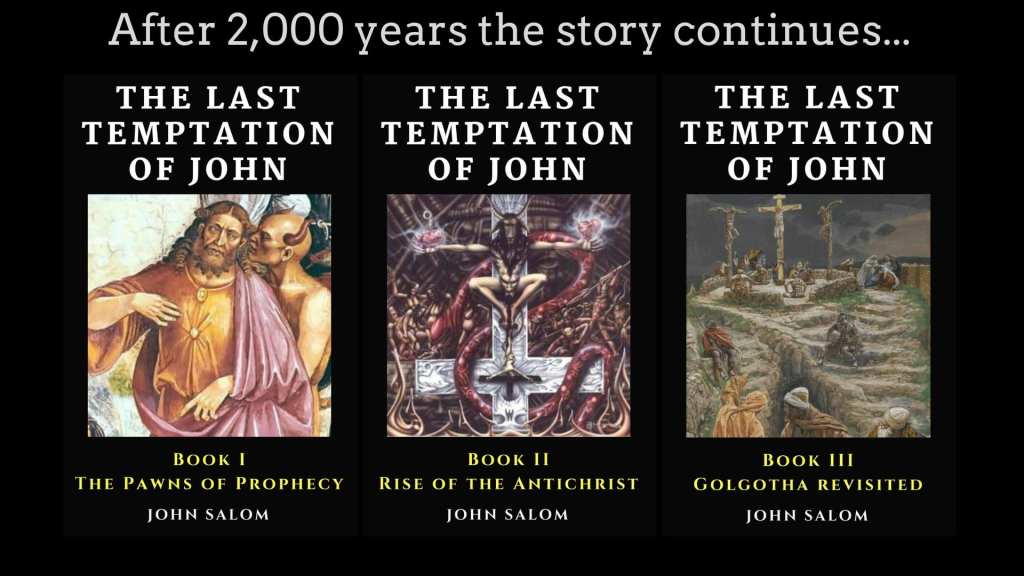
Although the trilogy known as the Last Temptation of John is not solely focused on alchemy, the craft plays an important role in the series because the main character (St John the Apostle) is an unhappy immortal whose primary goal in life is to find a way to die. Unable to discover a normal way to die, John turns to alchemy to find a solution. His curious quest takes him on a journey that involves The Philosopher’s Stone, Quintessence, Azoth, and of course The Magnus Opus. Will he successfully complete his alchemical goals? 

Read The Last Temptation of John to find out..