Tag Archives: Nigredo

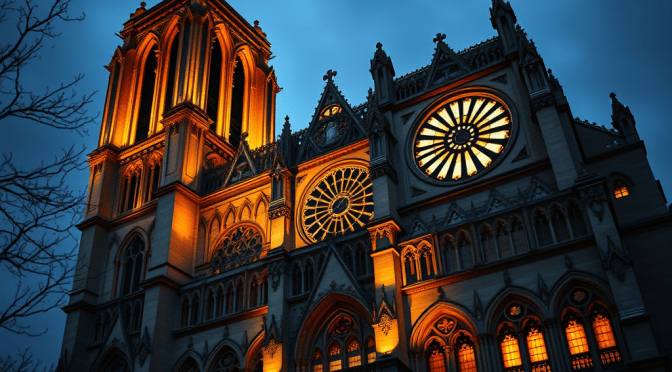
Is the Cathedral of Notre-Dame the Philospher’s Stone of Alchemy? Fulcanelli’s Stone Mysteries Unveiled

Introduction: The Cathedral as Alchemical Textbook

When Fulcanelli published Le Mystère des Cathédrales in 1926, he revealed a shocking truth: Gothic cathedrals are encrypted alchemical manuscripts in stone. Notre-Dame de Paris—the very cathedral that burned in 2019—contains the most profound of these hidden messages. This article deciphers:

  • The Alchemical Architecture of Notre-Dame
  • Secret Symbols in Stone & Glass
  • The Green Language (“Langue Verte”) of the Builders
  • Modern Confirmations of Fulcanelli’s Theories
  • Practical Guide to Seeing the Alchemy for Yourself

1. Notre-Dame’s Alchemical Blueprint

The Floor Plan as Laboratory

The cathedral’s layout mirrors an alchemist’s flask:

  • Nave = Alembic (distillation vessel)
  • Transept = Crucible
  • Rose Windows = Planetary metals (gold/sun, silver/moon)

“Every cathedral is a chemical formula written in light and stone.”
Fulcanelli, Le Mystère des Cathédrales

Interactive Map:
Explore Notre-Dame’s Alchemical Layout


2. The 7 Key Alchemical Symbols & Their Meanings

LocationSymbolAlchemical Meaning
West Façade (Left Portal)Melchizedek holding a cupThe Sacred Vessel (Grail = Philosopher’s Stone)
Central TympanumThe Last JudgmentNigredo (purification by fire)
North Rose WindowBlue & Red GlassMercury (♀) & Sulfur (♂) marriage
Chimeras/GargoylesAlchemical DragonsPrimordial Matter (Chaos before Order)
Labyrinth (Destroyed 18th c.)11-circuit path11 Steps to the Stone
St. Anne’s PortalSheela-na-gigSolve et Coagula (dissolution/rebirth)
The Lead RoofPhoenix CarvingsRubedo (final transformation)

Video Tour:
Notre-Dame’s Hidden Symbols


3. The Green Language: How Builders Encoded Secrets

What is Langue Verte?

A system of phonetic wordplay used by medieval alchemists:

  • Notre-Dame → “Notre-Dame” sounds like “Notre-Dame” (Our Lady) but also:
  • “Nostre-Dame”“Nos True Dame” (Our True Mercury/Alchemical Mother)
  • The Rose Windows → “Rose” = “Ros” (Dew, the Divine Water)

Real-World Example:

The “Portail Rouge” (Red Portal) contains:

  • Red stone = Rubedo stage
  • Hidden acrostics in Latin inscriptions

Decoding Tool:
Medieval Cipher Wheel Simulator


4. Modern Proof: Science Confirms the Alchemy

Recent Discoveries:

  1. 2019 Fire Revelation: When the roof burned, lead vaporized at 327°C—the exact temperature alchemists associated with “the flight of the dove” (spiritual ascension).
  2. Laser Scans (2022): Show deliberate asymmetries matching alchemical proportions.
  3. Stone Analysis: Limestone contains unusual quartz veins resembling alchemical “veins of the Earth.”

Scientific Paper:
X-Ray Fluorescence Study of Notre-Dame Stones


5. How to See the Alchemy Yourself

Virtual Tour Checklist:

  1. The West Façade: Count 7 alchemical steps in the left portal arches.
  2. The Cloister: Find the hidden caduceus in the column carvings.
  3. Stained Glass: Note how blue (lunar) & red (solar) panels face north/south.

Augmented Reality App:
Notre-Dame Alchemy AR


Conclusion: A Living Alchemical Crucible

Notre-Dame isn’t just a church—it’s the Philosopher’s Stone in architectural form. As restoration continues (set to reopen Dec 2024), watch for:

  • Newly exposed carvings under centuries of grime
  • The lead roof’s replacement (will it contain codes?)
  • The reliquary chamber (rumored to hold Hermetic texts)

“When you understand the cathedral, you hold the Stone in your hand.”
Attributed to Fulcanelli

Want to go deeper? Explore these 3D scans of the cathedral’s hidden geometries:
CNRS Notre-Dame Reconstruction Project

~ The Alchemy Master

Additional Resources:

The Magnum Opus: Alchemy’s Great Work of Transformation

Introduction: The Ultimate Alchemical Quest

The Magnum Opus (Latin for “Great Work”) is the pinnacle of alchemical pursuit—a sacred process of material and spiritual perfection. More than just turning lead into gold, it represents the transmutation of the self, the purification of the soul, and the attainment of divine wisdom.

For centuries, alchemists across Europe, the Islamic world, and Asia sought to complete the Great Work, believing it would grant:
The Philosopher’s Stone (transmutation & immortality).
The Elixir of Life (healing & eternal youth).
Divine Enlightenment (union with the cosmic mind).

This article explores:

  • The Stages of the Magnum Opus
  • Key Alchemists & Their Interpretations
  • Sacred Texts & Manuscripts
  • Scientific & Psychological Perspectives
  • The Burning Question: Did Anyone Ever Complete It?

1. The Four Stages of the Magnum Opus

The Great Work was traditionally divided into four color-coded stages, each representing a phase of transformation:

1. Nigredo (Blackening) – Putrefaction

  • Symbolism: Death, decay, the “dark night of the soul.”
  • Process: Breaking down impure matter (or ego) to its raw state.
  • Alchemical Act: Calcination (burning away impurities).

2. Albedo (Whitening) – Purification

  • Symbolism: Washing, lunar energy, the purified self.
  • Process: Cleansing the material (or soul) to a pristine state.
  • Alchemical Act: Sublimation (rising above base nature).

3. Citrinitas (Yellowing) – Illumination

  • Symbolism: Solar awakening, wisdom, the dawning of gold.
  • Process: Infusing the purified matter with divine light.
  • Alchemical Act: Fermentation (spiritual nourishment).

4. Rubedo (Reddening) – Perfection

  • Symbolism: The Philosopher’s Stone, resurrection, divine union.
  • Process: Final unification of opposites (soul + spirit).
  • Alchemical Act: Coagulation (solidifying perfection).

“Make the fixed volatile, and the volatile fixed, and you will have the Stone.”
Hermes Trismegistus, The Emerald Tablet

Further Reading:


2. Key Alchemists & Their Visions of the Great Work

AlchemistContribution
Hermes TrismegistusMythical founder; laid groundwork in Emerald Tablet.
Maria the Jewess (1st-3rd c.)Early alchemist; invented the bain-marie for gentle heating.
Zosimos of Panopolis (3rd-4th c.)Wrote on spiritual alchemy; linked Great Work to dreams.
Nicolas Flamel (14th c.)Claimed to complete the Work with his wife, Pernelle.
Isaac Newton (17th c.)Secretly sought the Stone through lab experiments.

Video Resource:


3. Sacred Texts of the Magnum Opus

1. The Emerald Tablet

  • Core axiom: “As above, so below.”
  • Link: Full Text

2. The Rosarium Philosophorum (1550)

  • A visual guide to the Great Work with symbolic illustrations.
  • Link: Online Manuscript

3. The Twelve Keys of Basil Valentine

  • Step-by-step instructions for creating the Stone.
  • Link: Free PDF

4. Scientific & Psychological Interpretations

Chemistry’s View

  • The Great Work mirrored early lab processes:
  • Distillation (separating essences).
  • Alloying metals (gold-like amalgams).
  • Modern parallels: Nuclear transmutation, nanotechnology.

Jung’s Perspective

Carl Jung saw the Magnum Opus as a metaphor for individuation:

  • Nigredo = Shadow work.
  • Rubedo = Wholeness of the Self.

“Alchemy is the psychology of the Middle Ages.”
Carl Jung

Further Reading:


5. Did Anyone Ever Complete the Magnum Opus?

Legendary Claims

  1. Nicolas Flamel – Allegedly succeeded with his wife, achieving immortality. His tomb was later found empty.
  2. Fulcanelli (20th c.) – Mysterious French alchemist said to have vanished after completing the Work.

The Truth?

  • No verifiable proof exists, but some alchemists may have:
  • Discovered medical tinctures (Paracelsus’ laudanum).
  • Achieved spiritual enlightenment (via inner alchemy).
  • Modern “successors”:
  • Chemists (synthesizing gold in particle accelerators).
  • Mystics (using meditation as the “inner Great Work”).

Video Resource:


Conclusion: The Eternal Work Continues

The Magnum Opus was never just about gold—it was about transforming the self and the universe. Whether through lab experiments, meditation, or art, the Great Work remains humanity’s quest for perfection.

“The Stone is within you; the Work is within you. Begin where you are.”
Anonymous Alchemist

Additional Resources:


Alchemy as Religion: The Sacred Science of Spiritual Transformation

Alchemy is often studied as a proto-science or a philosophical tradition, but at its core, it has always been a profoundly religious and mystical pursuit. Many alchemists saw their work not just as laboratory experiments but as a divine revelation, a sacred art that mirrored the soul’s journey toward perfection.

From its roots in Hermeticism and Gnosticism to its associations with esoteric Christianity, Kabbalah, and even the “black arts,” alchemy has always straddled the line between science, magic, and religion. This article explores:

  • Alchemy as a Spiritual Path: The Quest for Divine Union
  • The Religious Symbolism of the Great Work
  • Alchemy’s Ties to Esoteric Traditions (Hermeticism, Gnosticism, Kabbalah)
  • The Dark Side of Alchemy: Links to the Black Arts and Occult Magic
  • Modern Religious Alchemy: From Jungian Psychology to New Age Mysticism

1. Alchemy as a Spiritual Path: The Quest for Divine Union

Unlike modern chemistry, which focuses solely on material transformations, alchemy was a sacred science—a means of attaining gnosis (divine knowledge) and reuniting with the divine.

The Alchemist as a Priest of Nature

Alchemists saw themselves as mediators between heaven and earth, performing rituals that mirrored God’s act of creation. Their laboratories were temples, and their experiments were prayers in action.

“The alchemist is the priest of the divine art, working in the laboratory of the soul.”
Anonymous Rosicrucian Text

The Three Stages of Spiritual Alchemy

  1. Nigredo (Blackening) – Purification through suffering (the “dark night of the soul”).
  2. Albedo (Whitening) – Illumination and spiritual awakening.
  3. Rubedo (Reddening) – Divine union, the marriage of spirit and matter.

These stages parallel Christian mysticism, Buddhist enlightenment, and Hindu moksha.

Further Reading:


2. The Religious Symbolism of the Great Work

The Magnum Opus (Great Work) was not just about making gold—it was about the soul’s redemption.

Key Religious Motifs in Alchemy

  • The Philosopher’s Stone – Symbolized Christ, the perfected man, or the awakened Buddha.
  • The Rebis (Hermaphrodite) – The union of male (sulfur) and female (mercury), representing divine androgyny.
  • The Ouroboros (Serpent Eating Its Tail) – Eternal return, the cycle of death and rebirth.

Alchemy and the Bible

Many alchemists believed their art was hidden in Scripture:

  • The Book of Genesis – The separation of light from darkness as the first alchemical act.
  • The Transfiguration of Christ – Symbolized the ultimate transmutation.
  • The Apocalypse – The final purification of the world.

Video Resource:


3. Alchemy’s Ties to Esoteric Traditions

Alchemy did not exist in a vacuum—it was deeply entwined with mystical and occult traditions.

Hermeticism: The Foundation of Alchemical Religion

The Emerald Tablet of Hermes Trismegistus (“As above, so below”) became the cornerstone of alchemical thought, linking macrocosm (universe) and microcosm (man).

Gnosticism: The Divine Spark Trapped in Matter

Gnostic alchemists sought to free the spirit from the prison of the material world, much like the Gnostic demiurge myth.

Kabbalah: The Tree of Life and Alchemy

Jewish alchemists like Abraham Eleazar merged Kabbalistic teachings with alchemy, mapping the Sephiroth (divine emanations) onto chemical processes.

Further Reading:


4. The Dark Side of Alchemy: Links to the Black Arts and Occult Magic

Not all alchemy was pious—some branches delved into necromancy, demonology, and forbidden knowledge.

The Faustian Bargain: Alchemists and the Occult

Legends like Dr. Faustus and Gilles de Rais blurred the line between alchemy and diabolical pacts.

The “Forbidden” Alchemy of the Middle Ages

  • Homunculi – Artificial life created through dark rituals.
  • Necromantic Elixirs – Using human remains in potions.
  • Goetia (Demonic Magic) – Some grimoires included alchemical recipes.

Video Resource:


5. Modern Religious Alchemy: From Jung to New Age Mysticism

Alchemy never truly died—it evolved into psychology, occultism, and New Age spirituality.

Carl Jung: Alchemy as Psychology

Jung saw alchemy as a map of the unconscious, with symbols representing archetypes of the soul.

New Age Alchemy: Spiritual Transmutation Today

Modern seekers use meditation, energy work, and psychedelics as “inner alchemy.”

Alchemy in Secret Societies

Groups like the Rosicrucians, Freemasons, and Golden Dawn preserved alchemical rites.

Further Reading:


Conclusion: The Eternal Religion of Transformation

Alchemy was—and still is—a living religion of the soul, a path of divine fire and sacred metals. Whether through prayer, meditation, or the crucible, its message remains:

“Transform yourself, and you transform the world.”

Additional Resources:


2.15 Lazarus Rises…Again

Book II: Chapter 15
July 7

“I am the Mercury of the Wise.” I intoned.

“The Water that does not wet the hands.” Miriam chanted back again, continuing to do what I instructed her as part of our rite to save Alan.

The Nigredo had been going for nearly eighteen hours….

Yet still an unmasked Alan lolled helplessly in his chair, with his eyes glazed over and his body dead to the world.

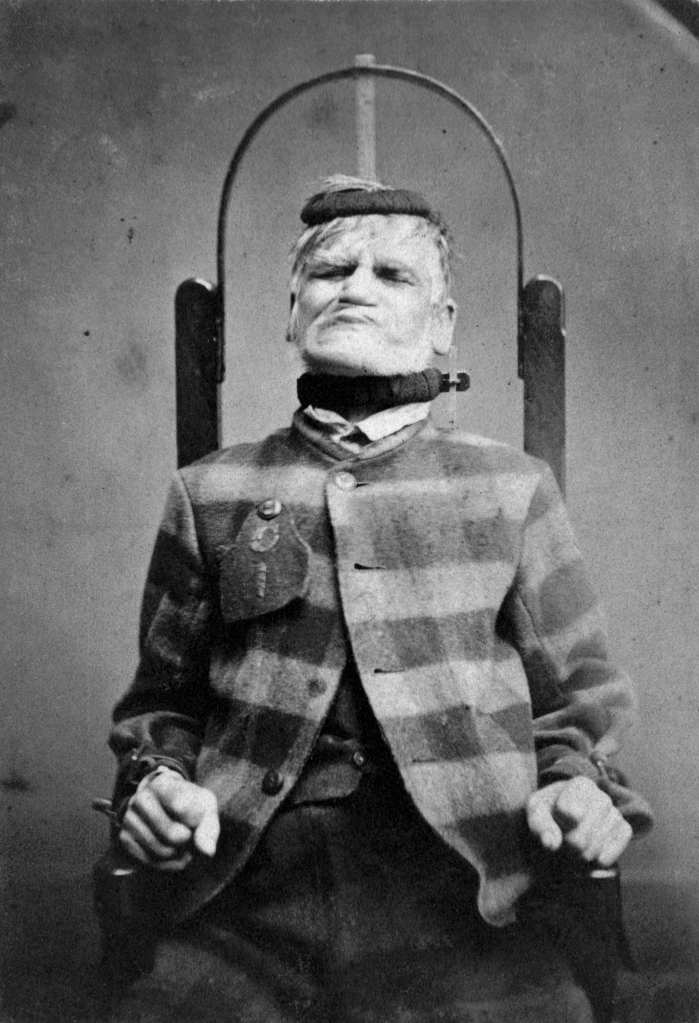
When I told Miriam that things would get ugly, I wasn’t lying – for Alan went through hell during our ritual.

First there were the convulsions – wrenching physical spasms that forced his body into inhuman contortions – they were almost as bad as the spasms people experience after taking their Covid vaccines (key word: almost as bad)

Then there were the Voices – terrible ravings about unspeakable atrocities – all spilling out of Alan’s mouth, even as his face took on horrible visages to match his words.

(Miriam had to cover her eyes more than once during this stage of the putrefaction and as I stole a glance at her during one of Alan’s more gruesome Voices, I wondered – was she recalling <whispers> of her own demonic possession from a time long past?)

I had no time to ponder further about her, because suddenly Alan tried to break loose from his ties! Were it not for the heavy straps that I’d used to bind him to his chair, he might well have succeeded in harming himself or one of us. As it was, I had just enough time to douse him with a foaming liquid from one of the flagons I had on hand – and although the container was marked with a skull and crossbones, by the time Miriam saw that infamous warning mark, it was too late – for I had already used the potion.

The result: Alan was immediately immobilized.

Although I had saved us from his ravings, as the hours passed, Miriam and I realized that there was something worse than the voices or the physical abuse — The Silence.

For nearly twelve hours, Alan did nothing.

He said nothing.

His once beautiful face now the unrecognizable mask of a man tortured from the inside out.

If I had not constantly been checking his breathing, I would have been certain he was dead.

But such was not the case.

And then, suddenly there was an instant in which Alan’s eyes were not glazed — as if his soul had reached to us across the depths.

But the moment quickly passed and once more Alan was gone.

Confused, Miriam broke the silence, “Did he…? Was that…?”

“You saw correctly.” I advised calmly. “Lazarus is coming back from the dead… again.” I chuckled, enjoying both my pun as well as the scientific curiosity of this whole experience.

I then forced an effervescent liquid down Alan’s throat and followed this up by dousing him with a special powder.

And finally it happened…

Wonder overtook Miriam as we watched Alan transform.

First the bruises and awful marks disappeared from his body.

Then Alan’s frame cast off its slouch, even as his face released the bonds of their internal struggle.

And finally, Alan’s eyes cleared of their haze once and for all.

Tears welled up in Miriam’s eyes, “Oh, John… I mean, Azoth… you did it!” But under her breath, I heard her say, “For the Lord is good and His love endures forever.” Finally she reached down to Alan, “I knew you wo—“

<GAAAASSSSP!> Alan convulsed again and began gulping for air.

Miriam shrank back. “What’s happening?”

“Stand back, you fool. The rite was not over yet!” And ripping Alan from his bonds, I heaved him upon my back and raced towards the door. “Come on, we have to submerge him in the tub, otherwise, he’ll suffocate!”


Continue Reading

16 – Rock of Peter
Book II Table of Contents