Tag Archives: Gnosticism

Alchemy as Religion: The Sacred Science of Spiritual Transformation

Alchemy is often studied as a proto-science or a philosophical tradition, but at its core, it has always been a profoundly religious and mystical pursuit. Many alchemists saw their work not just as laboratory experiments but as a divine revelation, a sacred art that mirrored the soul’s journey toward perfection.

From its roots in Hermeticism and Gnosticism to its associations with esoteric Christianity, Kabbalah, and even the “black arts,” alchemy has always straddled the line between science, magic, and religion. This article explores:

  • Alchemy as a Spiritual Path: The Quest for Divine Union
  • The Religious Symbolism of the Great Work
  • Alchemy’s Ties to Esoteric Traditions (Hermeticism, Gnosticism, Kabbalah)
  • The Dark Side of Alchemy: Links to the Black Arts and Occult Magic
  • Modern Religious Alchemy: From Jungian Psychology to New Age Mysticism

1. Alchemy as a Spiritual Path: The Quest for Divine Union

Unlike modern chemistry, which focuses solely on material transformations, alchemy was a sacred science—a means of attaining gnosis (divine knowledge) and reuniting with the divine.

The Alchemist as a Priest of Nature

Alchemists saw themselves as mediators between heaven and earth, performing rituals that mirrored God’s act of creation. Their laboratories were temples, and their experiments were prayers in action.

“The alchemist is the priest of the divine art, working in the laboratory of the soul.”
Anonymous Rosicrucian Text

The Three Stages of Spiritual Alchemy

  1. Nigredo (Blackening) – Purification through suffering (the “dark night of the soul”).
  2. Albedo (Whitening) – Illumination and spiritual awakening.
  3. Rubedo (Reddening) – Divine union, the marriage of spirit and matter.

These stages parallel Christian mysticism, Buddhist enlightenment, and Hindu moksha.

Further Reading:


2. The Religious Symbolism of the Great Work

The Magnum Opus (Great Work) was not just about making gold—it was about the soul’s redemption.

Key Religious Motifs in Alchemy

  • The Philosopher’s Stone – Symbolized Christ, the perfected man, or the awakened Buddha.
  • The Rebis (Hermaphrodite) – The union of male (sulfur) and female (mercury), representing divine androgyny.
  • The Ouroboros (Serpent Eating Its Tail) – Eternal return, the cycle of death and rebirth.

Alchemy and the Bible

Many alchemists believed their art was hidden in Scripture:

  • The Book of Genesis – The separation of light from darkness as the first alchemical act.
  • The Transfiguration of Christ – Symbolized the ultimate transmutation.
  • The Apocalypse – The final purification of the world.

Video Resource:


3. Alchemy’s Ties to Esoteric Traditions

Alchemy did not exist in a vacuum—it was deeply entwined with mystical and occult traditions.

Hermeticism: The Foundation of Alchemical Religion

The Emerald Tablet of Hermes Trismegistus (“As above, so below”) became the cornerstone of alchemical thought, linking macrocosm (universe) and microcosm (man).

Gnosticism: The Divine Spark Trapped in Matter

Gnostic alchemists sought to free the spirit from the prison of the material world, much like the Gnostic demiurge myth.

Kabbalah: The Tree of Life and Alchemy

Jewish alchemists like Abraham Eleazar merged Kabbalistic teachings with alchemy, mapping the Sephiroth (divine emanations) onto chemical processes.

Further Reading:


4. The Dark Side of Alchemy: Links to the Black Arts and Occult Magic

Not all alchemy was pious—some branches delved into necromancy, demonology, and forbidden knowledge.

The Faustian Bargain: Alchemists and the Occult

Legends like Dr. Faustus and Gilles de Rais blurred the line between alchemy and diabolical pacts.

The “Forbidden” Alchemy of the Middle Ages

  • Homunculi – Artificial life created through dark rituals.
  • Necromantic Elixirs – Using human remains in potions.
  • Goetia (Demonic Magic) – Some grimoires included alchemical recipes.

Video Resource:


5. Modern Religious Alchemy: From Jung to New Age Mysticism

Alchemy never truly died—it evolved into psychology, occultism, and New Age spirituality.

Carl Jung: Alchemy as Psychology

Jung saw alchemy as a map of the unconscious, with symbols representing archetypes of the soul.

New Age Alchemy: Spiritual Transmutation Today

Modern seekers use meditation, energy work, and psychedelics as “inner alchemy.”

Alchemy in Secret Societies

Groups like the Rosicrucians, Freemasons, and Golden Dawn preserved alchemical rites.

Further Reading:


Conclusion: The Eternal Religion of Transformation

Alchemy was—and still is—a living religion of the soul, a path of divine fire and sacred metals. Whether through prayer, meditation, or the crucible, its message remains:

“Transform yourself, and you transform the world.”

Additional Resources:


Alchemy as a Philosophy: The Quest for Divine Knowledge and Transformation

Alchemy is often misunderstood as a primitive form of chemistry, a misguided pursuit of turning lead into gold. Yet, at its core, alchemy is far more profound—it is a philosophical and spiritual tradition that seeks the purification of the soul, the understanding of cosmic unity, and the transformation of base existence into divine perfection. Many of the ancient and medieval world’s greatest philosophical minds were deeply immersed in alchemical thought, seeing it not merely as a laboratory practice but as a metaphysical journey.

The Philosophical Foundations of Alchemy

Hellenistic Alchemy and Greek Philosophy

The origins of Western alchemy can be traced to Hellenistic Egypt, particularly Alexandria, where Greek philosophy merged with Egyptian metallurgical knowledge and mystical traditions. Several key philosophical schools influenced alchemical thought:

  1. Pythagoreanism – The Pythagoreans believed in the mathematical harmony of the cosmos, where numbers held divine significance. This idea resonated with alchemists, who saw numerical symbolism in their work, such as the sacred Tetractys (1 + 2 + 3 + 4 = 10) representing the four classical elements.
  2. Platonism – Plato’s theory of Forms suggested that the material world is a shadow of a higher, perfect reality. Alchemists sought to uncover these hidden truths, believing that metals and matter could be refined to their purest, most divine state.
  3. Stoicism – The Stoics emphasized the Logos, the rational principle governing the universe. Alchemists adopted this idea, viewing their work as aligning with nature’s hidden laws.
  4. Gnosticism – Gnostic dualism (the struggle between spirit and matter) deeply influenced alchemy, framing the Great Work as a liberation of the divine spark trapped in material existence.

Aristotle’s Four Elements and Alchemical Thought

Aristotle’s theory of the four elements—earth, air, water, and fire—was foundational to alchemical philosophy. He posited that each element had its natural place in the cosmos and would return there if undisturbed. However, alchemists interpreted these elements not just as physical substances but as principles of existence:

  • Earth represented solidity and stability.
  • Water symbolized fluidity and dissolution.
  • Air stood for volatility and expansion.
  • Fire embodied transformation and purification.

As the Swiss psychologist Carl Jung later observed, these elements were archetypal symbols representing psychological and spiritual states rather than mere chemical properties. The alchemist’s goal was to transmute these elements within the self, achieving inner harmony and enlightenment.

Alchemy as Spiritual Transformation

The Union of Opposites: Solve et Coagula

One of the central tenets of alchemical philosophy is the conjunction of opposites (conjunctio oppositorum). The process of Solve et Coagula (dissolve and coagulate) represents the breaking down of impure matter and its reassembly into a perfected form. This mirrors the spiritual journey:

  • Solve – The dissolution of ego, ignorance, and material attachments.
  • Coagula – The reintegration of the self into a higher, enlightened state.

This concept appears in many esoteric traditions, including Taoism’s Yin and Yang and Hermeticism’s “As above, so below.”

The Philosopher’s Stone: Symbol of Perfection

The Philosopher’s Stone was not merely a substance to transmute metals but a metaphor for ultimate wisdom and immortality. It represented:

  • Physical perfection – The ability to purify base metals into gold.
  • Spiritual enlightenment – The attainment of divine knowledge.
  • Immortality – The transcendence of death, either literally (as in elixirs of life) or symbolically (as in spiritual rebirth).

Famous alchemists like Hermes Trismegistus (mythical founder of Hermeticism) and Paracelsus (Renaissance physician-alchemist) wrote extensively on the Stone’s symbolic meaning.

Alchemy’s Legacy in Modern Thought

Though modern science dismissed alchemy’s material claims, its philosophical and psychological insights endure:

  • Jungian Psychology – Carl Jung saw alchemy as a projection of the unconscious mind, where the alchemical process mirrored individuation (the integration of the self).
  • Esoteric Traditions – Rosicrucianism, Freemasonry, and Theosophy preserved alchemical symbolism.
  • Popular Culture – From Harry Potter’s Sorcerer’s Stone to Fullmetal Alchemist, alchemy remains a powerful metaphor for transformation.

Further Reading & Resources

For those seeking deeper knowledge, explore:

Conclusion: The Eternal Quest

Alchemy, at its heart, is not about gold but about gnosis—divine knowledge. It teaches that transformation is possible, whether in matter, mind, or spirit. As the Emerald Tablet proclaims:

“That which is below is like that which is above, and that which is above is like that which is below.”

The true alchemist seeks not just to change lead into gold but to transmute the self into something greater—a being in harmony with the cosmos.


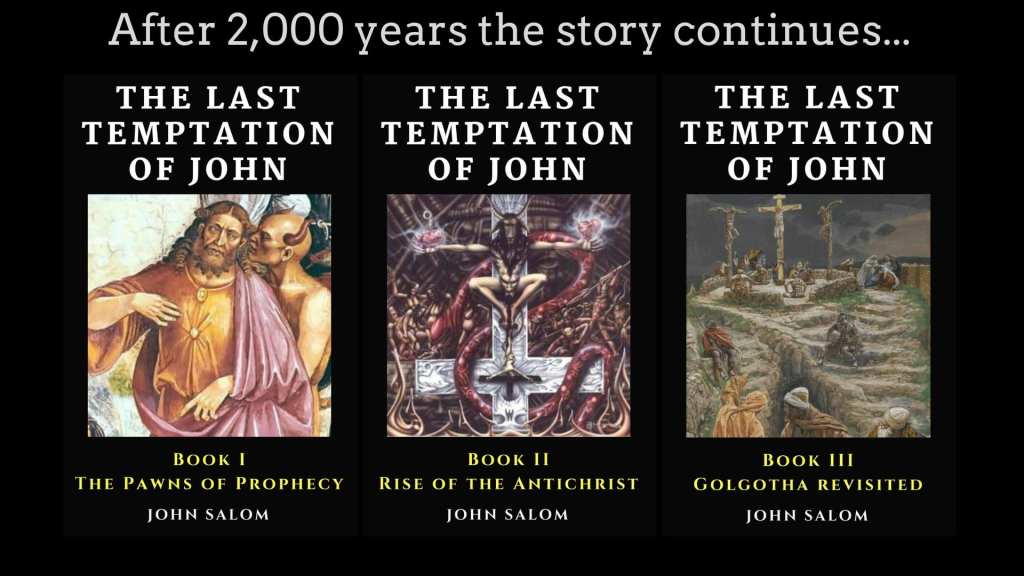
Alchemy & The Last Temptation of John Books

Although the trilogy known as the Last Temptation of John is not solely focused on alchemy, the craft plays an important role in the series because the main character (St John the Apostle) is an unhappy immortal whose primary goal in life is to find a way to die. Unable to discover a normal way to die, John turns to alchemy to find a solution. His curious quest takes him on a journey that involves The Philosopher’s Stone, Quintessence, Azoth, and of course The Magnus Opus. Will he successfully complete his alchemical goals? 

Read The Last Temptation of John to find out..