The Philosopher’s Stone (Latin: Lapis Philosophorum) is the most legendary and enigmatic concept in alchemy. More than just a mythical substance that turns lead into gold, it represents perfection, immortality, and divine wisdom.
For centuries, alchemists across Europe, the Islamic world, and Asia pursued this elusive treasure, believing it could: ✔ Transmute base metals into gold (physical perfection). ✔ Grant eternal youth and immortality (the Elixir of Life). ✔ Awaken spiritual enlightenment (union with the divine).
This article explores:
Origins & Symbolism of the Philosopher’s Stone
Key Alchemists Who Sought the Stone
Famous Texts & Manuscripts on the Stone
Scientific & Spiritual Interpretations
Modern Legacy (Science, Pop Culture, and Esotericism)
The Philosopher’s Stone remains the ultimate symbol of human aspiration—whether for wealth, immortality, or wisdom. Though no one has ever confirmed its physical existence, its spiritual and philosophical lessons endure.
“The Stone is within you; the work is within you. Seek it there.” — Anonymous Alchemist
Introduction: The Secret Thread of Hermetic Wisdom
Hermeticism (or Hermetism) is one of the most influential philosophical and spiritual traditions in Western esotericism, deeply intertwined with alchemy. Named after the mythical sage Hermes Trismegistus (“Thrice-Greatest Hermes”), this tradition teaches that the universe is a living, interconnected whole, and that humanity can attain divine knowledge through spiritual and alchemical practices.
At the heart of Hermeticism lies the belief that “As above, so below”—the microcosm (man) reflects the macrocosm (universe), and by mastering the secrets of nature, one can achieve gnosis (illumination) and immortality.
This article explores:
Who Was Hermes Trismegistus?
The Core Teachings of Hermeticism
Key Hermetic Texts (The Emerald Tablet, Corpus Hermeticum, etc.)
Hermeticism’s Influence on Alchemy
The Evolution of Hermetic Thought (From Antiquity to the New Age)
1. Who Was Hermes Trismegistus?
Hermes Trismegistus is a syncretic figure, blending the Greek god Hermes (messenger of the gods) with the Egyptian Thoth (god of wisdom, magic, and writing). He was said to have lived in ancient Egypt and authored sacred texts on alchemy, astrology, and theology.
The Legend of Hermes
Revealed divine secrets to humanity in cryptic writings.
Possessed the Emerald Tablet, the foundational text of alchemy.
Considered the father of Hermeticism, a tradition that shaped Western occultism.
“What is below is like what is above, and what is above is like what is below.” — The Emerald Tablet
Conclusion: The Living Tradition of Hermetic Alchemy
Hermeticism remains a powerful undercurrent in Western esotericism, alchemy, and occultism. Its teachings—hidden in symbols, encrypted in texts, and practiced in secret—continue to inspire seekers of divine knowledge.
“The lips of wisdom are closed, except to the ears of understanding.” — The Kybalion
The Magnum Opus (Latin for “Great Work”) is the pinnacle of alchemical pursuit—a sacred process of material and spiritual perfection. More than just turning lead into gold, it represents the transmutation of the self, the purification of the soul, and the attainment of divine wisdom.
For centuries, alchemists across Europe, the Islamic world, and Asia sought to complete the Great Work, believing it would grant: ✔ The Philosopher’s Stone (transmutation & immortality). ✔ The Elixir of Life (healing & eternal youth). ✔ Divine Enlightenment (union with the cosmic mind).
This article explores:
The Stages of the Magnum Opus
Key Alchemists & Their Interpretations
Sacred Texts & Manuscripts
Scientific & Psychological Perspectives
The Burning Question: Did Anyone Ever Complete It?
1. The Four Stages of the Magnum Opus
The Great Work was traditionally divided into four color-coded stages, each representing a phase of transformation:
1. Nigredo (Blackening) – Putrefaction
Symbolism: Death, decay, the “dark night of the soul.”
Process: Breaking down impure matter (or ego) to its raw state.
The Magnum Opus was never just about gold—it was about transforming the self and the universe. Whether through lab experiments, meditation, or art, the Great Work remains humanity’s quest for perfection.
“The Stone is within you; the Work is within you. Begin where you are.” — Anonymous Alchemist
Alchemy is often studied as a proto-science or a philosophical tradition, but at its core, it has always been a profoundly religious and mystical pursuit. Many alchemists saw their work not just as laboratory experiments but as a divine revelation, a sacred art that mirrored the soul’s journey toward perfection.
From its roots in Hermeticism and Gnosticism to its associations with esoteric Christianity, Kabbalah, and even the “black arts,” alchemy has always straddled the line between science, magic, and religion. This article explores:
Alchemy as a Spiritual Path: The Quest for Divine Union
The Religious Symbolism of the Great Work
Alchemy’s Ties to Esoteric Traditions (Hermeticism, Gnosticism, Kabbalah)
The Dark Side of Alchemy: Links to the Black Arts and Occult Magic
Modern Religious Alchemy: From Jungian Psychology to New Age Mysticism
1. Alchemy as a Spiritual Path: The Quest for Divine Union
Unlike modern chemistry, which focuses solely on material transformations, alchemy was a sacred science—a means of attaining gnosis (divine knowledge) and reuniting with the divine.
The Alchemist as a Priest of Nature
Alchemists saw themselves as mediators between heaven and earth, performing rituals that mirrored God’s act of creation. Their laboratories were temples, and their experiments were prayers in action.
“The alchemist is the priest of the divine art, working in the laboratory of the soul.” — Anonymous Rosicrucian Text
The Three Stages of Spiritual Alchemy
Nigredo (Blackening) – Purification through suffering (the “dark night of the soul”).
Albedo (Whitening) – Illumination and spiritual awakening.
Rubedo (Reddening) – Divine union, the marriage of spirit and matter.
These stages parallel Christian mysticism, Buddhist enlightenment, and Hindu moksha.
Alchemy did not exist in a vacuum—it was deeply entwined with mystical and occult traditions.
Hermeticism: The Foundation of Alchemical Religion
The Emerald Tablet of Hermes Trismegistus (“As above, so below”) became the cornerstone of alchemical thought, linking macrocosm (universe) and microcosm (man).
Gnosticism: The Divine Spark Trapped in Matter
Gnostic alchemists sought to free the spirit from the prison of the material world, much like the Gnostic demiurge myth.
Kabbalah: The Tree of Life and Alchemy
Jewish alchemists like Abraham Eleazar merged Kabbalistic teachings with alchemy, mapping the Sephiroth (divine emanations) onto chemical processes.
Conclusion: The Eternal Religion of Transformation
Alchemy was—and still is—a living religion of the soul, a path of divine fire and sacred metals. Whether through prayer, meditation, or the crucible, its message remains:
“Transform yourself, and you transform the world.”
In an effort to stop Miriam’s complaints, I finally agreed to help our friend Alan.
In order to do that I had to bring him to my private workshop — which was actually a just detached garage, a short walk away from the house.
From the outside it probably looked like any other barn one might find in upstate Pennsylvania.
Yet the inside was quite unlike anything you’ve seen – for I am an Alchemist — not just any amateur experimenter trying to turn metal into gold, mind you, but a full-fledged Alchemy Maestro, perhaps the greatest of them all!
(I know, I know, I probably should have told you this sooner, but remember, I tend to forget quite a bit in my old age. What’s that — what else have I forgotten to tell you about? Ha, now that’s a good question!)
“Once inside these walls you shall call me Azoth.” I instructed Miriam, as I fiddled with the multitude of locks that barred the door. “Additionally we’re going to take that stupid mask off Alan and you’re going to remove that silly outfit your wearing.”
“Wha-?” Miriam stammered, backing away. “I…I can’t…er…what about the vi-vi-virus?”
“Miriam, you fool, you’re immortal!” I raged at her. “You can’t die from any virus – much less a made-up one that’s never even existed! How stupid are you, girl? You know as well as I that Covid was just a PLANdemic carried about by globalists to get everybody vaxxed, chipped, and monitored as part of the United Nations Agenda 2030 creation of a world-wide police state. Do I really need to explain all this to you?”
Miriam began to bawl, physically shaking as her mind was clearly resisting what she knew to be true even as the #FakeNews propaganda she’d allowed herself to be force-fed these past few years surely told her I was lying.
I merely waited for events to play out.
In the end, Miriam caved. Yet even as she removed her pandemic garb she gave in to a new fear. “Ah, John, er, excuse me, Azoth… we’ll not be doing anything sacrilegious in there, right?”
“Do you want my help or not?” I screamed at her, doing nothing to hide my disgust.
Miriam cried again, but looking down at Alan, she struggled to regain control as she said, “I’m sorry, Azoth. Please, let’s hurry inside.”
“How does it feel to be the one who is manipulated, eh, Mary?” I chuckled.
I smiled to myself as I opened the final lock, before pulling the door ajar the door to let Miriam pass inside first – even though she was woman of the world who had seen quite a bit during her long life, as she entered my workshop I could sense her surprise at the sights before her.
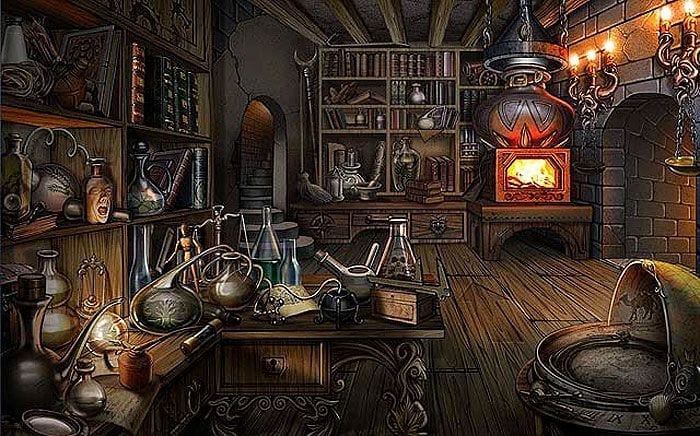
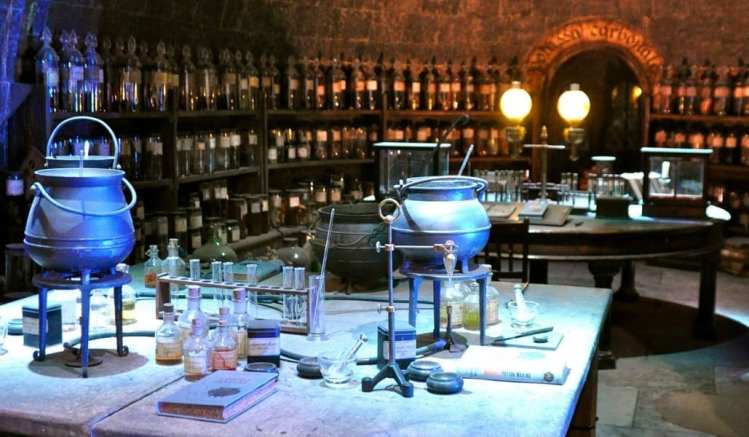
To say the oversized garage was over-stuffed was an understatement – for although the 30 x 20 foot interior was a healthy area, I had nearly every available spot crammed with something. A giant furnace dominated the far wall – pipes leading out from it in all directions – some carrying exhaust to the outside, others hooked up to trailing pipes that led off to smaller furnaces or connecting to heating beakers both large and small, and still others going down into the floor. (What’s their purpose? Sorry, that would take too long to explain. Just sit back and listen please).
I watched as Miriam noticed the multitude of glass bottles – how could she miss them? – for more than anything else, jars of all shapes and sizes filled my laboratory. In fact, one of the 30-foot walls was lined completely with a massive, custom-made shelving unit and every space was filled — giant bottles containing preserved animal parts, smaller decanters bubbling with strange liquids, and tiny phials glowing with mysterious crystals. These and more were stored on the shelves – and everywhere else about the room too.
Various tables piled up with unusual tools, hulking chests locked tight, and storage containers overflowing with materials took up much of the rest of the space.
Each with a purpose only I knew.
A bit further inside, I saw that Miriam noticed The Three Pillars. An important alchemy construct, the two outermost posts had a shelf jutting out towards the inside pillar — upon the shelves, each of the pillars held a bulbous carafe which in turn had a long nodule connected to a tube. The tubes of the carafes connected to pipes that were attached to additional tubes that intersected the middle pillar, and then eventually emerged to connect to a similar pair of carafes at the base – yet rather than being supported on shelves attached to the outside posts, these glass jars were situated upon smaller furnaces that were continuously heating the liquids inside the flagons. I knew that Miriam had no idea as to the purpose of this apparatus, and I wasn’t about to tell her (or you!)
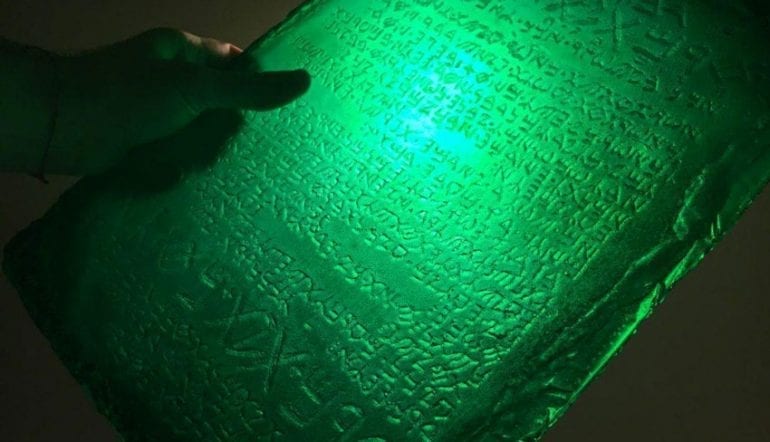
As you might expect, my workshop was not without its share of books too. From heavy tomes to delicate scrolls, my fetish with books played out here even more than it did in the living room of my house. I followed Miriam’s eyes with pride as I saw her espy the volume that was my most prized possession – a large stone tablet, shaded emerald green, sat reverently upon a podium in the very center of the room.
Although the engraved text was large enough read even from afar, it was written in a language that I knew that even Miriam did not understand. (If YOU want to know more, do some research — look for references on any of the following: The Emerald Tablet, or The Tabula Smaragdina, or The Secret of Hermes. See, I do give up some secrets).
Next, I could see Miriam captivated by the fact that nearly every wall surface was covered with Symbols; even the floor was covered in a giant glyph – a circle inside a square, inside a triangle, inside a humongous circle, the outer edges of each shape touching the inner edges of the ones they were housed within. As for the symbols on the walls, in one area, I saw Miriam note a collection of four triangles, representing the four basic elements: upright triangle for “fire,” pointing down for “water,” pointing down with horizontal line dissecting for “earth,” and pointing up with horizontal line dissecting for “air.”
“Ah… Azoth,” Miriam found her voice again, “what does the circle with the dissecting lines represent?”
“Hardly!” I snorted. “Quintessence is much more than a folk tale. Unlike the other elements, it has no physical qualities – it’s neither hot nor cold, wet or dry. It is incapable of change and yet always changing. It controls light and matter. It is the space between – but in a LIVING way.”
“Interesting.” Miriam was clearly impressed by my knowledge (and rightly so). Yet I noticed that she changed her tune a bit, when she asked meekly, “But, Azoth, I thought that Einstein’s Relativity dismissed aethyr?”
Aethyr – The Space Between?
“Wrong! Einstein attempted to dispute the existence of aethyr in his Special Theory of Relativity, yet even then his negative proof relied mainly upon an Occam’s razor – postulating that the existence of aethyr was not necessary to explain the gaps in the universe. However, later in life he corrected himself in the commentary to his General Theory of Relativity– wherein he admitted the logical need for aethyr.”
“Ah, John, did YOU have anything to do with his changing viewpoint?”
“No comment.” I smiled. (What, you think Einstein got all his grand ideas on his own?)
“What about all the other symbols you have painted here?”
“And those different colored roses? Is this place also a greenhouse?”
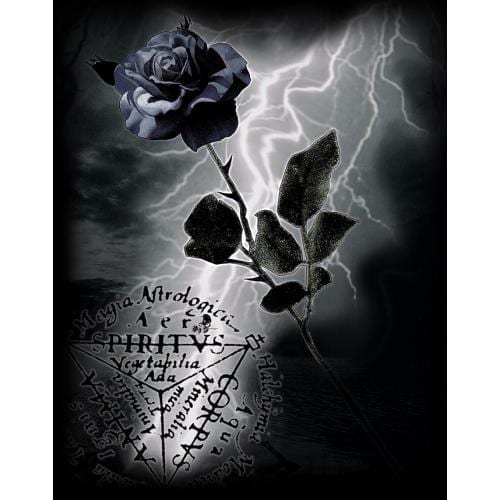
“Don’t be a fool – my lab is hardly a garden! The roses have their place in my work and the colors have meaning. Red means ‘passion.’ White – ‘purity.’ Yellow – ‘compassion.’ Orange – ‘optimism’ (and before YOU comment, it’s true, I don’t have many orange roses on purpose!). Blue – ‘promise.’ And the ones gilded with Gold mean ‘Perfection.’”
“And…” Miriam hesitated, “The Black ones?”
I paused a moment, wondering if I should speak the truth. In the end, I didn’t care enough to fight…
“The Withered Roses offer Death.”
“And you said you use these roses in your work?”
“I extract their essence as the backbone of certain experiments.”
“But why would you ever need the Black ones? Unless…”
And Miriam looked at me in horror, suddenly realizing that my most important secret of all…




 The Last Temptation of John