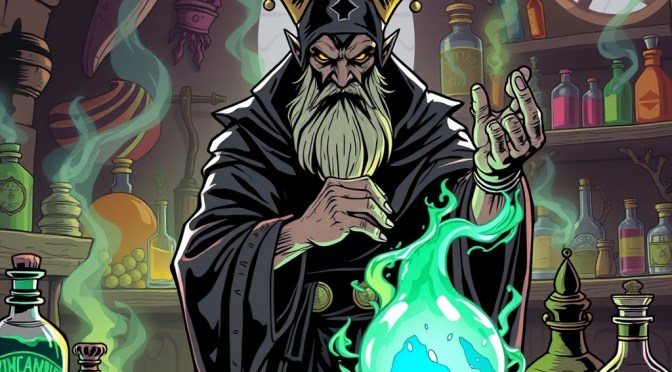
Alchemy is often studied as a proto-science or a philosophical tradition, but at its core, it has always been a profoundly religious and mystical pursuit. Many alchemists saw their work not just as laboratory experiments but as a divine revelation, a sacred art that mirrored the soul’s journey toward perfection.
From its roots in Hermeticism and Gnosticism to its associations with esoteric Christianity, Kabbalah, and even the “black arts,” alchemy has always straddled the line between science, magic, and religion. This article explores:
- Alchemy as a Spiritual Path: The Quest for Divine Union
- The Religious Symbolism of the Great Work
- Alchemy’s Ties to Esoteric Traditions (Hermeticism, Gnosticism, Kabbalah)
- The Dark Side of Alchemy: Links to the Black Arts and Occult Magic
- Modern Religious Alchemy: From Jungian Psychology to New Age Mysticism
1. Alchemy as a Spiritual Path: The Quest for Divine Union
Unlike modern chemistry, which focuses solely on material transformations, alchemy was a sacred science—a means of attaining gnosis (divine knowledge) and reuniting with the divine.
The Alchemist as a Priest of Nature
Alchemists saw themselves as mediators between heaven and earth, performing rituals that mirrored God’s act of creation. Their laboratories were temples, and their experiments were prayers in action.
“The alchemist is the priest of the divine art, working in the laboratory of the soul.”
— Anonymous Rosicrucian Text
The Three Stages of Spiritual Alchemy
- Nigredo (Blackening) – Purification through suffering (the “dark night of the soul”).
- Albedo (Whitening) – Illumination and spiritual awakening.
- Rubedo (Reddening) – Divine union, the marriage of spirit and matter.
These stages parallel Christian mysticism, Buddhist enlightenment, and Hindu moksha.
Further Reading:
2. The Religious Symbolism of the Great Work
The Magnum Opus (Great Work) was not just about making gold—it was about the soul’s redemption.
Key Religious Motifs in Alchemy
- The Philosopher’s Stone – Symbolized Christ, the perfected man, or the awakened Buddha.
- The Rebis (Hermaphrodite) – The union of male (sulfur) and female (mercury), representing divine androgyny.
- The Ouroboros (Serpent Eating Its Tail) – Eternal return, the cycle of death and rebirth.
Alchemy and the Bible
Many alchemists believed their art was hidden in Scripture:
- The Book of Genesis – The separation of light from darkness as the first alchemical act.
- The Transfiguration of Christ – Symbolized the ultimate transmutation.
- The Apocalypse – The final purification of the world.
Video Resource:
3. Alchemy’s Ties to Esoteric Traditions
Alchemy did not exist in a vacuum—it was deeply entwined with mystical and occult traditions.
Hermeticism: The Foundation of Alchemical Religion
The Emerald Tablet of Hermes Trismegistus (“As above, so below”) became the cornerstone of alchemical thought, linking macrocosm (universe) and microcosm (man).
Gnosticism: The Divine Spark Trapped in Matter
Gnostic alchemists sought to free the spirit from the prison of the material world, much like the Gnostic demiurge myth.
Kabbalah: The Tree of Life and Alchemy
Jewish alchemists like Abraham Eleazar merged Kabbalistic teachings with alchemy, mapping the Sephiroth (divine emanations) onto chemical processes.
Further Reading:
4. The Dark Side of Alchemy: Links to the Black Arts and Occult Magic
Not all alchemy was pious—some branches delved into necromancy, demonology, and forbidden knowledge.
The Faustian Bargain: Alchemists and the Occult
Legends like Dr. Faustus and Gilles de Rais blurred the line between alchemy and diabolical pacts.
The “Forbidden” Alchemy of the Middle Ages
- Homunculi – Artificial life created through dark rituals.
- Necromantic Elixirs – Using human remains in potions.
- Goetia (Demonic Magic) – Some grimoires included alchemical recipes.
Video Resource:
5. Modern Religious Alchemy: From Jung to New Age Mysticism
Alchemy never truly died—it evolved into psychology, occultism, and New Age spirituality.
Carl Jung: Alchemy as Psychology
Jung saw alchemy as a map of the unconscious, with symbols representing archetypes of the soul.
New Age Alchemy: Spiritual Transmutation Today
Modern seekers use meditation, energy work, and psychedelics as “inner alchemy.”
Alchemy in Secret Societies
Groups like the Rosicrucians, Freemasons, and Golden Dawn preserved alchemical rites.
Further Reading:
Conclusion: The Eternal Religion of Transformation
Alchemy was—and still is—a living religion of the soul, a path of divine fire and sacred metals. Whether through prayer, meditation, or the crucible, its message remains:
“Transform yourself, and you transform the world.”
Additional Resources:
- The Alchemy of Prayer (Esoteric Christianity)
- Practical Kabbalistic Alchemy
- The Occult History of Alchemy (Documentary)
 The Last Temptation of John