Introduction: The Cathedral as Alchemical Textbook
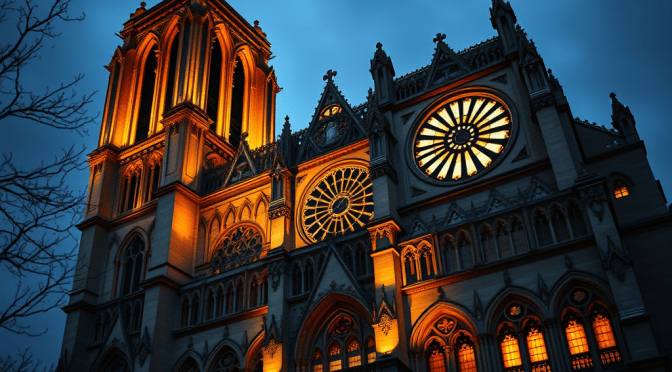
When Fulcanelli published Le Mystère des Cathédrales in 1926, he revealed a shocking truth: Gothic cathedrals are encrypted alchemical manuscripts in stone. Notre-Dame de Paris—the very cathedral that burned in 2019—contains the most profound of these hidden messages. This article deciphers:
The Alchemical Architecture of Notre-Dame
Secret Symbols in Stone & Glass
The Green Language (“Langue Verte”) of the Builders
Modern Confirmations of Fulcanelli’s Theories
Practical Guide to Seeing the Alchemy for Yourself
1. Notre-Dame’s Alchemical Blueprint
The Floor Plan as Laboratory
The cathedral’s layout mirrors an alchemist’s flask:
Nave = Alembic (distillation vessel)
Transept = Crucible
Rose Windows = Planetary metals (gold/sun, silver/moon)
“Every cathedral is a chemical formula written in light and stone.” — Fulcanelli, Le Mystère des Cathédrales
2019 Fire Revelation: When the roof burned, lead vaporized at 327°C—the exact temperature alchemists associated with “the flight of the dove” (spiritual ascension).
Laser Scans (2022): Show deliberate asymmetries matching alchemical proportions.
Stone Analysis: Limestone contains unusual quartz veins resembling alchemical “veins of the Earth.”
Introduction: The Greatest Mystery of 20th-Century Alchemy
Fulcanelli is the most enigmatic alchemist of the modern era—a man who allegedly completed the Magnum Opus, discovered the Philosopher’s Stone, and then vanished without a trace. His true identity remains unknown, his life shrouded in myth, and his disappearance fuels speculation that he achieved literal or spiritual immortality.
This article explores:
Who Was Fulcanelli? (Theories on His Identity)
His Alchemical Works & Hidden Knowledge
The Mystery of His Disappearance
Did He Achieve Immortality? (And Where Is He Now?)
His Legacy in Modern Esotericism
1. Who Was Fulcanelli? The Theories
Fulcanelli was the pseudonym of a French alchemist who appeared in the early 20th century. His real identity is debated, but candidates include:
Possible Identities
Candidate
Evidence
Jules Violle (Physicist)
Similar writing style, scientific knowledge.
Jean-Julien Champagne (Artist)
Illustrated Fulcanelli’s books; deep esoteric ties.
Pierre Dujols (Occult Bookseller)
Taught alchemy; mentored Fulcanelli’s students.
The Pupil Who Revealed Him: Eugène Canseliet
Fulcanelli’s most famous student, Eugène Canseliet, claimed to have met him after his supposed “disappearance” in 1926, looking decades younger.
“Fulcanelli was not a man; he was an intelligence who used a body.” — Jacques Bergier, The Morning of the Magicians
Fulcanelli remains the ultimate alchemical mystery—a man who either conquered death or became pure myth. Whether he walks among us, exists in another realm, or was simply a brilliant hoax, his teachings challenge us to ask:
“Is immortality possible? And if so, what would we do with it?”
The Philosopher’s Stone (Latin: Lapis Philosophorum) is the most legendary and enigmatic concept in alchemy. More than just a mythical substance that turns lead into gold, it represents perfection, immortality, and divine wisdom.
For centuries, alchemists across Europe, the Islamic world, and Asia pursued this elusive treasure, believing it could: ✔ Transmute base metals into gold (physical perfection). ✔ Grant eternal youth and immortality (the Elixir of Life). ✔ Awaken spiritual enlightenment (union with the divine).
This article explores:
Origins & Symbolism of the Philosopher’s Stone
Key Alchemists Who Sought the Stone
Famous Texts & Manuscripts on the Stone
Scientific & Spiritual Interpretations
Modern Legacy (Science, Pop Culture, and Esotericism)
The Philosopher’s Stone remains the ultimate symbol of human aspiration—whether for wealth, immortality, or wisdom. Though no one has ever confirmed its physical existence, its spiritual and philosophical lessons endure.
“The Stone is within you; the work is within you. Seek it there.” — Anonymous Alchemist
Introduction: The Secret Thread of Hermetic Wisdom
Hermeticism (or Hermetism) is one of the most influential philosophical and spiritual traditions in Western esotericism, deeply intertwined with alchemy. Named after the mythical sage Hermes Trismegistus (“Thrice-Greatest Hermes”), this tradition teaches that the universe is a living, interconnected whole, and that humanity can attain divine knowledge through spiritual and alchemical practices.
At the heart of Hermeticism lies the belief that “As above, so below”—the microcosm (man) reflects the macrocosm (universe), and by mastering the secrets of nature, one can achieve gnosis (illumination) and immortality.
This article explores:
Who Was Hermes Trismegistus?
The Core Teachings of Hermeticism
Key Hermetic Texts (The Emerald Tablet, Corpus Hermeticum, etc.)
Hermeticism’s Influence on Alchemy
The Evolution of Hermetic Thought (From Antiquity to the New Age)
1. Who Was Hermes Trismegistus?
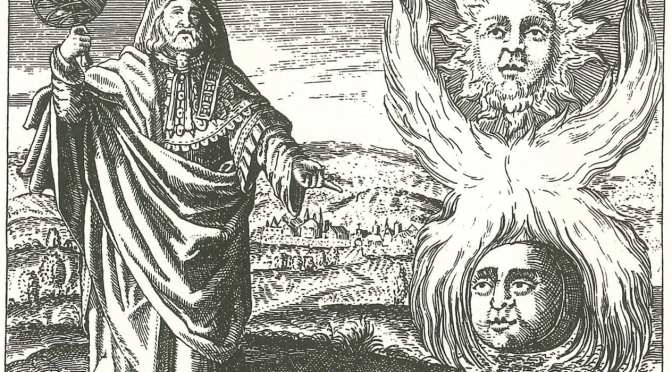
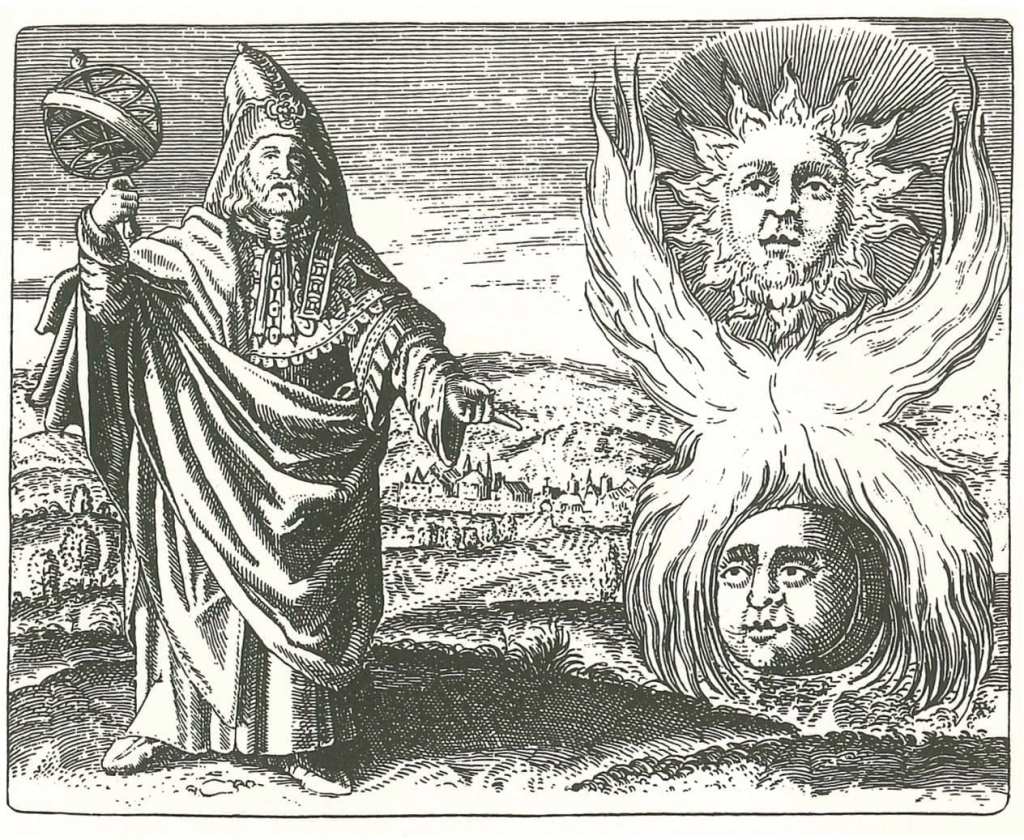
Hermes Trismegistus is a syncretic figure, blending the Greek god Hermes (messenger of the gods) with the Egyptian Thoth (god of wisdom, magic, and writing). He was said to have lived in ancient Egypt and authored sacred texts on alchemy, astrology, and theology.
The Legend of Hermes
Revealed divine secrets to humanity in cryptic writings.
Possessed the Emerald Tablet, the foundational text of alchemy.
Considered the father of Hermeticism, a tradition that shaped Western occultism.
“What is below is like what is above, and what is above is like what is below.” — The Emerald Tablet
Conclusion: The Living Tradition of Hermetic Alchemy
Hermeticism remains a powerful undercurrent in Western esotericism, alchemy, and occultism. Its teachings—hidden in symbols, encrypted in texts, and practiced in secret—continue to inspire seekers of divine knowledge.
“The lips of wisdom are closed, except to the ears of understanding.” — The Kybalion
In the labyrinth of alchemical symbolism, two of the most enigmatic concepts are Alkahest (the Universal Solvent) and Azoth (the Primordial Life Force). These were not merely chemical substances but metaphysical keys to unlocking nature’s deepest secrets:
Alkahest – The “solvent of all solvers,” capable of dissolving any material (even gold) back to its primordial state.
Azoth – The “quintessence of life,” a spiritual mercury representing the animating force of the universe.
Both were central to the Great Work (Magnum Opus), the alchemist’s quest for perfection. This article explores:
Origins & Meanings of Alkahest and Azoth
Key Alchemists Who Pursued Them
Symbolism in Alchemical Texts
Scientific & Esoteric Interpretations
Modern Legacy in Science and Spirituality
1. Alkahest: The Universal Solvent
Origins & Definition
First named by Paracelsus (1493–1541), though the concept existed earlier.
From Dutch “al-kahest” (“all-dissolver”).
Believed to reduce all matter to its primal essence (Prima Materia).
The Quest for Alkahest
Alchemists theorized it could: ✔ Dissolve any substance (even diamonds). ✔ Purify metals for transmutation. ✔ Extract the “essence” of plants and minerals for medicines.
“Alkahest is the key to all secrets; it opens the locked doors of nature.” — Johann Rudolf Glauber
Was It Real?
Some believed it was a supercharged alcohol or acid.
Van Helmont (1580–1644) claimed to possess it (possibly a potassium carbonate solution).
Modern equivalents: Aqua regia (dissolves gold) or superacids.
Conclusion: The Eternal Solvent and the Infinite Life-Force
Alkahest and Azoth represent alchemy’s highest ideals—mastery over matter and spirit. Though their physical forms remain elusive, their symbolic power endures:
“Seek the Alkahest within, and you shall find the Azoth of your soul.”
The Magnum Opus (Latin for “Great Work”) is the pinnacle of alchemical pursuit—a sacred process of material and spiritual perfection. More than just turning lead into gold, it represents the transmutation of the self, the purification of the soul, and the attainment of divine wisdom.
For centuries, alchemists across Europe, the Islamic world, and Asia sought to complete the Great Work, believing it would grant: ✔ The Philosopher’s Stone (transmutation & immortality). ✔ The Elixir of Life (healing & eternal youth). ✔ Divine Enlightenment (union with the cosmic mind).
This article explores:
The Stages of the Magnum Opus
Key Alchemists & Their Interpretations
Sacred Texts & Manuscripts
Scientific & Psychological Perspectives
The Burning Question: Did Anyone Ever Complete It?
1. The Four Stages of the Magnum Opus
The Great Work was traditionally divided into four color-coded stages, each representing a phase of transformation:
1. Nigredo (Blackening) – Putrefaction
Symbolism: Death, decay, the “dark night of the soul.”
Process: Breaking down impure matter (or ego) to its raw state.
The Magnum Opus was never just about gold—it was about transforming the self and the universe. Whether through lab experiments, meditation, or art, the Great Work remains humanity’s quest for perfection.
“The Stone is within you; the Work is within you. Begin where you are.” — Anonymous Alchemist
Alchemy is often studied as a proto-science or a philosophical tradition, but at its core, it has always been a profoundly religious and mystical pursuit. Many alchemists saw their work not just as laboratory experiments but as a divine revelation, a sacred art that mirrored the soul’s journey toward perfection.
From its roots in Hermeticism and Gnosticism to its associations with esoteric Christianity, Kabbalah, and even the “black arts,” alchemy has always straddled the line between science, magic, and religion. This article explores:
Alchemy as a Spiritual Path: The Quest for Divine Union
The Religious Symbolism of the Great Work
Alchemy’s Ties to Esoteric Traditions (Hermeticism, Gnosticism, Kabbalah)
The Dark Side of Alchemy: Links to the Black Arts and Occult Magic
Modern Religious Alchemy: From Jungian Psychology to New Age Mysticism
1. Alchemy as a Spiritual Path: The Quest for Divine Union
Unlike modern chemistry, which focuses solely on material transformations, alchemy was a sacred science—a means of attaining gnosis (divine knowledge) and reuniting with the divine.
The Alchemist as a Priest of Nature
Alchemists saw themselves as mediators between heaven and earth, performing rituals that mirrored God’s act of creation. Their laboratories were temples, and their experiments were prayers in action.
“The alchemist is the priest of the divine art, working in the laboratory of the soul.” — Anonymous Rosicrucian Text
The Three Stages of Spiritual Alchemy
Nigredo (Blackening) – Purification through suffering (the “dark night of the soul”).
Albedo (Whitening) – Illumination and spiritual awakening.
Rubedo (Reddening) – Divine union, the marriage of spirit and matter.
These stages parallel Christian mysticism, Buddhist enlightenment, and Hindu moksha.
Alchemy did not exist in a vacuum—it was deeply entwined with mystical and occult traditions.
Hermeticism: The Foundation of Alchemical Religion
The Emerald Tablet of Hermes Trismegistus (“As above, so below”) became the cornerstone of alchemical thought, linking macrocosm (universe) and microcosm (man).
Gnosticism: The Divine Spark Trapped in Matter
Gnostic alchemists sought to free the spirit from the prison of the material world, much like the Gnostic demiurge myth.
Kabbalah: The Tree of Life and Alchemy
Jewish alchemists like Abraham Eleazar merged Kabbalistic teachings with alchemy, mapping the Sephiroth (divine emanations) onto chemical processes.
Conclusion: The Eternal Religion of Transformation
Alchemy was—and still is—a living religion of the soul, a path of divine fire and sacred metals. Whether through prayer, meditation, or the crucible, its message remains:
“Transform yourself, and you transform the world.”
Alchemy is often dismissed as a pseudoscience—a mystical pursuit of turning lead into gold or discovering the Elixir of Life. Yet, hidden beneath its esoteric symbolism and arcane language, alchemy was the precursor to modern chemistry, medicine, and experimental science.
From the laboratories of medieval alchemists to the notebooks of Isaac Newton, alchemy laid the groundwork for the scientific method, laboratory techniques, and the very concept of material transformation. This article explores:
Alchemy’s Role in the Birth of Experimental Science
Key Alchemical Discoveries That Shaped Modern Chemistry
Famous Scientists Who Were Secret Alchemists
Why Alchemy Was More Than Just “Failed Chemistry”
The Legacy of Alchemy in Modern Science
1. Alchemy as the First Experimental Science
Long before the term “scientist” existed, alchemists were the first true experimentalists. They:
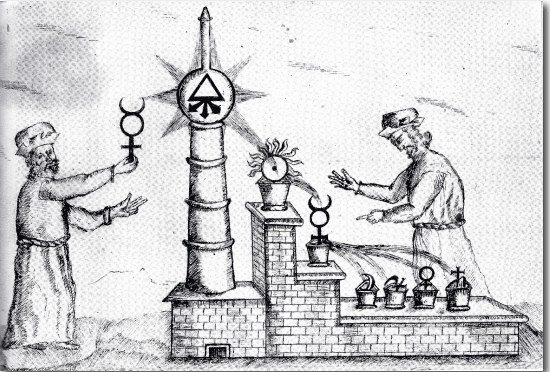
Developed laboratory tools (retorts, alembics, furnaces).
Pioneered chemical processes (distillation, sublimation, fermentation).
Recorded systematic observations (though often in coded language).
The Scientific Method in Alchemy
While alchemy included mystical elements, its practitioners followed a proto-scientific method:
Observation – Studying reactions between substances.
Hypothesis – Theorizing how metals “grew” in the earth.
Though alchemy was once mocked, we now recognize it as the cradle of experimental science. Its practitioners: ✔ Invented lab techniques still used today. ✔ Discovered key chemical processes. ✔ Inspired giants like Newton and Boyle.
The next time you see a chemist using a Bunsen burner (descended from alchemical furnaces) or a beaker (from medieval glassware), remember—science owes its birth to the alchemists.
“Alchemy is the art of far and near, and I think it’s a spiritual art as much as it is a science.” — Salvador Dalí
Alchemy is often misunderstood as a primitive form of chemistry, a misguided pursuit of turning lead into gold. Yet, at its core, alchemy is far more profound—it is a philosophical and spiritual tradition that seeks the purification of the soul, the understanding of cosmic unity, and the transformation of base existence into divine perfection. Many of the ancient and medieval world’s greatest philosophical minds were deeply immersed in alchemical thought, seeing it not merely as a laboratory practice but as a metaphysical journey.
The Philosophical Foundations of Alchemy
Hellenistic Alchemy and Greek Philosophy
The origins of Western alchemy can be traced to Hellenistic Egypt, particularly Alexandria, where Greek philosophy merged with Egyptian metallurgical knowledge and mystical traditions. Several key philosophical schools influenced alchemical thought:
Pythagoreanism – The Pythagoreans believed in the mathematical harmony of the cosmos, where numbers held divine significance. This idea resonated with alchemists, who saw numerical symbolism in their work, such as the sacred Tetractys (1 + 2 + 3 + 4 = 10) representing the four classical elements.
Platonism – Plato’s theory of Forms suggested that the material world is a shadow of a higher, perfect reality. Alchemists sought to uncover these hidden truths, believing that metals and matter could be refined to their purest, most divine state.
Stoicism – The Stoics emphasized the Logos, the rational principle governing the universe. Alchemists adopted this idea, viewing their work as aligning with nature’s hidden laws.
Gnosticism – Gnostic dualism (the struggle between spirit and matter) deeply influenced alchemy, framing the Great Work as a liberation of the divine spark trapped in material existence.
Aristotle’s Four Elements and Alchemical Thought
Aristotle’s theory of the four elements—earth, air, water, and fire—was foundational to alchemical philosophy. He posited that each element had its natural place in the cosmos and would return there if undisturbed. However, alchemists interpreted these elements not just as physical substances but as principles of existence:
Earth represented solidity and stability.
Water symbolized fluidity and dissolution.
Air stood for volatility and expansion.
Fire embodied transformation and purification.
As the Swiss psychologist Carl Jung later observed, these elements were archetypal symbols representing psychological and spiritual states rather than mere chemical properties. The alchemist’s goal was to transmute these elements within the self, achieving inner harmony and enlightenment.
Alchemy as Spiritual Transformation
The Union of Opposites: Solve et Coagula
One of the central tenets of alchemical philosophy is the conjunction of opposites (conjunctio oppositorum). The process of Solve et Coagula (dissolve and coagulate) represents the breaking down of impure matter and its reassembly into a perfected form. This mirrors the spiritual journey:
Solve – The dissolution of ego, ignorance, and material attachments.
Coagula – The reintegration of the self into a higher, enlightened state.
This concept appears in many esoteric traditions, including Taoism’s Yin and Yang and Hermeticism’s “As above, so below.”
The Philosopher’s Stone: Symbol of Perfection
The Philosopher’s Stone was not merely a substance to transmute metals but a metaphor for ultimate wisdom and immortality. It represented:
Physical perfection – The ability to purify base metals into gold.
Spiritual enlightenment – The attainment of divine knowledge.
Immortality – The transcendence of death, either literally (as in elixirs of life) or symbolically (as in spiritual rebirth).
Famous alchemists like Hermes Trismegistus (mythical founder of Hermeticism) and Paracelsus (Renaissance physician-alchemist) wrote extensively on the Stone’s symbolic meaning.
Alchemy’s Legacy in Modern Thought
Though modern science dismissed alchemy’s material claims, its philosophical and psychological insights endure:
Jungian Psychology – Carl Jung saw alchemy as a projection of the unconscious mind, where the alchemical process mirrored individuation (the integration of the self).
Esoteric Traditions – Rosicrucianism, Freemasonry, and Theosophy preserved alchemical symbolism.
Popular Culture – From Harry Potter’s Sorcerer’s Stone to Fullmetal Alchemist, alchemy remains a powerful metaphor for transformation.
Alchemy, at its heart, is not about gold but about gnosis—divine knowledge. It teaches that transformation is possible, whether in matter, mind, or spirit. As the Emerald Tablet proclaims:
“That which is below is like that which is above, and that which is above is like that which is below.”
The true alchemist seeks not just to change lead into gold but to transmute the self into something greater—a being in harmony with the cosmos.
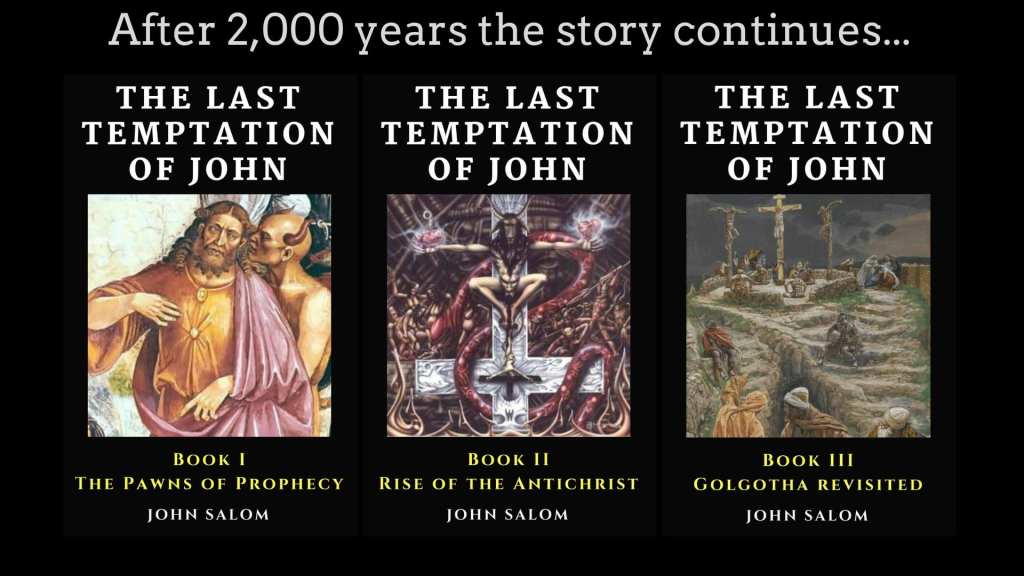
Alchemy & The Last Temptation of John Books
Although the trilogy known as the Last Temptation of John is not solely focused on alchemy, the craft plays an important role in the series because the main character (St John the Apostle) is an unhappy immortal whose primary goal in life is to find a way to die. Unable to discover a normal way to die, John turns to alchemy to find a solution. His curious quest takes him on a journey that involves The Philosopher’s Stone, Quintessence, Azoth, and of course The Magnus Opus. Will he successfully complete his alchemical goals?
I am about to finally do it — my terrible life is about to end!
“Let Fire and Azoc suffice.” <Power> was all around me as I spoke the words of the Greek master Aristeus while at last I neared the completion of the Magnus Opum. “The Golden Key rules all, it alone shall open what has been shut — the great Gift of the Divine.”
Alone in my workshop, I was not longer just John of Salome; instead I was Azoth – Penultimate Master of Alchemy!
I am Azoth
Standing before a small altar in front of the furnace near the rear of my garage, I felt the heat biting at my back. With the oven door open, flames were licking forth, tasting the air – tongues of yellow and red continuously snaked out and more than a few flares came into contact with my body — yet to no effect.
After working for nearly two weeks without rest, I had (again) completed the first three steps of The Great Work – during the Negrido I had purified myself by using fire to burn my iniquity away from the inside out; later I had attained further enlightenment via the Albedo, and after that I’d quickly worked through the Citrinitas stage (opening my soul to the solar dawn of creation). Therefore as it stood now, at this stage of the rite, my physical body was beyond harm from anything in the natural world – for, as Azoth, I had again reached the beginning of Rubedo — wherein I endeavored to achieve….
The unification of the limited with the unlimited – in the hopes of breaking the bonds of Death and achieving a <oneness> with God himself!
This was not the first time, I had reached this stage of The Great Work.
Yet always before my experiments had ended in failure.
This time, however I vowed things would turn out differently.
Thankfully, for the past two weeks God had not forced any visions upon me, allowing me the freedom to continue my work. I was now more convinced than ever that my only hope in breaking the bonds that held me captive in this forsaken life was via the completion of the Magnus Opum. And so, I had once more transformed myself into Azoth and I had been busy working through the Rites of The Great Work ever since.
“By Life, the Beginnings of things are known. Air is the Life of things, therefore the Beginning of things.” I continued my chant, my voice growing deeper, richer, more alive. “To catch Air is to use the Golden Key of Nature, a window to Heaven’s Aeythr!” And here I raised my arms on high, drawing Air and Aethyr into myself – even as the flames nearly engulfed me!
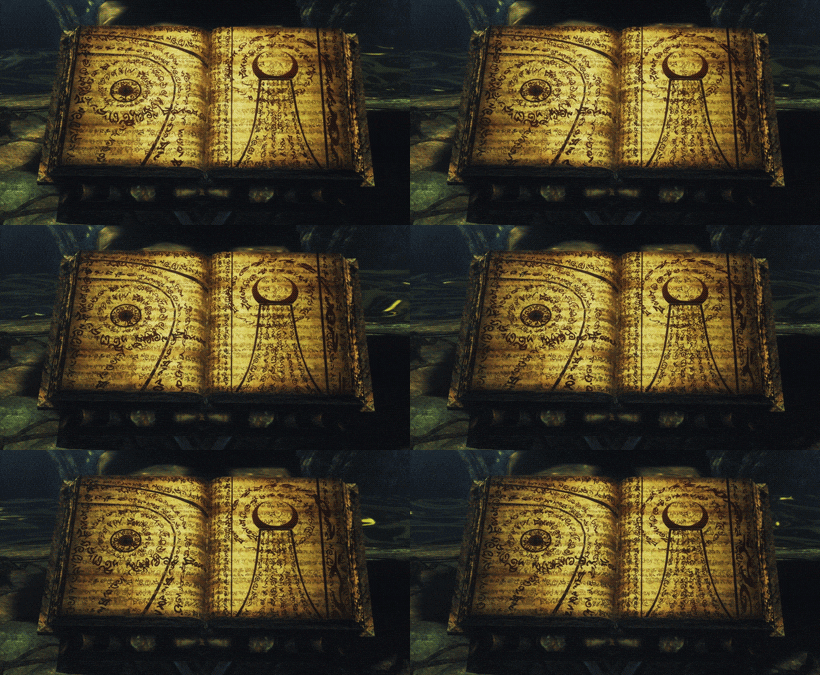
A sudden stillness settled upon the room as I lowered my arms. After the incantation, I turned my attention back to the altar below and specifically to three large tomes open before me. Two were sacred texts of Alchemy – one from Aristeus, written centuries before Christ’s birth, while the other contained the scientific works of Apollonius of Tyana, a contemporary of mine (during what would have been my original lifetime). Although far from the only references that I used to conduct my experiments, these two authors held the most esteem in my eyes.
As for the third book, it was written in my own hand and nearly twice the size of the other two books combined – for it contained the sum of MY knowledge on the subject of Alchemy – every thought, every experiment, every inkling or idea which I ever had for the past millennia or more during which I had worked The Rites, all of it was written within this book.
My book on Alchemy was a living thing
I made cursory checks of Aristaeus and Apollonius – scanning through their instructions on the Rite; yet in truth, I cast but a hasty glance at each, for I had read their texts so many times I knew them by heart and I knew there was nothing more they could teach me.
Therefore, it was to the larger volume – to my own work — that I now turned; flipping through its pages, I searched for that one piece of knowledge that had always eluded me, seeking the <key> by which I could finally complete The Great Work.
For I now knew that the secret lay within MY own words – of this I was absolutely certain – and yet, I just didn’t know WHERE within the journal’s thousands of pages that key piece of knowledge might be.
Riffling through my notes, I muttered as I read…
Spirit of the Air comes out of the rays of the Sun and the Moon without which none can live…
“No. Not it.” And I turned ahead a couple hundred pages…
Consider that you must have a permanent Water, that which congeals in the Fire and is joined with the perfect bodies… After this, give in to the Spirit made from the Air…
“I’ve done this before too!” I was frustrated.
But then, as a new thought emerged, I quickly flipped back halfway through my book, turning over so many pages that I had to use both hands to move such a weight of paper.
After finding the place I sought, I pondered, “Is there more to Air than I have ever imagined?”
Suddenly I moved to the very end of the text, to a blank page, and scrawled…
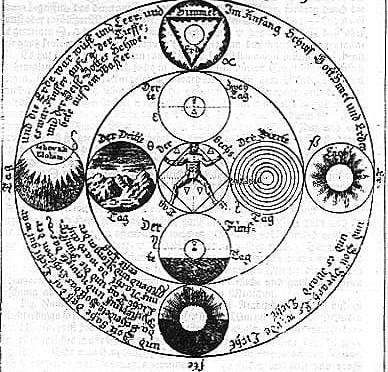
Air. It is breathed by all living things, yet it is not the life of all – why? Unless… unless… you would go back to the First Chaos from which God formed all things!
“Ah, it is ONLY from the First Chaos that one can draw the Truth.” I spoke aloud. Then back to my book, I continued writing…
Aristeus was wrong! Verily, I do agree with him that every species of beings has its own species of Air, its own Lifeforce. Yet, he makes no mention as to the Principle of each being and I now say this is the real key! For regardless of the species, is not the <Essence> of each altogether ‘Aerial?’
Again, I began to flit backwards through my manual, searching… seeking… at last going back to very first few pages – to a time when I wrote well over a thousand years past!
…Air is truly Divine, it is the subject of the search of all philosophers — for therein resides Life!
“And so it goes – there IS a difference between the Air which we breathe, and the Aerial substance which is within the Soul.” I was flabbergasted. “Oh, the time I have wasted – to discover that which I had known all along!”
That’s when I realized that for centuries I had been making The Great Work so much harder than it had to be.
Now, as I stood there, I finally understood that it was the very essence of Simplicity.
Working hard to contain my enthusiasm, I looked down upon my altar, wherein sat a silver bowl filled with mercury — within the interior of the dish, the color of the elixir mixed so well with the metal of the bowl that it was impossible to tell where the viscous mineral ended and the vessel began. Yet hanging over the lip of the dish were twelve golden keys of various shapes and sizes, all of them piercing into the mercurial soup. Reaching down, now picked up the Second Key, now brimming with confidence.
Holding the key aloft, I admired it. Silver droplets cascaded down – yet not a single one reached the floor, for flames from the furnace flashed out and consumed them as they fell – surrounding me in a wreath of Fire.
“The Golden Key shall open the Door.” I chanted, <power> once more filling my words. “Air catches Aire. Matter from the Earth is the same as that which is in Heaven. This is the infallible Truth!”
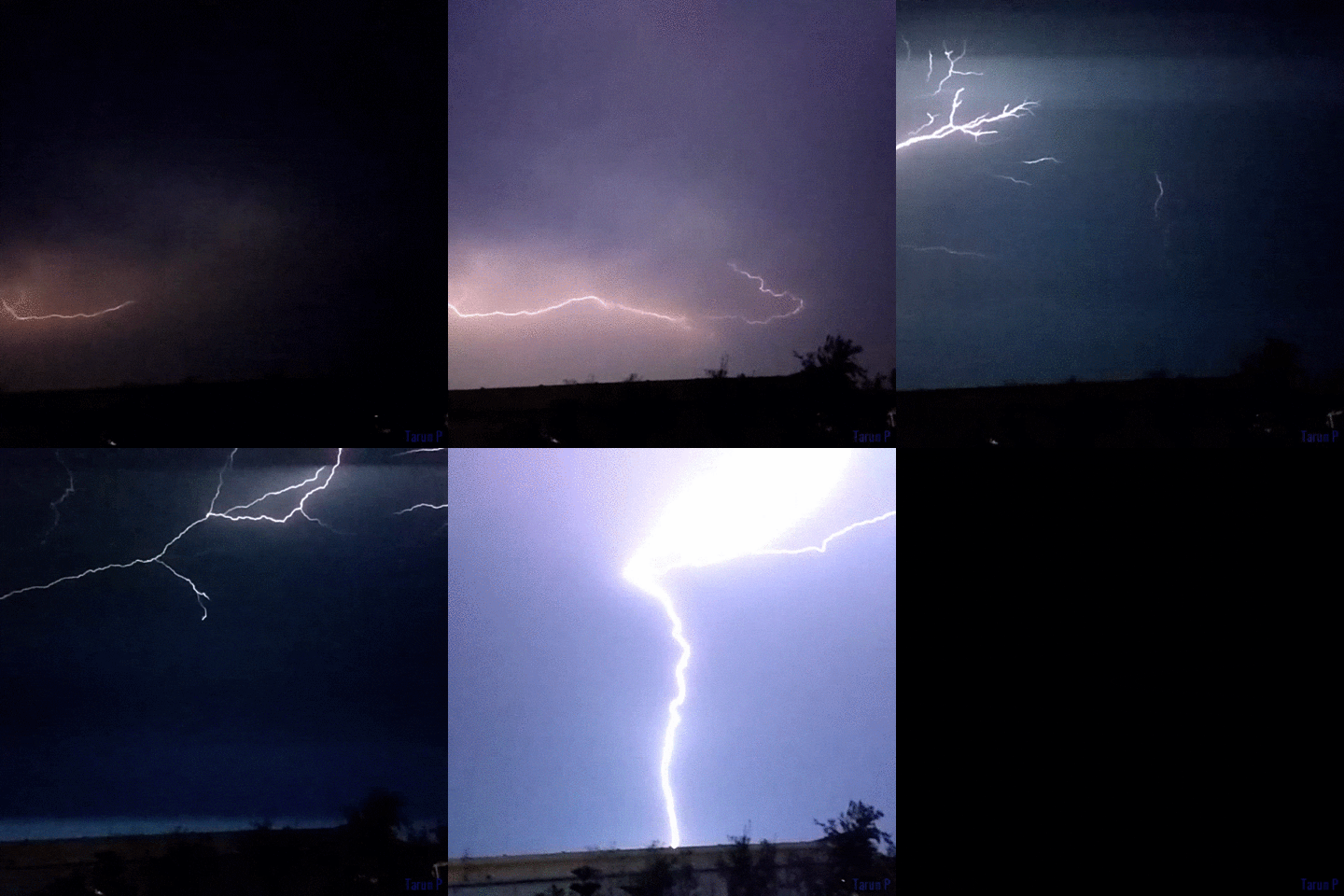
<Rroom-boom-bOOM-BOOM-BOOM!!>
Thunder rolled suddenly outside – yet rather than startle me, it only caused me to cackle in delight, for I was at last certain that I had discovered the <key> to completing the Rubedo.
In my very soul I could feel that <Oneness> was close.
Lightening continued to crack, yet I roared above the din, “I seek the Simple, an <essence> universal to all! I have been purified by The Fires of Corruption, I have been quenched by The Waters of Life, my body is of the detestable Earth, yet my Soul is from the Aire, and above all, I am The Quintessence!!!”






 The Last Temptation of John