Category Archives: Tantalizing Tidbits

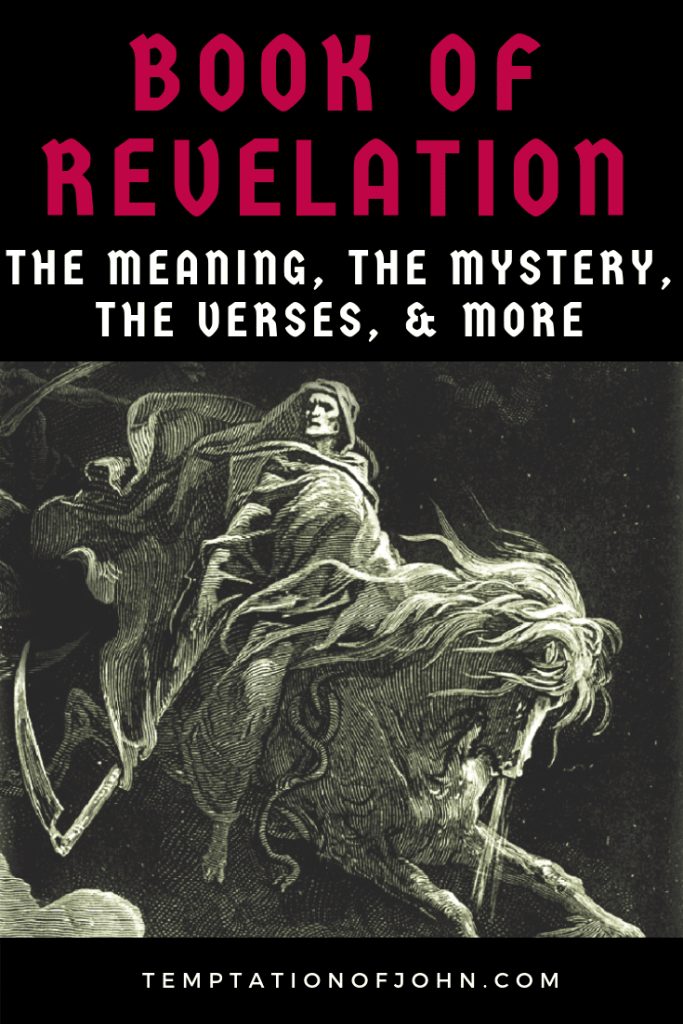
Book of Revelation – The Meaning, The Mystery, and More

The Book of Revelation has fascinated readers for nearly 2,000 years. In this article we’ll delve into the most popular topics related to this famous apocalyptic text. We’ll discuss the most famous verses, key symbols, and noteworthy characters of Revelation. We’ll debate if the Apostle John is really the author of Revelation. We’ll examine popular books that feature themes of Revelation. And we’ll even consider the question – what if the John’s Revelation was coming true today. It promises to be a wild ride – are you ready?
Editor’s Note: This article is a master guide that provides an introduction for each of the topics listed above. For those subjects that require more in-depth research, links to ‘feature articles’ are provided so you can learn even more! Additionally, throughout this article, you’ll see words highlighted in BLUE – all of these are hyperlinks to other quality websites whose content we have curated for you as reference material, specific Bible verses, and further discussion so you can continue your research. 

[lwptoc]
I. Book of Revelation – Fast Facts

1-Who is the author of the Book of Revelation? 

The author identifies himself as John of Patmos. The mainstream view is that this is the Apostle John, however not everyone agrees on this. (See more about this controversy in Section III below – “Debate: Did the Apostle John really write Revelation?”)

2-When was the Book of Revelation written?

The majority of early church fathers believed the Book of Revelation was written sometime between 64-96 AD. Modern scholars tend to pinpoint the date to 81-96 AD. Why 64AD? It was the year of the Great Fire of Rome – allegedly started by the Emperor Nero (but blamed on the Christians). Emperor Nero was the first historical figure to be proclaimed as the Antichrist and it was believed by many that the Beast of Revelation was none other than Nero himself. As for the 81-96 AD range – these dates comprise the reign of Emperor Domitian – allegedly the Roman ruler who exiled the Apostle John to the island of Patmos where the saint is thought to have written this book. 

3-What are the other names for the Book of Revelation?

The Book of Revelation is also sometimes called The Revelation to John, The Apocalypse of John, The Revelation of Jesus Christ, The Apocalypse, or just Revelation

Note that the word “Revelation” is singular and not pluralized in any of the titles. 

4-Where is the Book of Revelation in The Bible?

The Book of Revelation is the last book of the New Testament in most Christian Bibles. 
II. What is the Book of Revelation About?

Revelation – a Synopsis

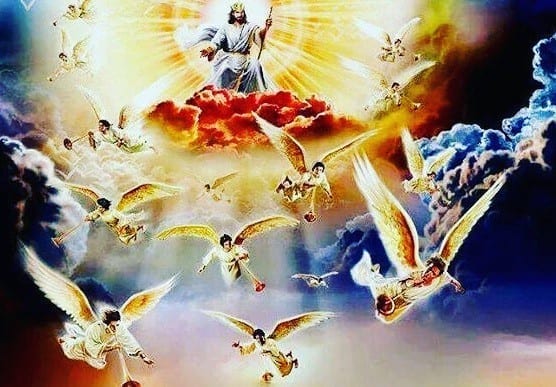
At it’s most basic level, the Book of Revelation is a piece of apocalyptic literature about the End of the World and the Second Coming of Jesus Christ

The book is structured as a letter from John of Patmos writing to the Seven Churches of Asia. In the text, John describes his visions (i.e. his inspired revelations) of a coming apocalypse – a series of cataclysmic catastrophes that will rock the world – and warns his readers about the Antichrist – the incarnate of Satan’s Son who is destined to rule the world during Armageddon. Thankfully John concludes on a positive note – describing the inevitable victory of Good over Evil in the form of Jesus Christ’s glorious return to save the world. 

Revelation – Key Definitions

If we truly want to understand what the Book of Revelation is about, we should probably define a couple key words. To begin with we need to know the definition of the word revelation. Next we’ll need to know what people mean when they talk about apocalyptic literature

What is the definition of the word revelation?

If we want to delve into the meaning of the BOOK of Revelation we first need to start by knowing what the meaning of the WORD revelation is. To that end, Merriam-Webster and Dictionary.com give the meaning of the word revelation as follows: 

  • an act of revealing or communicating divine truth
  • something that is revealed by God to humans
  • an act of revealing to view or making known
  • something that is revealed
    especially : an enlightening or astonishing disclosure
  • a pleasant often enlightening surprise

Meanwhile, Bible Study Tools talks about the meaning of revelation from a Biblical standpoint, defining a revelation as “an uncovering, a bringing to light of that which had been previously wholly hidden or only obscurely seen… The Scriptures are not merely the “record” of revelation; they are the revelation itself in a written form, in order to the accurate preservation and propagation of the truth.”

Now that we understand what a revelation is, let’s explore what people mean when they talk about apocalyptic literature

What is Apocalyptic Literature?

Britannica has a great piece about this topic and defines apocalyptic literature as a “literary genre that foretells supernaturally inspired cataclysmic events that will transpire at the end of the world.” The discussion points out a few key elements of this type of writing:

  • It is a product of the Judeo-Christian tradition.
  • “Apocalyptic literature is characteristically pseudonymous.
  • It takes narrative form.
  • It employs esoteric language.
  • It expresses a pessimistic view of the present.
  • It treats the final events as imminent.”

There are well over 30 ancient texts that have been classified as apocalyptic literature, but the most famous are:

And yet, it is the Book of Revelation that is nigh synonymous with the word Apocalypse — and a single reading of the text is enough to let anyone understand why. 

III. Debate: Did the Apostle John really write Revelation? (Feature Article)

Did the Apostle John really write The Book of Revelation?

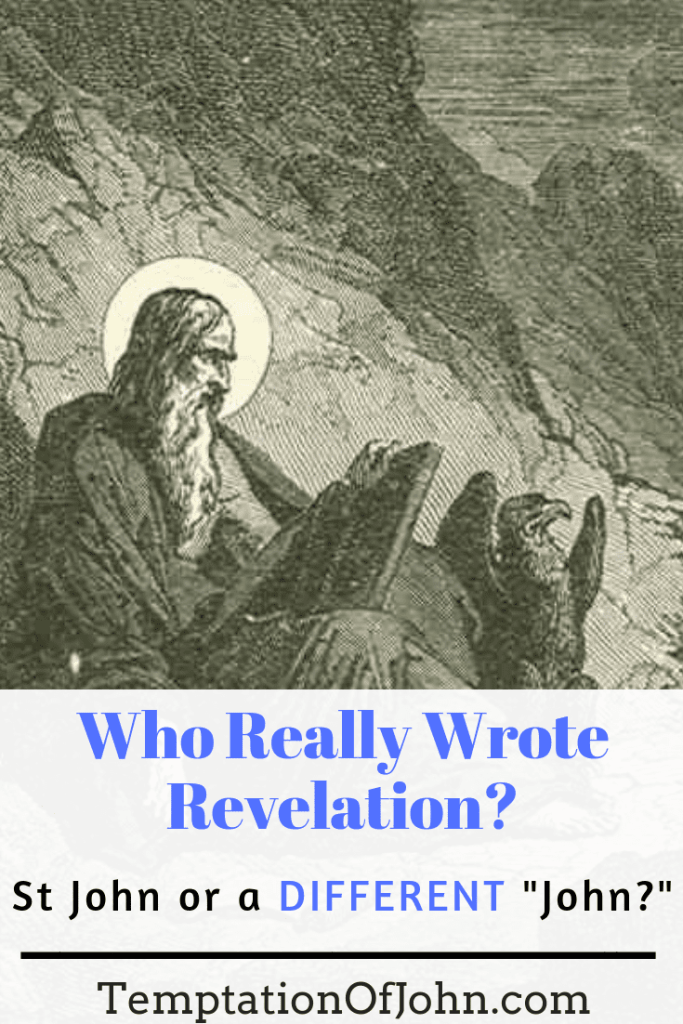
The answer is not as easy as it seems. In this feature article we’ll explore who “John of Patmos” may be. I’ll give you the arguments in favor of St John being the author and also talk about why some experts believe there was “another John” behind this famous book. I’ll also give you my opinion on this age-old question which has now plagued Christians for nearly 2,000 years. 

Click here to read this feature article: “Who Really Wrote Revelation?”

IV. Revelation in The Bible
As noted already, the Book of Revelation can be found as the final book of the New Testament in most Christian Bibles. But it wasn’t always that way.

When was The Book of Revelation added to The Bible?

The earliest Christians didn’t have the modern Bible that we know today – in fact those of the first and second centuries often didn’t even agree on which books among early Christian literature should be recognized as ‘canon’ and which should be cast aside – such was the case with the Book of Revelation too. Although we don’t know the exact date the Revelation was formally included into early forms of The Bible, we can pinpoint down to the decade. Writings from early church fathers and various councils of elders discuss the book as follows:

Given these dates, we can say with some assurance that the Book of Revelation was accepted into formal Christian canon sometime between 364 AD and 367 AD.

Additionally it should be noted that the Book of Revelation was also later affirmed by the synods of Hippo (393 AD) and Carthage (397 AD)   and the church elders Philastrius of Brescia (385 AD), Rufinus of Aquileia (404 AD), Jerome (414 AD), and Augustine (426 AD).

As an interesting aside, in addition to the challenges that the  Book of Revelation faced in mainstream Christian circles, it should be noted that some Eastern Orthodox churches have never accepted it into their sacred canon.

What is the relationship of Revelation to The Old Testament?

It’s hard to overlook the fact that much of the content, symbols, and imagery of the Book of Revelation can be found in numerous books of the Hebrew Old Testament and other apocryphal literature from the time before Christ. For example, debates rage over the relationship of Revelation to all of the following Old Testament books. 

One thing is for sure, the author of Revelation was very familiar with the Hebrew Old Testament.

The importance of this fact is key for another reason — that the author of Revelation was so influenced by the Old Testament speaks to the author likely being Jewish. And what do we know about St John the Apostle?

  • He was a Jew from Galilee. 
  • His mentor Jesus was also a Jew, and as an apocalyptic teacher Jesus was quoted many times over in preaching that ‘this generation will not pass away before these things come to pass’ (Matthew 24:34) and similar apocalyptic messages that related back to the Old Testament.
  • That Saint John was indoctrinated with a heavy dose of apocalyptic thinking is an easy connection to make.

Most importantly, these facts support the case for Saint John as the author of the Book of Revelation. (Keep this in mind when you read the feature article “Who Really Wrote Revelation?”


“The Apocalypse” by Master Bertram, c 1380 AD

V. The 13 Most Famous Verses from Revelation
(Feature Article)

No study of the Book of Revelation would be complete without diving into the most famous verses from the text. We have another feature article that explores this topic in detail and provides some great artwork to accompany the verses.  Click here to read “The 13 Most Famous Verses from The Book of Revelation.”

In the interest of space we’ll merely list the most referenced verses from the book. They are:

  1. Revelation 1: 1-2
  2. Revelation 1: 8
  3. Revelation 3: 20
  4. Revelation 6: 8
  5. Revelation 6: 12
  6. Revelation 7: 9
  7. Revelation 9: 11
  8. Revelation 12: 7-9
  9. Revelation 13: 1-2
  10. Revelation 13: 16-18
  11. Revelation 14: 1
  12. Revelation 20: 12-15
  13. Revelation 21: 1-4

Click here to read the feature article. 


VI. Key Symbols of Revelation

Given that the Book of Revelation is at one and the same time an apocalyptic, prophetic, and futuristic text, it should come as no surprise that the book is filled with symbols and imagery laced with alternative meaning. Church elders and scholars have debated for nearly 2,000 years about what all the signs and symbols of Revelation mean. We have an in-depth article about this topic called “Understanding the Apocalyptic Imagery & Symbols from the Book of Revelation” that we encourage you to read, but in the meantime, here is a brief introduction to each of the key symbols. 

Key Symbols:

(Each of these symbols is explored in more detailed in the feature article). 

  • 7 Churches of Asia: important messages are delivered to churches in Ephesus, Smyrna, Pergamum, Thyatira, Sardis, Philadelphia, and Laodicea.
  • Book of Life: a roll call of those who will be saved. This famous tome is referenced throughout the Bible and also plays a role in The Last Temptation of John books
  • Throne of God: the seat of the Supreme Being – who is attended to by various other dignitaries of Revelation. 
  • 7 Seals of Revelation: one of the most important symbols in Revelation – as each seal is broken, a terrible new judgement is released upon the world. 


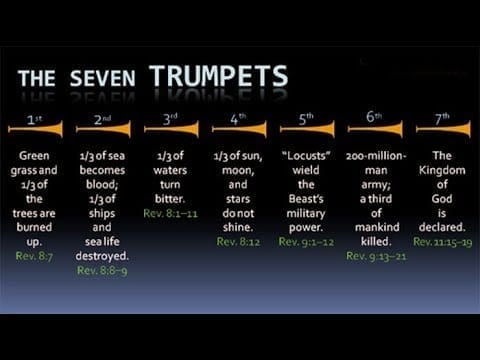
  • 7 Trumpets of Revelation: the angels blow their trumpets after the 7th Seal is broken – releasing further catastrophes and starting the 3 Woes. 
  • Golden Censor: an incense burner that is filled with fire from the alter of Heaven and poured upon the earth. 
  • The Wormwood Star: the star of doom from Revelations 8 that falls from the sky and poisons the waters of earth. 
  • 3 Woes: world catastrophes that are triggered by the final 3 trumpets. The 3rd Woe also triggers the release of the 7 Bowls. 
  • The Little Scroll – a ‘bitter’ scroll given to John by a Mighty Angel (Michael?) that is a source of prophetic knowledge about the coming apocalypse. 
  • 7 Bowls of Revelation: more disasters are unleashed upon our world as each of the Seven Angels pour out a bowl filled with God’s wrath. 
  • NOTE: The relationship between the 7 Seals, 7 Trumpets, 7 Bowls, and 3 Woes is explored in detail in the feature article
  • The New Jerusalem: the climax of Revelation occurs in Revelation 21 when a New Jerusalem emerges where the saved ones will dwell with God. 
  • The River of Life: Revelation 22 describes the return of Eden and the final destruction of the curse of sin. 

VII. The Main Characters of Revelation

The Book of Revelation is filled with a colorful cast of characters – some good, some evil, but all interesting. Here are the main characters from Revelation with links to learn more about each one…

Jesus Christ

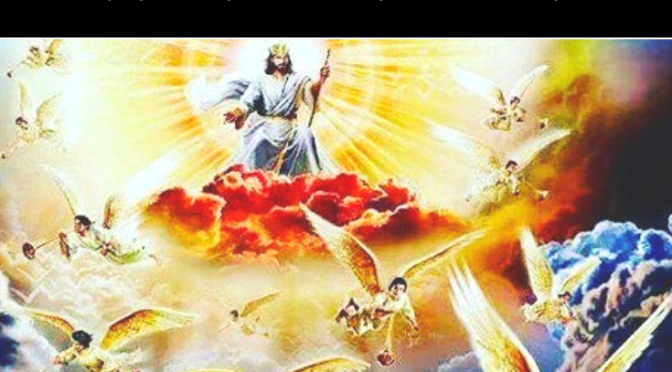
The very first verse of Revelation tells us that the visions of the author are in fact the ‘testimony of Jesus Christ.’ Jesus is featured throughout Revelation and the book is the de facto story of Christ’s Second Coming. 

Later in Revelation (example 5:5 Jesus is also called “The Conquering Lion of Judah“)


“The Second Coming” by Ron DiCianni

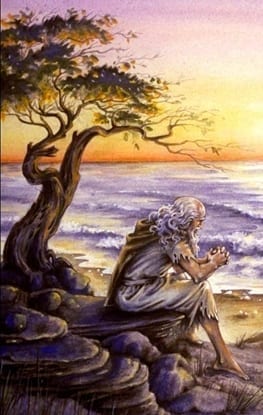
John of Patmos

We meet John of Patmos in Revelation 1:9 where he identifies himself as the author of the Book of Revelation. John of Patmos is thus clearly an important figure for our research, and yet, we know so little about him. Is he Saint John the Apostle or another persona entirely? Check out this article to learn more: “Who Really Wrote Revelation?


Gustav Dore’s “John of Patmos”

The Seven Angels of the 7 Churches

Revelation 1: 20 introduces the Seven Angels of the 7 Churches. As we discussed above, John gives a message to each angel at each of the churches in Revelation chapters 2 & 3. The angels are located at Ephesus, Smyrna, Pergamum, Thyatira, Sardis, Philadelphia, and Laodicea.

Jezebel

We meet Jezebel only once in Revelation by name – in verse 2: 20-25 which warns the Church of Thyatira to be wary of the prophetess’s teachings. 

For an interesting discussion about Jezebel visit this article by the United Church of God


The 24 Elders

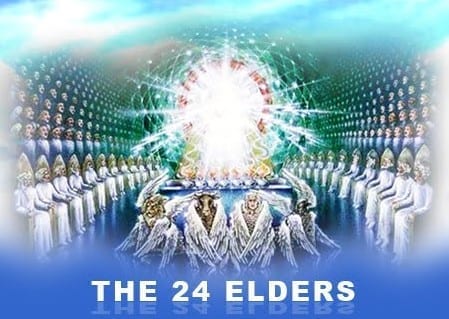
Twenty-Four Elders appear in Revelation 4:4, described as surrounding the Throne of God. Much debates exists about who the elders were: specific people/kings, the heads of churches or cities, or perhaps an allegory for different types of matter, elements, planets, or even our souls. 
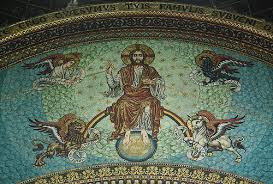
The 4 Living Creatures

Also in the throne room that is described in Revelation 4: 8 are 4 ‘living creatures’ described as having six wings and with “eyes all over, front and back. The popular interpretation is that the creatures in Revelations are similar to those described by the prophet Ezekiel in the Old Testament and the most popular theories suggest that the living creatures are either angels or perhaps the gospel writers (Matthew, Mark, Luke, and John). Additionally, because of their many eyes, they are held to be all knowledgeable and it’s said that nothing escapes their notice.
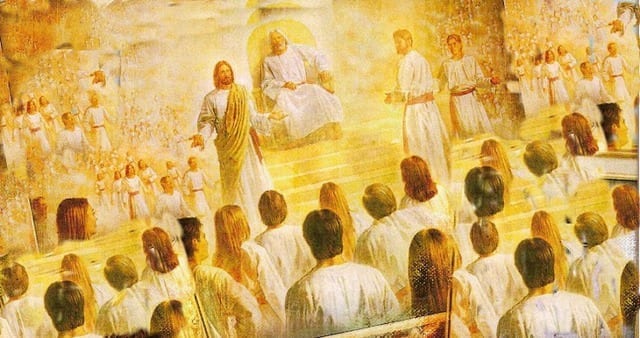
Souls in White Robes

Revelation 6 introduces us to the souls in white robes who had previously died for the faith. For an excellent discussion on these souls and who they may be see this article by Bible.org

Four Horsemen of the Apocalypse

Possibly the most popular of all personalities in Revelation, the 4 Horsemen are introduced to us in Revelation 6 where we meet 4 beings riding on horses of various colors (red, black, white, and pale). At the most basic level they are said to represent Disease, War, Famine, and Death. Because some believe Revelation was an allegorical attack on the Roman empire, others believe the riders represent oppressions by that famed world power. Still others hold a different theory


Four Horsemen of the Apocalypse, by Victor Vasnetsov, c1887

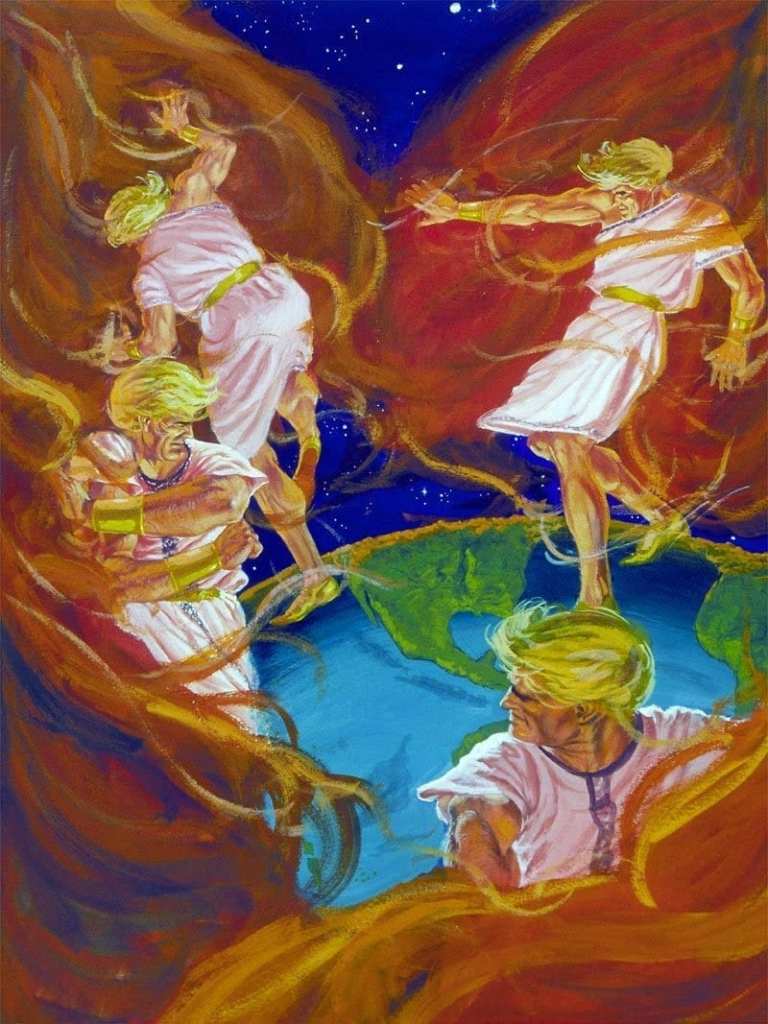
4 Angels holding the 4 Winds

Revelation 7 showcases the 4 winds being held in check by 4 powerful angels. This event occurs just prior to all hell being unleashed onto the world (literally!) since the next few chapters see the breaking of the Seals, the blowing of Trumpets, and more (all associated with world catastrophes). Some suggest the angels holding back the winds is an allegory for God’s power holding back Satan’s and that the latter can only act when given the OK by God. 
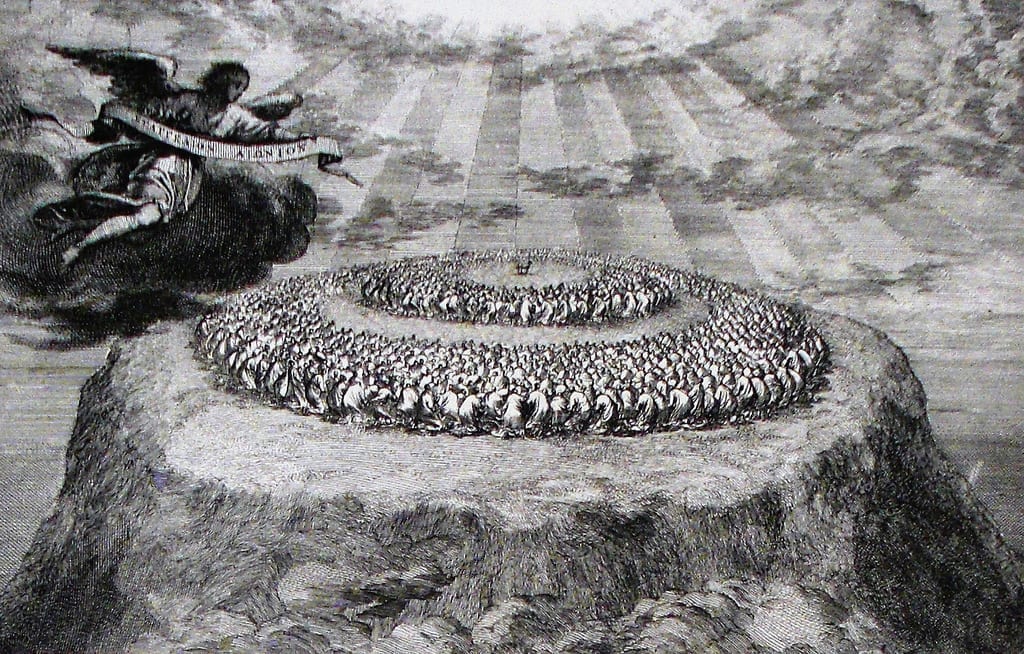
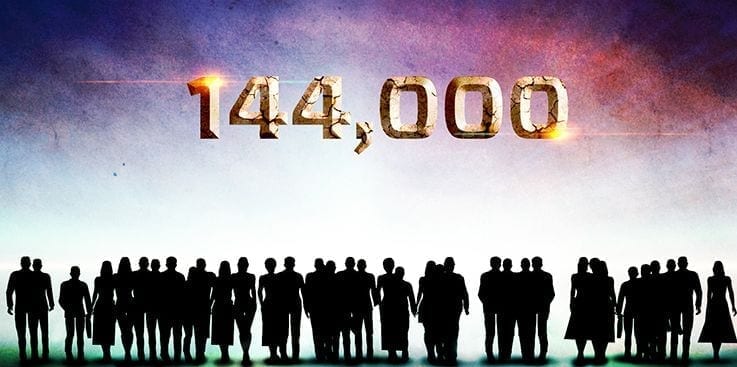
The 144,000

Another popular group from Revelation is the famed 144,000. The Book of Life holds the names of those 144,000 lucky people who are apparently marked to be able to avoid the catastrophes that the rest of the world will suffer in Revelation. These raptured people will be redeemed and taken to heaven where they will wait it out while the world is cleansed. Their fate is described in Revelation 7 and 14. 
Seven angelic trumpeters

Revelation 8 is when the real action of the book heats up as famed 7 Seals begin to be broken and the Seven Angels begin to blow their trumpets. There is actually an EIGHT angel who pours a golden censer full of wrath upon the world just to add to the fun. 

For a discussion on WHO the angels are, see this article by Bible Study Tools


The seven angels with seven trumpets, and the angel with a censer, from the Bamberg Apocalypse.

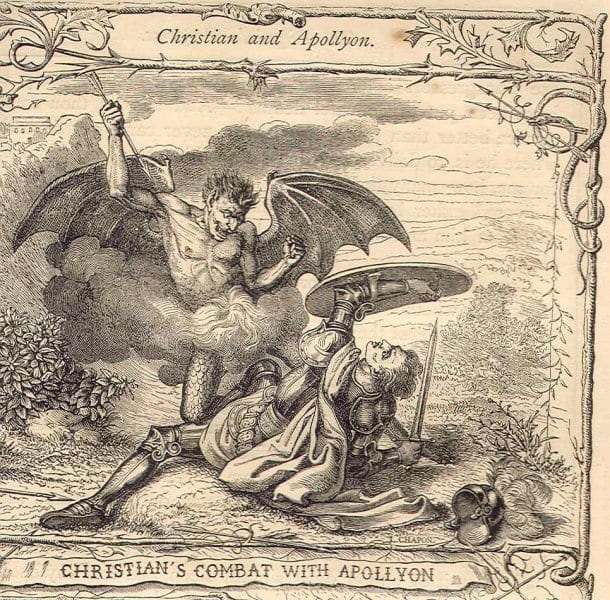
Abaddon

In Revelation 9 we meet Abaddon! He is also known as Apollyon The Destroyer. Some suggest this is Satan, others the devil’s chief demon, and still others the Angel of Death

For commentary here, see articles by Got Questions or Bible Study Tools

The Mighty Angel

Revelation Chapter 10 is actually considered a kind of ‘interlude’ as the people of earth are given a slight reprieve from all the catastrophes caused by the breaking of the Seven Seals and the blowing of the Seven Trumpets. During this break in the action, John of Patmos is given the little scroll by the mighty angel – as instructed, John eats the ‘bitter’ scroll. This will become a source from which he can prophesy what he knows to all peoples and all nations.

This angel is also called the Mighty Angel of the 7 Thunders. 

As to WHO the Mighty Angel is we don’t know. Some say Archangel Michael, others Archangel Gabriel, and still others Jesus Christ. 


Johannes verschlingt das Buch “Might Angel and Little Scroll” c 1530

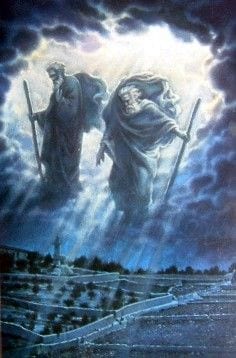
The Two Witnesses

Although perhaps not as popular as other figures from Revelation, these two prophets are no less important. We meet them in Revelation 11:14 and their role is to prophecy to the world during the 1,260 days that God’s Temple is ‘being trampled upon’ by Satan’s minions.

As to WHO they are the debate ranges – the most popular theories are that they are Elijah and Enoch of Old Testament fame. This is the case in the Last Temptation of John books where the Two Witnesses play a prominent role. 
The Beast

The Beast of Revelation is one of the most famous archetypes of the entire book – synonymous with the Antichrist himself.

Yet what many people don’t realize is that there is more than just one beast discussed in the book.

In fact there are THREE related Beast-type characters that we need to focus our attention on. They are…


The Dragon

Revelation 12 introduces the Dragon – a version of ‘the serpent’ that has repeatedly been representative of Lucifer/Satan throughout other books of The Bible. Archangel Michael casts the dragon out of heaven and down to earth, where It then makes war upon the world. 
The Beast of the Sea 

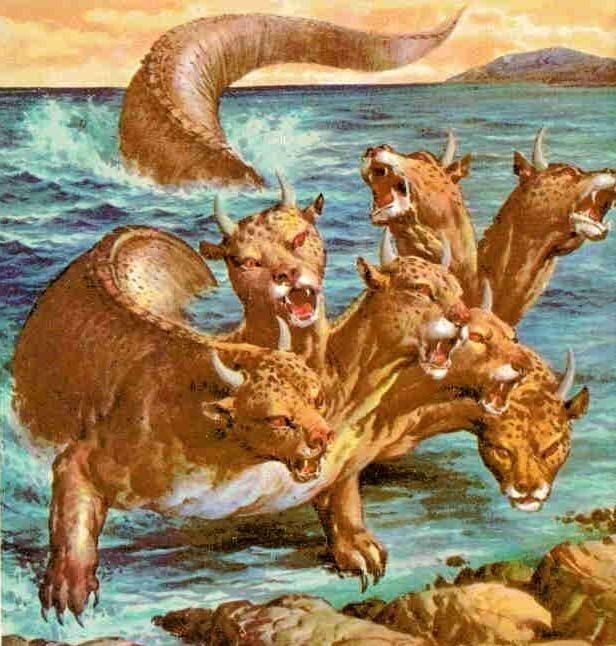
We meet the sea beast in Revelation 13 and 17. After the beast rises from the sea it is given ‘authority and power’ from the dragon. Most theories suggest the sea beast is representative of world governments and/or the old world order (i.e. the Roman government). 
The Beast of the Earth

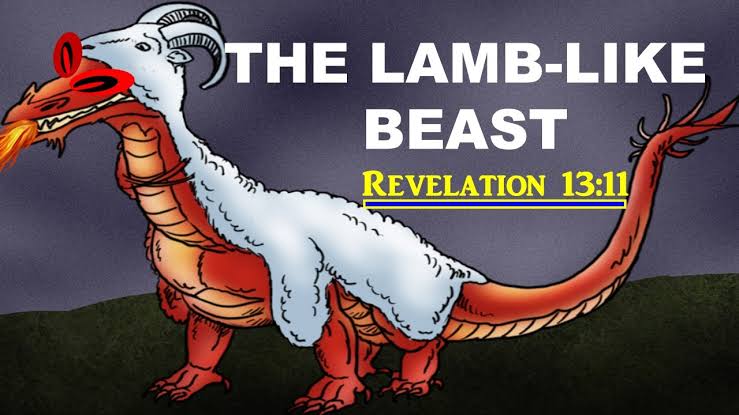
Also called The False Prophet, this beast is described in Revelation 13. Although not as famous as the dragon or the beast of the sea, the beast of the earth is no less important, for this is the beast who looks like a lamb but deceives like a dragon. Additionally, this beast will lead the world astray by causing people to get The Mark of the Beast

Understanding the beast character is critical to grasping the meaning of Revelation. For additional discussions about the Beasts of Revelation see…

  1. Got Questions – Who is the Beast of Revelation?
  2. Life, Hope, & Truth – Who is the Beast?
  3. Simply Bible – the 3 Beasts of Revelation
  4. WUA Seminars – What do the 4 Beast of Revelation represent?

Both beasts (in their human form) feature highly in The Last Temptation of John book series. 

The Woman & her Child

The woman who gives birth to a child in Revelation 12 is often misunderstood. She is not to be confused with the ‘other’ woman of Revelation (i.e. Mystery, the whore of Babylon), and her child is not the Antichrist. Despite the Dragon trying to eat the child at birth, the baby is instead taken up to God, while the woman flees into the wilderness and war breaks out in heaven.

Debates rage as to if the woman is The Virgin Mary, the Catholic Church, or another person, and the same goes for the identity of her child (is it Jesus, his teaching, the people of the church or the world). 

Archangel Michael

Although we don’t know if the Mighty Angel of Revelation 10 is Michael, we DO know he appears in Revelation 12 since Michael’s feats of strength are detailed in The War of Heaven where the powerful archangel casts Satan (in the form of The Dragon) and his minions out of God’s kingdom. 


Victory of St. Michael by Raphael, 16th century

Mystery, the Whore of Babylon

Another key figure in Revelation is the Whore of Babylon, AKA “Mystery, Babylon the Great, the Mother of Prostitutes and Abominations of the Earth.”

We meet this woman in Revelation 17 and her story continues through chapter 18. She is the woman clothed in scarlet who rides upon the Beast (of the sea). 
The traditional view is that the whore is representative of Rome and many of the details which describe Mystery fit this theory. 

To learn more about Mystery, check out these links: 

VIII. Popular Books about Revelation

Here are some NON-fiction books that will help you continue your research on Revelation…

For some fun reading, consider these popular FICTIONAL accounts that deal with the events of Revelation…

IX. What if the Book of Revelation was coming true TODAY?

The Antichrist has come.

What if the events detailed in The Book of Revelations were about to occur… this year?

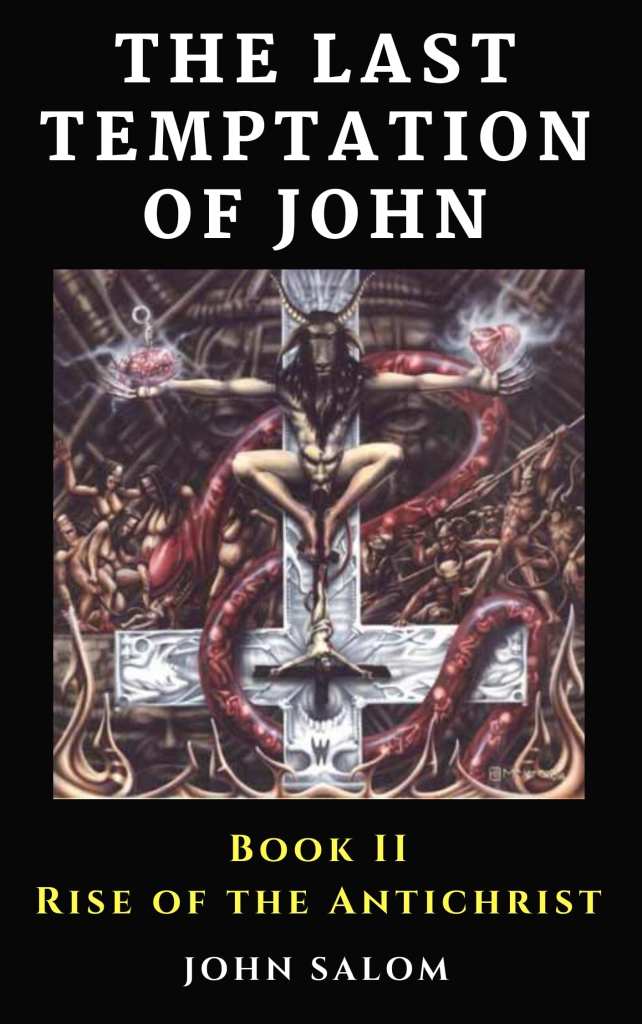
Could anyone save us from certain death? The answer is YES. Hard as it may be to believe, St. John the Apostle is still alive today – having been blessed with the Gift of Immortality so that he could survive to fight against the coming of The Antichrist. Unfortunately, over the course of the last 2,000 years John has lost is faith!

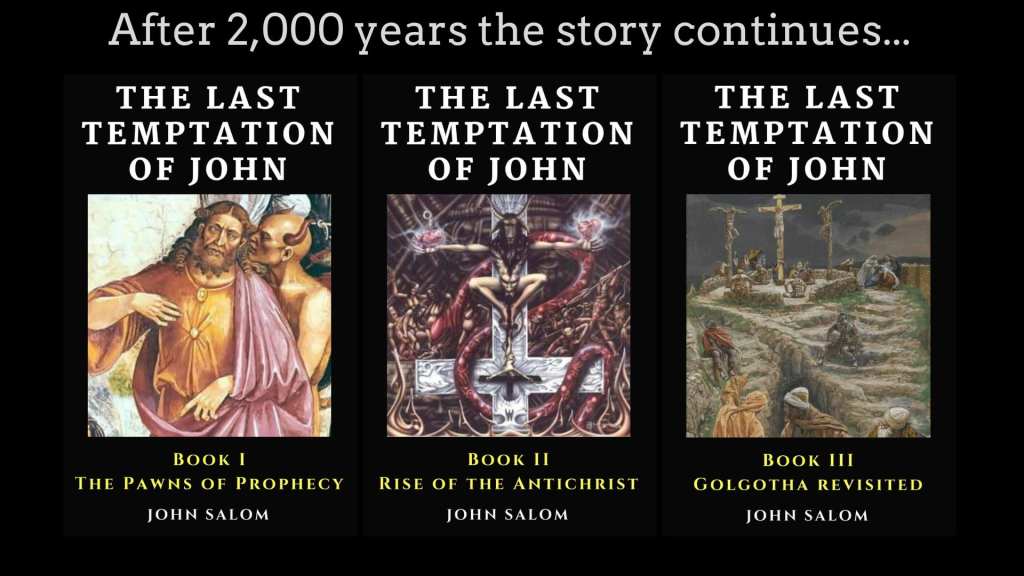
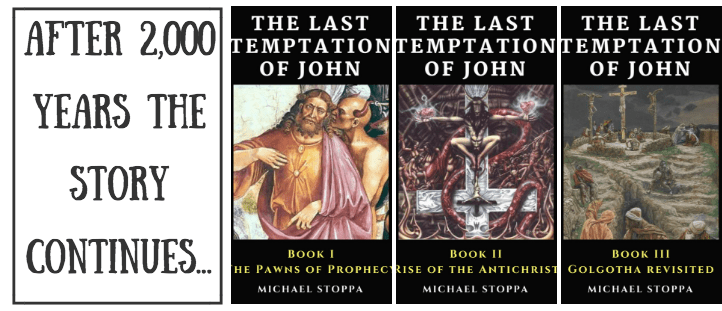
Can John recover his faith in time to stop Armageddon or will Satan’s Son achieve Ultimate Victory? The answer to that question and many more will be revealed in the thrilling new book series The Last Temptation of John.

Read the trilogy today… if your faith is strong enough.

Continue Reading…


Understanding the Apocalyptic Imagery and Symbols of The Book of Revelation

Given that the Book of Revelation is at one and the same time an apocalyptic, prophetic, and futuristic text, it should come as no surprise that the book is filled with symbols and imagery laced with alternative meaning. Church elders and scholars have debated for nearly 2,000 years about what all the signs and symbols of Revelation mean. We’ll point them out for you and give you links to learn more…

[lwptoc]

Editor’s Note: This article is part of a larger series about The Book of Revelation. This article focuses only on the imagery and symbols of Revelation. For more on the diverse characters, the meaning, verses, definitions, and other interesting tidbits about The Book of Revelation, please see Revelation – the Meaning, the Mystery, the Verses, and More…

Symbols & Imagery of Revelation

The symbols and imagery are organized with the flow of the Book of Revelation. The chapters/verses that discuss the symbols are provided for you to learn more. 

7 Churches of Asia

Revelation 1: 11

Location of the 7 Churches: Ephesus, Smyrna, Pergamum, Thyatira, Sardis, Philadelphia, Laodicea. All of these are in Asia Minor. 

A message for each church is given in Revelations Chapter 2 (Ephesus, Smyrna, Pergamum, Thyatira) and Revelation Chapter 3 (Sardis, Philadelphia, and Laodicea).


Links to learn more about The 7 Churches of Asia

Book of Life

The Book of Life is essentially the Roll Call of Heaven – if your name is written in the book, then you’ve got a ticket to ride to heaven. If not, you’re doomed to the fires of Hell. 

In Revelation, the Book of Life is referenced in the following locations:

  1. Revelation 3: 5
  2. Revelation 13: 8
  3. Revelation 17: 8
  4. Revelation 20: 12-15
  5. Revelation 21: 27

The Book of Life is not unique to Revelations. It’s also referenced in Psalm 69, in the New Testament books of Luke 10: 20, Paul’s Letter to the Philippians 4: 3, and Hebrews 12: 23. Additionally it plays a role in multiple apocryphal texts including – The Book of Jubilees, The Book of Enoch, The Second Book of Baruch, and the Ascension of Isaiah

In The Last Temptation of John, numerous references are made to The Book of Life and Mary Magdalene is the present keeper of this famous tome. The Book is the cause of great sorrow to Mary for she is repeatedly distressed to see names disappear from the book as it continues to be reduced down to the prophesied number of just 144,000 raptured souls. 

Links to learn more about The Book of Life

Throne of God

Revelations Chapter 4 brings us into the throne room of God, where the Supreme Being is attended to by 24 Elders. Also on hand are the 4 Living Creatures: a lion, an ox, an eagle, and a man. Most importantly, the Lamb of God is given the Scroll with Seven Seals in Revelations Chapter 5 – this is the scroll that will release the various catastrophes of Revelation as each of the seven seals are broken.


Revelations Throne of God – Matthias Gerung

Did you know?

The Throne of God motif is not unique to Revelation — it plays a key role in Judaism, Christianity, and Islam. Other holy books say it can be found in the Seventh Heaven and that is is also known as  is Araboth (Judaism), and al-‘Arsh (Islam).

Links to learn more about The Throne of God

7 Seals of Revelation

The 7 Seals as a group are one of the most important symbols in Revelation and they are detailed in Revelation Chapter 6, Chapter 7, and Chapter 8

A seal is a device used to keep a document shut (for example a wax seal) and the 7 seals of Revelation are just that – protective guards that keep shut portions of a secret scroll that John saw in his visions. The only person that can open the seals is Lion and the Lamb (AKA Jesus). 


As the Lamb opens each of the 7 seals a new judgement is released upon the world.

  • The first 4 seals of Revelation release the dreaded 4 Horsemen of the Apocalypse.
  • Seal 5 calls for the Wrath of God. Seal 6 releases a Day of Wrath (earthquakes, etc around the world).
  • Seal 7 triggers an entirely new set of catastrophes involving the 7 Trumpets, 7 Golden Bowls, and more. 

Did you know?

In the Last Temptation of God book trilogy, the Seals of Revelation are started to be opened as early as Book I – The Pawns of Prophecy – with devastating results for the world. 

Links to learn more about The Seven Seals of Revelation

7 Trumpets of Revelation

The 7 Trumpets are sounded after the 7th Seal is broken. The catastrophes associated with the various trumpets are described in Revelation Chapter 8, Chapter 9, and Chapter 12

Trumpets 5, 6, and 7 also signal the coming of the 3 Woes. 

Links to learn more about The Seven Trumpets of Revelation

Golden Censer

After the seven angels blow their seven trumpets in Revelation Chapter 8, an eight angel brings out a golden censer filled with fire from the heavenly altar, and throws it to the earth – unleashing peals of thunder, rumblings, flashes of lightning, and an earthquake. 


Links to learn more about The Golden Censer

The Wormwood Star

Revelations Chapter 8 tells how the star called “Wormwood” fell from the sky after the third angel blew his trumpet. The result: “a third of the waters turned bitter, and many people died from the waters that had become bitter.”

Did you know?

Wormwood is mentioned seven times in the Hebrew Bible, always with the implication of bitterness. The Hebrew term לענה (la’anah), means “curse.” 


The Cloisters Apocalypse, c 1330

Links to learn more about The Wormwood Star

The 3 Woes of Revelation

The 3 Woes are catastrophes and plagues that are triggered by the final 3 of the 7 Trumpets. They are detailed in Revelation Chapter 9 and Chapter 11. The 3rd Woe triggers the beginning of the release of the Bowls (and so the party continues!)

Links to learn more about the 3 Woes

The Mighty Angel & The Little Scroll

Revelation Chapter 10 is actually considered a kind of ‘interlude’ as the people of earth are given a slight reprieve from all the catastrophes caused by the breaking of the Seven Seals and the blowing of the Seven Trumpets. During this break in the action, John of Patmos is given the little scroll by the mighty angel – as instructed, John eats the ‘bitter’ scroll. This will become a source from which he can prophesy what he knows to all peoples and all nations. 


Johannes verschlingt das Buch “Might Angel and Little Scroll” c 1530

Did you know?

In the Last Temptation of John books, this scroll is referred to as The Scroll of the Illuminated Angels. Although tiny in size, it promises to play a major role in helping to defeat the Antichrist. 

Links to learn more about The Mighty Angel and the Little Scroll

7 Bowls of Revelation

After the Seven Spiritual Figures of Revelation are discussed in chapters 15, humanity is again forced to endure more plagues – this time with the Seven Bowls. Revelation Chapter 16 describes what happens when the 7 Angels of Revelation pour out the contents of their 7 Bowls. The basic gist is that each bowl contains a Wrath of God. 

Links to learn more about the Seven Bowls of Revelation

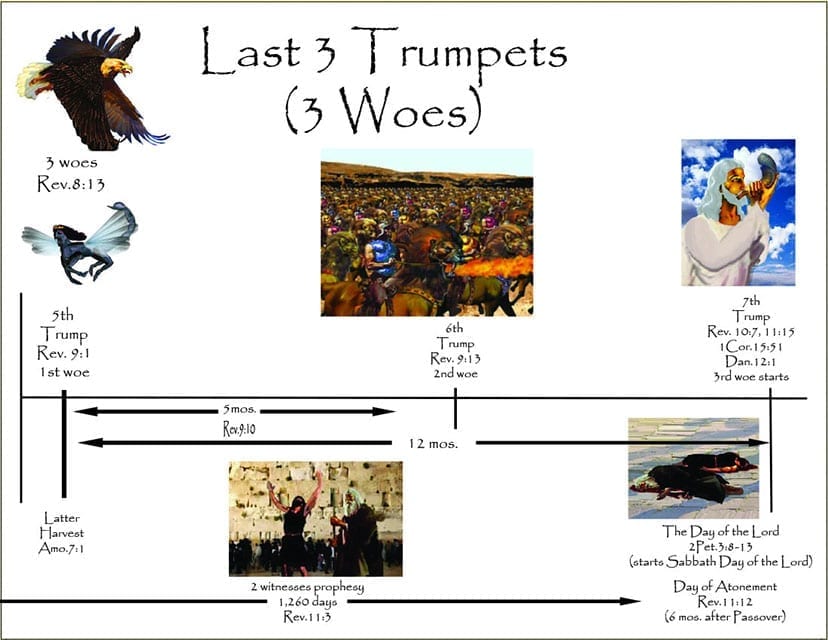
How do the 7 Seals, 7 Trumpets, 7 Bowls, and 3 Woes relate to one another?

Here’s a handy chart that puts it all together for you along with a timeline of events….


I would love to credit the source of the chart but it’s unclear who this is so if anyone knows please contact me so I can update. 

See the action unfold as each of the Seven Seals are broken in The Last Temptation of John’s final book – Golgotha Revisited. The Seven Angels, their seals, woes, and trumpets are part of the exciting climax of the entire trilogy. Read it today

The New Jerusalem, New Heaven, and New Earth

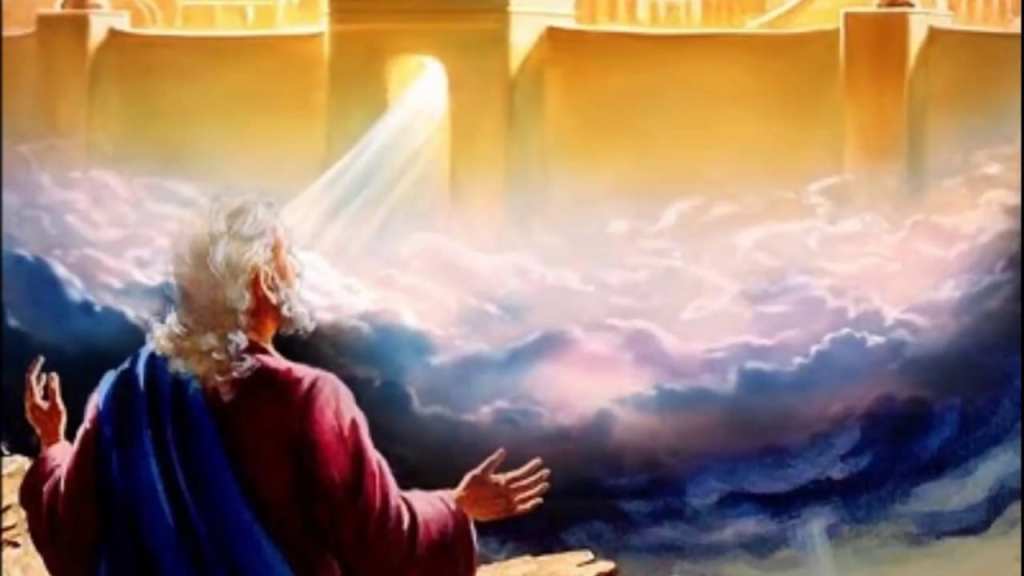
Although there is a brief reference to the New Jerusalem in Revelation 3: 12, it is Revelation Chapter 21 that details how the New Heaven and Earth will replace the old, and tells how God will come to dwell with humanity in the New Jerusalem.


“The New Jerusalem” c1900 Giclee

The importance of Chapter 21 as the key message of hope in Revelation cannot be over-estimated – the emergence of the New Jerusalem is the climax of the entire book. 

Links to learn more about The New Jerusalem

River of Life and Tree of Life

Revelation Chapter 22, the final chapter of the book, depicts the restoration of Eden – which includes the rebirth of the River of Life and the Tree of Life. All nations and peoples are healed and the curse of sin is destroyed forever. 


“Christ Enthroned Over the River of Life” c 1220

Links to learn more about The River of Life

Links to learn more about the Tree of Life

You May Also Like


Is the AntiChrist Coming in Our Time?

What if the events detailed in The Book of Revelation were about to occur… this year?

Could anyone save us from certain death? The answer is YES. Hard as it may be to believe, St. John the Apostle is still alive today – having been blessed with the Gift of Immortality so that he could survive to fight against the coming of The Antichrist. Unfortunately, over the course of the last 2,000 years John has lost is faith!

Can John recover his faith in time to stop Armageddon or will Satan’s Son achieve Ultimate Victory? The answer to that question and many more will be revealed in the thrilling new book series The Last Temptation of John.

Read it the trilogy today… if your faith is strong enough.


13 Most Famous Verses of Revelation

Verses of Revelation – No study of the Book of Revelation would be complete without diving into the most famous verses from the text. We have another article about the Book of Revelations in a broader sense (discussing the meaning, the key symbols and characters, and even the debate over who really wrote the book), but here the focus is on the actual verses from this legendary book.

Here then are the 13 Most Popular Verses of The Book of Revelation… 

Editor’s Note: The choice of which specific verses are considered the ‘most famous’ was decided by a review of search engine traffic volume as well as cross-references to other respected sites on this topic. Obviously not everyone may agree on the selection of these verses and if YOU have a different verse you’d like to recommend please let us know in the comments. 

Revelation 1: 1-2

Revelation 1: 1-2

“This book is the record of the events that Jesus Christ revealed. God gave him this revelation in order to show to his servants what must happen very soon. Christ made these things known to his servant John by sending his angel to him, and John has told all that he has seen.” 

Gustav Dore’s “John of Patmos”

Revelation 1: 8

Revelation 1: 8 

“I am Alpha and Omega, the beginning and the ending, saith the Lord, which is, and which was, and which is to come, the Almighty.”


Revelation 3: 20

Revelation 3: 20

“Here I am! I stand at the door and knock. If anyone hears my voice and opens the door, I will come in and eat with that person, and they with me.”

“Christ at the Door Knocking” by William Holman Hunt c 1853

Revelation 6: 8

Revelation 6: 8

“I looked, and there before me was a pale horse! Its rider was named Death, and Hades was following close behind him. They were given power over a fourth of the earth to kill by sword, famine and plague, and by the wild beasts of the earth.”

Gustav Dore’s Pale Rider

Revelation 6: 12

Revelation 6: 12

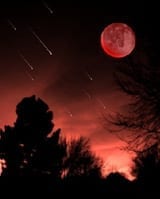
“I watched as he opened the sixth seal. There was a great earthquake. The sun turned black like sackcloth made of goat hair, the whole moon turned blood red…”


Revelation 7: 9

Revelation 7: 9

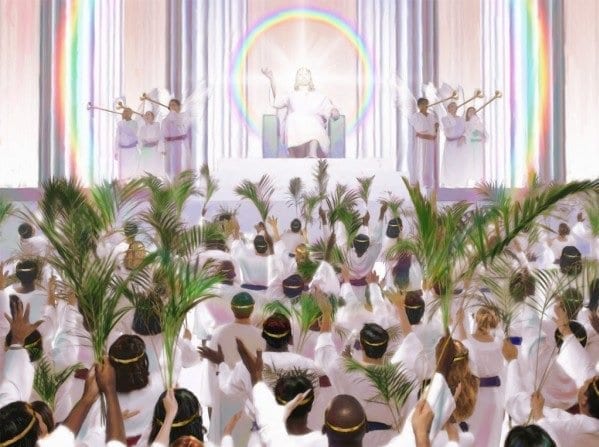
“After this I looked, and there before me was a great multitude that no one could count, from every nation, tribe, people and language, standing before the throne and before the Lamb. They were wearing white robes and were holding palm branches in their hands.”


Revelation 9: 11

Revelation 9: 11

“They had as king over them the angel of the Abyss, whose name in Hebrew is Abaddon and in Greek is Apollyon (that is, Destroyer).”

John Bunyan’s “Christian vs Abaddon” c 1850

Revelation 12: 7-9

Revelations 12: 7-9

“Then war broke out in heaven. Michael and his angels fought against the dragon, and the dragon and his angels fought back. But he was not strong enough, and they lost their place in heaven. The great dragon was hurled down—that ancient serpent called the devil, or Satan, who leads the whole world astray. He was hurled to the earth, and his angels with him.”

Luca Giordano’s “The Fall of the Rebel Angels”

Revelation 13: 1-2

Revelation 13: 1-2

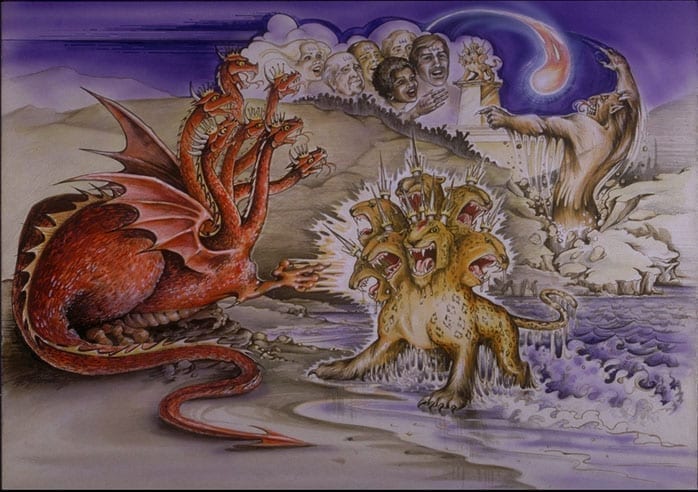
“The dragon stood on the shore of the sea. And I saw a beast coming out of the sea. It had ten horns and seven heads, with ten crowns on its horns, and on each head a blasphemous name. The beast I saw resembled a leopard, but had feet like those of a bear and a mouth like that of a lion. The dragon gave the beast his power and his throne and great authority.”


Revelation 13: 16-18

Revelation 13: 16-18 

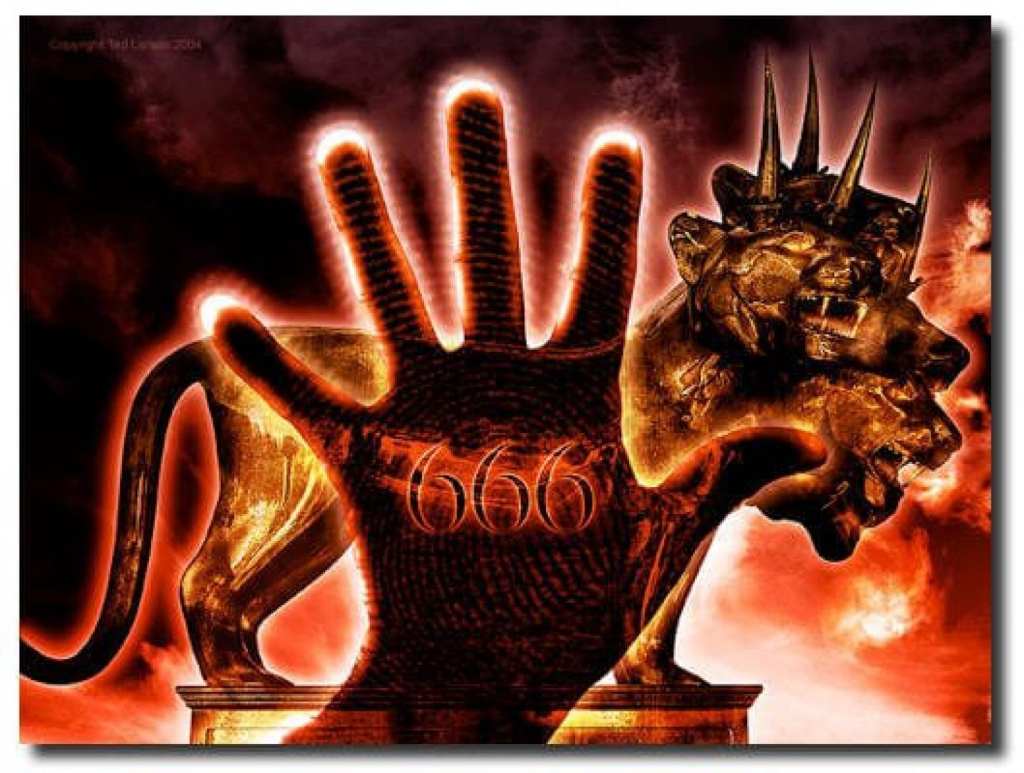
“It also forced all people, great and small, rich and poor, free and slave, to receive a mark on their right hands or on their foreheads, so that they could not buy or sell unless they had the mark, which is the name of the beast or the number of its name. This calls for wisdom. Let the person who has insight calculate the number of the beast, for it is the number of a man. That number is 666.” 


Revelation 14: 1

Revelation 14: 1

“Then I looked, and there before me was the Lamb, standing on Mount Zion, and with him 144,000 who had his name and his Father’s name written on their foreheads.”


Revelation 20: 12-15

Revelation 20: 12-15

“And I saw the dead, great and small, standing before the throne, and books were opened. Another book was opened, which is the Book of Life. The dead were judged according to what they had done as recorded in the books. The sea gave up the dead that were in it, and death and Hades gave up the dead that were in them, and each person was judged according to what they had done. Then death and Hades were thrown into the lake of fire. The lake of fire is the second death. Anyone whose name was not found written in the Book of Life was thrown into the lake of fire.”


Revelation 21: 1-4

Revelation 21: 1-4 

“Then I saw a new heaven and a new earth, for the first heaven and the first earth had passed away, and there was no longer any sea. I saw the Holy City, the new Jerusalem, coming down out of heaven from God, prepared as a bride beautifully dressed for her husband. And I heard a loud voice from the throne saying, ‘Look! God’s dwelling place is now among the people, and he will dwell with them. They will be his people, and God himself will be with them and be their God. He will wipe every tear from their eyes. There will be no more death, or mourning or crying or pain, for the old order of things has passed away’.”


You May Also Like


The AntiChrist is Here – Today?

What if the events detailed in The Book of Revelation were about to occur… this year?

Could anyone save us from certain death? The answer is YES. Hard as it may be to believe, St. John the Apostle is still alive today – having been blessed with the Gift of Immortality so that he could survive to fight against the coming of The Antichrist. Unfortunately, over the course of the last 2,000 years John has lost is faith!

Can John recover his faith in time to stop Armageddon or will Satan’s Son achieve Ultimate Victory? The answer to that question and many more will be revealed in the thrilling new book series The Last TeLastTemptationofJohn-Bk1mptation of John.

Read it the trilogy today… if your faith is strong enough.


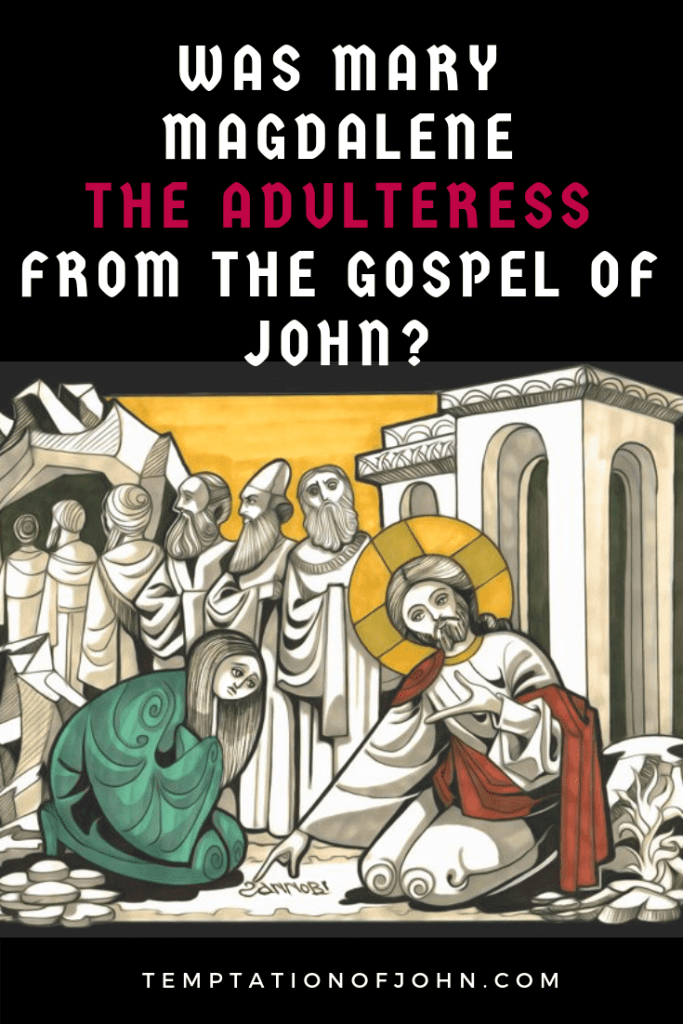
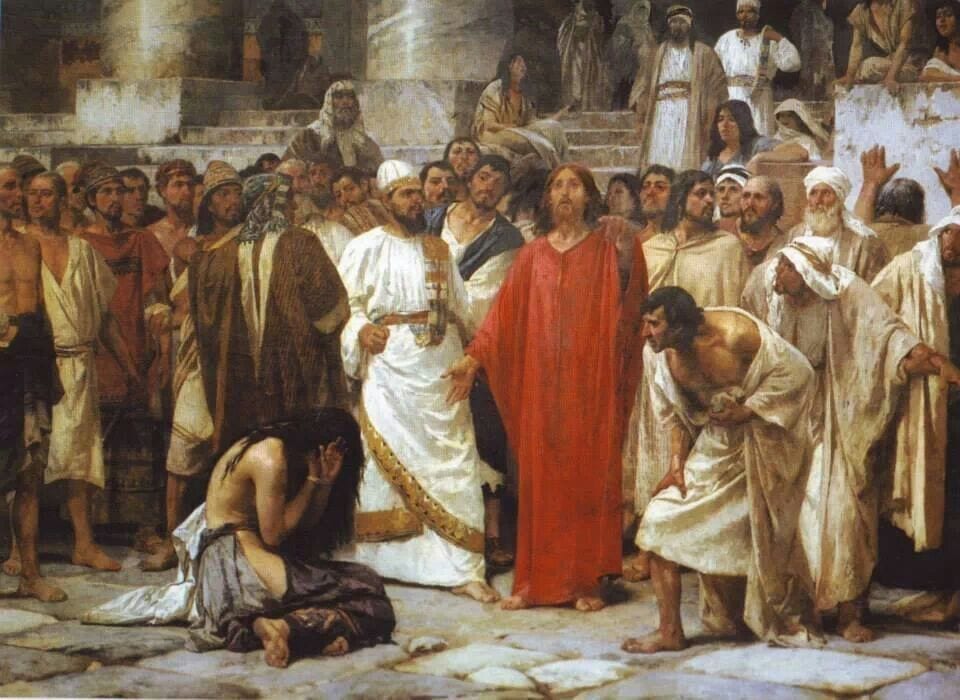
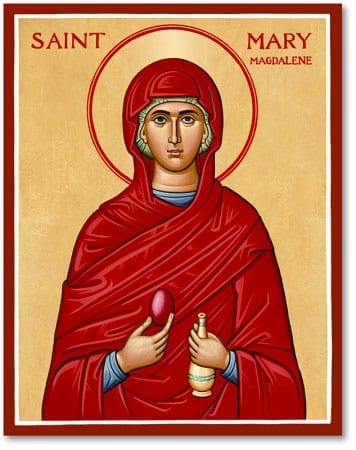
Was Mary Magdalene the Adulteress from The Gospel of John?

Was Mary Magdalene the Adulteress from The Gospel of John? Many Christians have been brought up believing that famous Adulteress from the Gospel of John was in fact Mary Magdalene and for nearly 1,300 years this is what was formally taught in Catholic doctrine – but is this legend even true?

In this article, we’ll explore the connection between the woman caught in adultery from John’s Gospel and the disciple Mary Magdalene from the Bible. 

Editor’s Note: This article is part of a larger article about Mary Magdalene titled “Mary Magdalene – Saint, Sinner, or Something More?”

Why Do People Believe Mary Magdalene is the Woman Caught in Adultery?

The notion that the adulteress was Mary Magdalene traces back to (at least) the early 6th century when Pope Gregory I officially proclaimed her to be the adulteress from John 8.

In order to make the association stick, Pope Gregory also had to connect the dots by proclaiming that Mary Magdalene was in fact also Mary of Bethany – the sister of Martha and Lazarus. This was necessary because Mary of Bethany was the proclaimed to be the woman with the sinful past who washed Jesus’ feet with her tears and/or anointed him with the alabaster jar of perfume in various gospels).

Why all the Mary’s?

The reason Mary of Bethany had to be the woman who anointed Jesus in order to trace her back to Mary Magdalene is a bit of a circuitous route. The apparent basis for Pope Gregory’s decision relates to Luke 8:2 where Mary Magdalene is specifically named as having been cured of “7 demons” by Christ. One or more of these ‘demons’ was thought to relate to a sinful ‘sexual’ past and from there it was apparently just a hop, skip, and a jump for Pope Gregory to connect the dots from Mary Magdalene, to Mary of Bethany, to the woman who anointed Jesus, to the Adulteress of John.

Well that makes perfect sense, right? Not!

Is there ANY Evidence that Supports Mary Magdalene is the Adulteress?

Besides the ‘sexual demon’ theory, there are some who claim that Mary’s place of birth was the best ‘evidence’ of all.

To wit: Mary Magdalene also means Mary of Magdala. This is important because Magdala, located along the Sea of Galilee near Tiberias, was a prosperous port city during the time of Christ. And what do we know about nearly all ‘port cities’ the world over? They are a haven for prostitutes.

It’s reported that Rome eventually destroyed Magdala “because of its moral depravity and its participation in the Jewish revolt.”

Additionally, the Jewish Talmud word Magdalene may be translated to “curling women’s hair,” which apparently is code word for “adulteress.”

Thus more ammunition to support Pope Gregory’s claims that Mary Magdalene was a woman of ill-repute and that she was committed to Christ for saving her from her unsavory past. 

So Was Mary Magdalene the Adulteress?

Honestly we may never really know, however it’s worth digging a bit deeper into Pope Gregory’s decision.

Clearly we can conclude that Mary Magdalene was definitively the “Mary” of Luke 8 – after all she was specifically named by her full name in this verse. However one is left to wonder why the mention of her past demons and her place of birth must also necessarily mean that she was the adulteress, or Mary the sister of Martha, or the penitent woman with the perfume.

Consider the following…
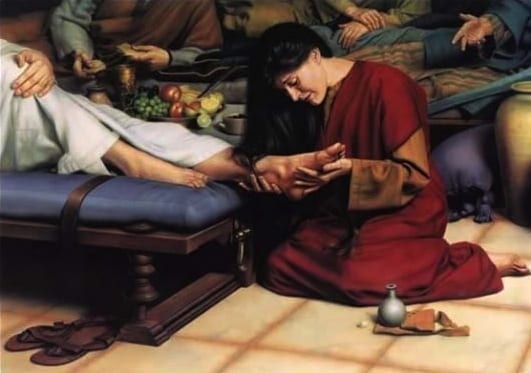
  • Mary was one of the most common names among the people of this time in Israel (even Jesus’ mother was named Mary), so just because a “Mary” is mentioned in the Bible that doesn’t mean it must be Mary Magdalene, right?
  • In every other Biblical story that references Mary Magdalene, she is called by her full name at some point in the story. Why would she not be identified by name in the story about the adulteress or if Mary Magdalene was also Mary of Bethany? 

We may never know why Pope Gregory made this decision (although our discussion of Conspiracy Theories about Mary Magdalene is of interest here), however it should be noted that while the Catholic Church held this view from the 6th century onward, it was officially reversed in 1969 by Pope Paul VI (although without much fanfare). As it stands now, the Church no longer associates Mary Magdalene with Mary of Bethany or the Adulteress. And as an interesting side note, the Eastern Orthodox Church apparently never did. 


What’s the Truth about Mary Magdalene in the Bible?

In spite of her past demons and her place of birth the fact is that there is no concrete evidence that Mary Magdalene is the famous adulteress from the Gospel of John 8:3-11.

The name of the adulteress in these verses is actually not given so we have no way of knowing who the woman was.

The Adulteress could have been Mary Magdalene…or pretty much any other woman alive at the time who lived there.

Additional References

Learn more about the debate with these links:

  1. Catholic Straight Answers: Who was Mary Magdalene?
  2. Wikipedia: Mary Magdalene Bio
  3. Wakeup.Org: Mystery of Mary Magdalene
  4. Bible Odyssey: Mary Magdalene 
  5. Bible Archaeology: Was Mary Magdalene a Prostitute? 
  6. Smithsonian: Who was Mary Magdalene? 
  7. The Bible Means: Where in the Bible is Mary Magdalene a Prostitute?

What do YOU Believe?

Do you have an opinion or theory on this topic? Let us know what you believe about Mary Magdalene and the Adulteress. 

You May Also Like


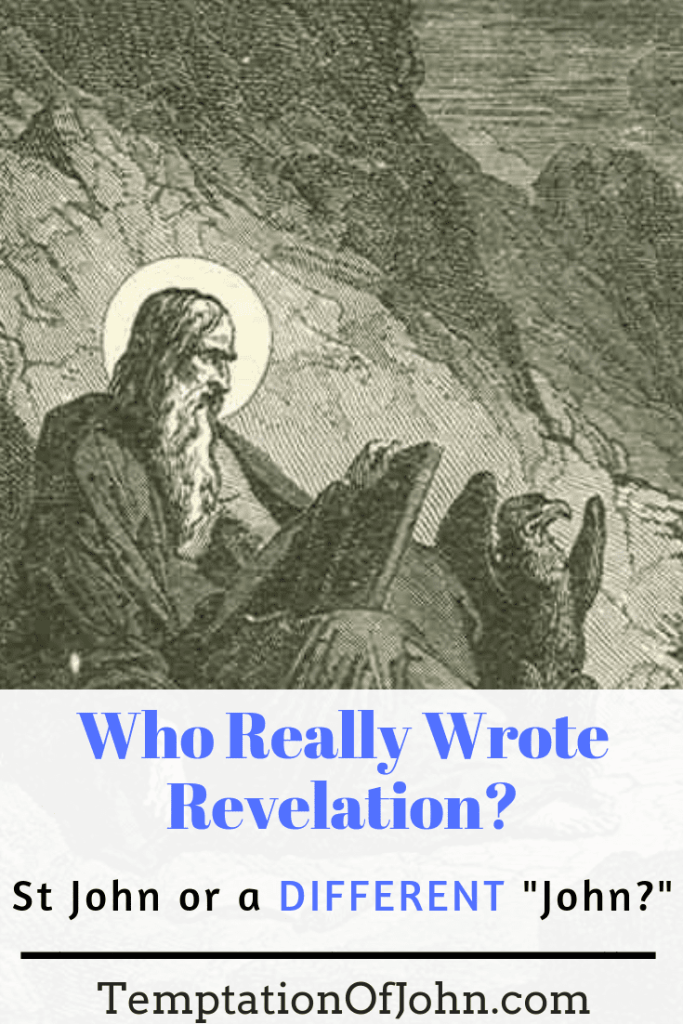
Who Wrote The Book of Revelation? Apostle John or a DIFFERENT John?

Who wrote the Book of Revelation? Did the Apostle John really Revelation? The answer is not as easy as it seems. In this article we’ll explore the arguments in favor of St John being the author and also talk about why some experts believe there was “another John” behind this famous book. I’ll also give you my opinion on this age-old question which has now plagued Christians for nearly 2,000 years. 

1. Who was John of Patmos?

John of Patmos” is the self-identified author in the text of The Book of Revelation.

While it’s helpful that the author named himself for us, the problem we face has always been – WHO exactly was John of Patmos? Was he St John the Apostle or was he perhaps a lesser known “John?”

Let’s explore…
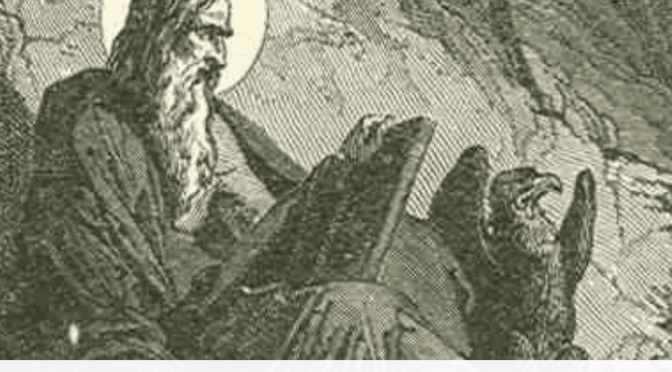
Gustav Dore’s “John of Patmos”

2. Who Wrote the Book of Revelation – What Most People Believe

The mainstream view is that John of Patmos is in fact John the Apostle.

Apostle John was also known as St John the Immortal, John the Beloved, John of Zebedee, John the Revelator, John the Divine, and John the Theologian. Given that he was a man of many names, it’s possible that Saint John was also known as John of Patmos too. 

What Books did St John write?

In addition to being credited with The Book of Revelation, Apostle John is also commonly held by many to be the author of The Gospel of John, the Epistles of John, and possibly the apocryphal text called The Gospel of the Secret Supper (a text long lost to history but which can now be read in The Gnostic Bible).

When is St John believed to have written The Book of Revelation?

The theory is that the apostle was evangelizing in Rome and was exiled to the island of Patmos by the Roman Emperor Domitian in 95 AD as punishment because John was perceived as a threat to Roman rule. Recall that during Domitian’s rule Rome didn’t look kindly on Christians and banished a number of alleged practitioners of  ‘magic and prophecy.’

Under this theory then John is said to have received visions while on Patmos and that he wrote the Book of Revelation during these later years of his life.

HOWEVER, not everyone agrees that Saint John is the true author of The Book of Revelation…

3. Is there “another John” who could be the real author of Revelation?

Despite the mainstream view that John the Apostle wrote Revelation, many modern scholars do not believe this to be true. Perhaps the most famous in our times is Bart Ehrman.  There were also numerous early church elders (among them the famed Eusebius) who believed the author of Revelation was a “different John.”

Who were these other Johns?

Speculation as to who the real John of Patmos was has raged over the centuries. Various other Johns have been put forward as being the author of Revelation. These include:

Why don’t some people believe St. John wrote The Book of Revelation?

The main reasons some early church fathers as well as modern experts don’t buy in to St. John being the author of Revelation has to do with the argument that St. John was NOT (in their view) John of Patmos. Belief in this ‘two-John’ theory has to do with the vast differences between the other texts that St John is  alleged to have written compared to the Book of Revelation. These differences can be summarized as follows: 

  • The author of Revelation specifically identifies himself (i.e. as John of Patmos), while whoever wrote the Gospel of John and the Epistles of John does not specifically identify himself (although St John is held to be the author in most mainstream circles). 
  • There are noted differences in language – the original Greek used in the Gospels and Letters of John is more ‘elegant’ and mistake-free while in Revelations it is more crude. (For more on this, read this book on the topic). 
  • The theological outlook of the books are clearly different. To wit: the Gospel of John focuses on establishing Jesus as the Messiah and professes that whoever believes in him will have eternal life. More importantly the Gospel of John is NOT an apocalyptic text and there is little to no discussion of a soon-to-approach end of the age. The Book of Revelation is the very epitome of an apocalyptic text and its primary purpose is to discuss the soon-to-occur End Times. 

But there’s yet another problem with The Johns…

We don’t know much about John the Evangelist, John the Presbyter, and John the Elder – in fact, it’s possible that these monikers were actually alternate names for the Apostle John. If so, then this could mean that the apostle actually DID write Revelation. After all, being that St John was known by so many names, it’s highly possible he was John of Patmos too. 

4. But did Saint John even write The Gospel of John?

Pondering this question will take  you further down the John Rabbit Hole…

Did you know that not all scholars believe that John the Apostle even wrote the Gospel of John?

The biggest reasons for this trace all the way back to John’s roots. Let’s recall that the apostle John was.  According to the Bible, Saint John was…

  • John of Zebedee, the brother of James, AKA James the Greater).
  • John and his brother were both some of the first disciples Jesus recruited during the early days of his ministry.
  • While John and James went on to become prominent figures in Jesus’ evangelical mission (both during his life and after), they were also both allegedly poor fisherman from Galilee who likely not even literate.
  • The language they spoke was Aramaic, but The Gospel of John and the Epistles were all originally written (as far as we know) in Greek – with a highly literate style.

How did an illiterate, Aramaic speaking fisherman from Galilee write in a high form of Greek?

While it’s certainly possible that John learned a new language during his own evangelical missions as he allegedly traveled outside Palestine on his way to Rome, and while it’s possible that he also learned to read and write, some wonder if he would have been able to develop this writing skills to the level displayed in the Gospel and Letters.

HOWEVER – what’s interesting about this knock on John is that this argument (i.e. that basically St John wasn’t educated enough to use the writing style of the Gospel and the Epistles) actually supports St John being the author of Revelation!

Remember, the writing style of the Greek used by John of Patmos in Revelation is said to be riddled with errors and ‘of a cruder nature.’ Isn’t this exactly as one might suspect of say a fisherman who learned Greek later in life?!?

And so the rabbit hole just got deeper, eh?

5. What do I personally believe about who wrote Revelation?

Personally I choose to believe that St John the Apostle actually wrote everything attributed to him – i.e. The Gospel of John, the Epistles of John, AND The Book of Revelations. This means that I therefore also believe that Saint John the Apostle was indeed John of Patmos.

But how do I reconcile the differences in style between the books and that St John was allegedly illiterate?

Just because someone doesn’t know how to read or write early in life doesn’t mean they can’t learn later, right? And isn’t is possible that if John traveled through Greek-speaking lands that he learned to read, speak, and write that language over the years?

Perhaps most importantly of all, I’m willing to ascribe to the theory that God is more than capable of inspiring St John with whatever literary skills he needed to pen these books.

I also think it makes for a better story.

So either way, Saint John wins in my book!. 🙂

What’s YOUR Take?

Who do YOU believe really wrote Revelations?

You May Also Like…


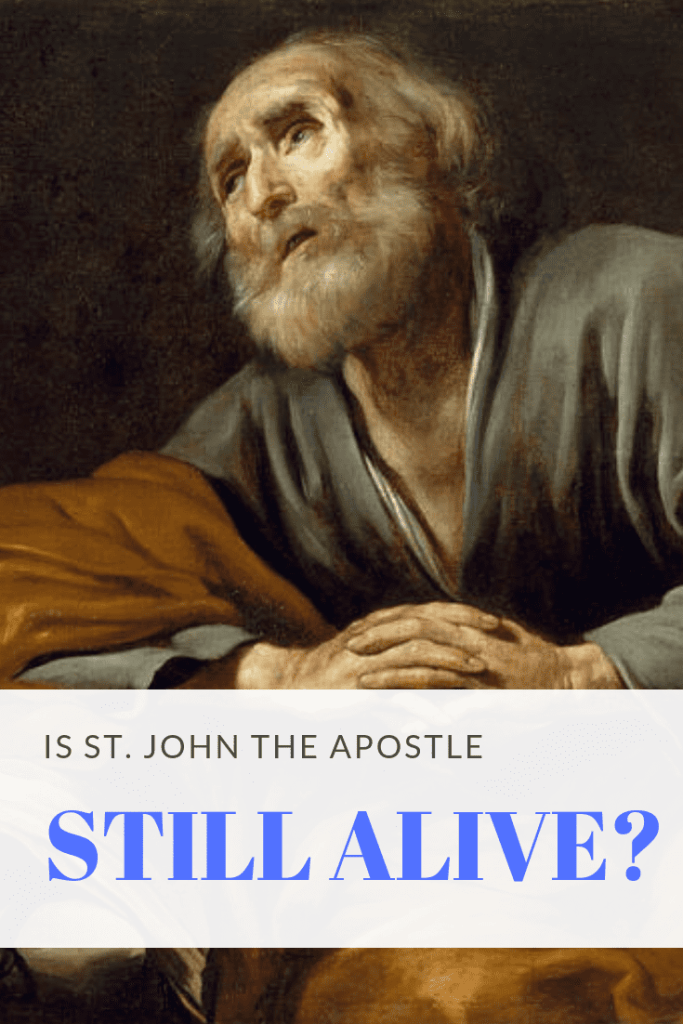
Is St. John Still Alive?

Is St. John Still Alive? It’s a question that’s been asked by Christians for nearly 2,000 years.

In this article, we’ll examine what caused this legend to start, talk about the evidence that supports it, discuss the possibility that John is immortal (and why), and also talk about how Saint John died (assuming he did) and where John’s tomb is. Finally, (for those that think John is still alive) we’ll also talk about what his mission may be.

Did Saint John die? That, my friends is the question. Now let’s get some answers!

1. Who was John of Salome?

John, the younger brother of James, son of Zebedee and Salome, was a fishermen in Galilee during the time of Jesus Christ’s missionary work. Together with his brother, John was one of the first persons called by Jesus to join his group of disciples. John and his brother went on to become part of Jesus’s inner circle, were named as two of the legendary Twelve Apostles, and after Jesus’s death and resurrection, John, James, and others went on to change the world by creating and spreading the new faith of Christianity.

As for John himself, he is credited with writing The Gospel of John, the two Epistles of John, and the Book of Revelation that are all part of the accepted canon of The Bible we have today. His writing and evangelical work throughout Palestine and Rome caused untold numbers to convert to Christianity and the fruits of his labors are beyond measure.

Always close to Jesus, John is often pictured near Christ in classic art and in The Bible he is repeatedly mentioned as one of the three apostles (along with his brother James and Peter) who were the closest associates of Jesus. Because of his favoritism by Jesus, John was known as John the Beloved.

In fact, John became so famous in Christian lore that he picked up a slew of other monikers over the years. He and his brother James were called Boangeres which translated to ‘sons of thunder’ because of their alleged quick tempers. John himself was also known by many other names including: John of Zebedee, John the Revelator, John the Divine, and John the Theologian. It’s possible he was also the same person as the Christian writers known as John the Evangelist, John the Presbyter, and John the ElderAs the accepted author of Revelation, he is also presumed to be John of Patmos. And, as is most relevant to this article, he was (is?) sometimes called Saint John the Immortal.

“Saint” John

For all his efforts, John of Salome was one of the first ‘saints’ of the Christian Faith. Because he was made a saint during the early days of the religion (pre-congregation) we don’t have records that tell us the day he was made a saint, however we do know his Feast Days.

For Catholics and Western Christians, the Feast of St John is December 27. For Eastern Orthodox Christians, he is celebrated on September 26.

2. Why Do People Believe John Didn’t Die?

Saint John – the ‘beloved’ apostle of Jesus who was allegedly responsible for writing multiple books of the Bible and instrumental in helping to get the Christian Religion started.

You mean the guy that lived over 2,000 years  ago? You want me to believe he is still alive today?

Actually – YES.

And before you say preposterous, I would respectfully ask that you at least consider the EVIDENCE in favor of this claim.

3. Evidence from Christian Literature Supporting St. John’s Immortality

I. Gospel of John

Perhaps the most respected evidence that supports the possibility that Apostle John may still be alive today comes to us from the Gospel of John.

Here the author himself wrote about his potential immortality in John, Chapter 21: 21-23.

In this scene, Peter is talking to Jesus after his resurrection and John is following them at a distance. Jesus has just told Peter about the latter’s manner of death. Peter then asks how John will die. To which Jesus responds…

“If I want John to remain alive until I return, what is that to you? You must follow me.”

John 21:21-23 was such a powerful case for the immortality of John that allegedly even the other apostles and Jesus’ disciples at that time believed St. John would not die and that instead John would remain alive until Jesus’ Second Coming.

II. Book of The Mormon

Further evidence about the possibility that St. John is still alive comes from the Book of Mormon, Chapter 28: 4-7.

(Editor’s Note: I am not a Mormon nor am I here to debate the worthiness of the Mormon religion, I’m simply giving you applicable verbiage that relates to the subject at hand – AKA that St John may still be alive today. You can make your own decisions).

With an open mind, consider these verses in which Jesus is speaking directly to the other disciples about John…

“…Blessed is John, for he shall never taste of death; but he shall live to behold all the doings of the Father unto the children of men, even until all things shall be fulfilled according to the will of the Father, when I shall come in my glory with the powers of heaven. And he shall never endure the pains of death; but when I shall come in my glory he shall be changed in the twinkling of an eye from mortality to immortality; and then shall he be blessed in the kingdom of my Father.”

III. Doctrine and Covenants

Additional evidence that Apostle John is still alive comes from another Mormon text — the Doctrine and Covenants, Section 7: 1-3.

Once more it’s a scene in which Jesus is talking to Peter and John and we get more verbiage from Jesus himself that he wants John to remain alive until he returns.

Consider for yourself this alleged conversation between Jesus and his beloved apostle John which is clearly an expansion of the text from the Gospel of John: 21-23. As with John’s Gospel, the scene is told from the point of view of the author which is again St. John himself…

“And the Lord said unto me: John, my beloved, what desirest thou? For if you shall ask what you will, it shall be granted unto you.”

And I said unto him: “Lord, give unto me power over death, that I may live and bring souls unto thee.”

And the Lord said unto me: “Verily, verily, I say unto thee, because thou desirest this thou shalt tarry until I come in my glory, and shalt prophesy before nations, kindreds, tongues and people.”

And for this cause the Lord also said unto Peter: “If I will that he tarry till I come again, what is that to thee? For he desired of me that he might bring souls unto me, but thou desiredst that thou mightest speedily come unto me in my kingdom. I say unto thee, Peter, this was a good desire; but my beloved John has desired that he might do more, or a greater work yet among men than what he has before done. Yea, he has undertaken a greater work; therefore I will make him as flaming fire and a ministering angel; he shall minister for those who shall be heirs of salvation who dwell on the earth…”

IV. Gospel of the Secret Supper

The Gospel of the Secret Supper, AKA John’s Interrogation, is a Cathar text.

John’s Gospel of The Secret Supper, which is filled with blockbuster revelations about numerous topics and it is so salacious that , I’ll leave it to you to discover one on your own.

You can get a copy of The Gospel of The Secret Supper in The Gnostic Bible. The Gospel of the Secret Supper is located in Section Seven – Cathar Literature.

Beyond just John’s apocryphal text, the Gnostic Bible is a massive, 800-page book that includes gnostic texts such as the Gospel of Thomas, the Gospel of Judas, and the highly heretical Reality of the Rulers that attempts to turn the story of Genesis upside down. If you decide to buy it – you’ve been warned.

4. Why is Apostle John Still Alive? Are there other immortals too?

I’ve been pondering the question of John’s immortality for years. Asking questions such as…

  • If Jesus made the Apostle John immortal what is John doing now?
  • How would John feel about being stuck on this world for over 2,000 years?
  • Why did Jesus want John to remain alive until the Second Coming? What is John’s secret mission?
  • Are there other people who Jesus made immortal too?
  • If Jesus raised Lazarus from the dead, how did Lazarus die again?
  • Whatever happened to Mary Magdalene? Is she immortal too?

The more I explored these questions, the more convinced I became enamored by the idea that not only was St. John alive but that maybe Lazarus and Mary were too. I became so inspired by the possibility of it all that I wrote a FICTIONAL “What If?” story about it.

So what would John’s story be if he was alive today?

Let’s find out…


The Last Temptation of John – Book Summary

The Antichrist has come.
What if the events detailed in The Book of Revelations were about to occur… this year?

Could anyone save us from certain death? The answer is YES. Hard as it may be to believe, St. John the Apostle is still alive today – having been blessed with the Gift of Immortality so that he could survive to fight against the coming of The Antichrist. Unfortunately, over the course of the last 2,000 years John has lost is faith!

Can John recover his faith in time to stop Armageddon or will Satan’s Son achieve Ultimate Victory? The answer to that question and many more will be revealed in the thrilling new book series The Last Temptation of John.

Read the trilogy today… if your faith is strong enough. If nothing else, assuming you have a sense of humor, it’s good for a few laughs. 🙂

5. How did Apostle John Die?

Well obviously if the events detailed in my book The Last Temptation of John are true (and the Antichrist has risen) then we’re hoping St. Johh did NOT die, right? After all, if the horrific events detailed in John’s Book of Revelation are about to occur today then we need St. John and his fellow immortals to fight on our behalf!

And if nothing else, the possibility that Apostle John is still alive today makes for an interesting subject for a book, neh?  🙂

But for those of you who don’t buy St. John’s immortality and you believed he died and is buried, then perhaps you’ll enjoy this…

The inscription on his tomb where Saint John is (allegedly) buried…

Then again, how do we know if John is actually inside? 🙂

6. Links to Learn More

I’m certainly not the only person to write about the possibility that Apostle John may still be alive today. Here are various references to learn more about the topic – some present arguments in favor of John being immortal, others argue against it. I’ll leave to YOU to decide for yourself.

  1. Brittanica.com – Bio of St John’s Life
  2. Christian Forums – Is St John Still Alive?
  3. Wikipedia: St John the Apostle
  4. All Power to the Lamb: Is John the Apostle Dead?
  5. Christianity Stack Exchange: What is the basis of the Mormon belief that St John is still alive?
  6. Tradition in Action: Is St John still alive?
  7. Above Top Secret: Is St John immortal?
  8. BibleStudy.org: How did St John Die?
  9. Community Logos: Why do people believe St John is still alive?
  10. Mormon Research Ministry: Is St John a surviving apostle and still alive today?
  11. Gospel Secrets Unveiled: Could St John be one of two apostles still alive today?

You May Also Like


Who is The Antichrist?

The Antichrist Cometh

It’s a question that goes back over 2,000 years – Who is The Antichrist? In this article, we’ll explore the topic by delving into the Book of Revelation to first gain a better understanding of the history of the Antichirst from a Christian perspective. After that we’ll discuss the potential candidates for Satan’s Son – both past and present.

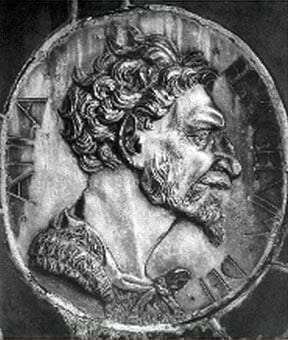
Possible Antichrist’s include infamous villains of history like Nero, Attila the Hun, Archbishop Arnulf of Rheims, Adam Weishaupt of the Illuminati, and Adolf Hitler, while current candidates include the The Pope, the man behind the Covid-19 plandemic Dr. Anthony Fauci, the anti-American globalist and former US President Hussein Barack Obama, the public face of the Great Reset Klaus Schwab, and even the self-beloved technocrat turned pseudo-philanthropist Bill Gates.

Is The Beast is in our world today? Are the End Times near? Will the chosen few really be taken up to the heavens while the rest are “Left Behind?” Come with us as we explore the mystery of The Antichrist. 


Revelations 13:15

“Here is wisdom: let him that hath understanding count  the number of The  Beast: for it is the number of a man and his number is 6-6-6…” 


Brief History of The Antichrist

To understand about The ANTIchrist, we must first understand the mystery of “The Christ.” 

From the Greek word “Christos,” Christ is a Christian word that means “Savior” or “Redeemer” and many Christians (myself included) believe that Jesus of Nazareth is the Savior of the World who will lead his people to an everlasting life.

It should be noted that Christians didn’t come up with the idea of The Christ in a vacuum – since Jesus was in fact a Jew and it was the Jewish people’s concept of a “Messiah” who would save the Israelite people from and liberate from their struggles.

Unfortunately for Jesus from a Jewish perspective, his people didn’t buy into him as the Jewish Messiah and I’m sure you know how the story unfolds from there – his Crucifixion, his Death, and (as Christians believe) his Resurrection.

Understanding the history of Jesus as The Christ is important because one of Jesus’ last promises to his Apostles was that he would come again to our world (AKA the famous Second Coming of Jesus) and release us from the bonds us death and into everlasting life. 

The Second Coming of Jesus is associated with The End Times – a cataclysmic period foretold by most world religions and often associated with Armageddon (The Last Battle between the forces of Good vs Evil) and The Apocalypse (the end of the world) in which our world will undergo a “Last Judgement” of sorts (another topic common among world religions).

From the Christian perspective (and relevant to the topic of The Antichrist) St. John the Apostle’s Book of Revelation details the End Times in great detail, as do numerous other Gnostic texts (including The Apocalypse of Paul, The First Apocalypse of James, and the infamous Gospel of The Secret Supper which also attributed to St. John). Quite often the case is made that a certain amount of “faithful” followers will be Raptured (thus saving them from any suffering), while those “Left Behind” will be forced to suffer the events detailed in John’s Revelations – after which time the non-believers and ‘sinners’ will be ‘cast into the fires of Hell, while those who repent will be else Redeemed via Jesus’ Second Coming. 

If Jesus is then The Christ – AKA the Savior of the World, the ANTIchrist is thus the Destroyer of the World – the entity who seeks to either stop the Second Coming from taking place and get as many from our world as possible to follow his path to self-destrubtion and thus return to the Fiery Pits with he and his father Satan. 


What Else is The Antichrist Called?

Throughout history The Antichrist has been known by many names:

  • Satan’s Son
  • The Beast
  • The Anti Messiah
  • Antikhristos (Greek)
  • The Man of Sin
  • False Messiah
  • Belial
  • The Little Horn (of Daniel)
  • The Man of Lawlessness
  • The Dajjal or Al-Masīḥ ad-Dajjāl (Islam)
  • The Whore of Babylon
  • The Abomination of Desolation (Revelations, 17)

Who are The HISTORICAL Candidates for The Antichrist?

Nero – Emperor of Rome

Why Nero?
He set fire Rome in order to make way for his new kingdom — and he played the harp while watching his city burn!

Nero blamed the arson on Christians and used that excuse to begin their persecution (feeding them to wild beasts, using them as ‘human torches’ for his parties,etc). He also martyred Saint Peter (crucifying him upside down).

When John wrote Revelation, he incorporated a method of associating each letter of the alphabet with a corresponding numerical value (a process known as gematria) and “6-6-6” is the sum value of the Hebrew letters that spell the name…Nero Caesar!

Attila The Hun

Why Attila?
Attila and his barbarians left a trail of death and destruction across Asia and Europe that the world had never seen before. He destroyed more than a 100 cities such that ‘their dead could not be numbered.’
No armies could stop him, ultimately it was The Hand of God (in the form of a plague among his troops) that saved Rome and the rest of Europe from his advance.

Attila was the most feared man of his age and he was aptly known as “The Scourge of God.”

Archbishop Arnulf of Rheims

Why the archbishop?
Arnulf was the Thinking Man’s AntiChrist.

Born of a prostitute and a king, he rose to power himself and then attempted to orchestrate multiple conspiracies to bring down a French king as well as Pope John XV — hoping to install figureheads in both places so that he could puppet behind the scenes.
Arnulf went so far as to accuse Pope John of being the antichrist – as a cover for his own efforts. Truly this archbishop was a mysterious man who has yet to be fully understood.

Adam Weishaupt

Why Weishaupt?
What you may not know is that Adam Weishaupt was the Founder of the Illuminati – one of the most famous secret societies in the world today.

If that’s not shocking enough, many conspiracy theorists believe he also killed the real man known as George Washington and took his place America’s first President!

Why did he do it? The legend goes that Weishaupt wanted to forever altered world history by creating a superpower that would control the world and displace the Catholic Church. Answer: it could only be The Antichrist!


Who are the CURRENT Candidates for The Antichrist?

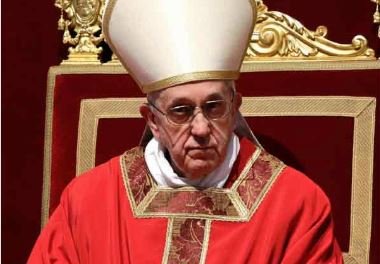
Pope Francis

Why Pope Francis?

As the head of the Roman Catholic Church, The Pope has long been considered a candidate for Satan’s Son. While Pope Francis’s actions to reform the much-maligned church quickly made him a beloved leader for his people early in his career, in the post-Covid world he revealed himself to be a proponent of globalism and an advocate against individual freedoms.

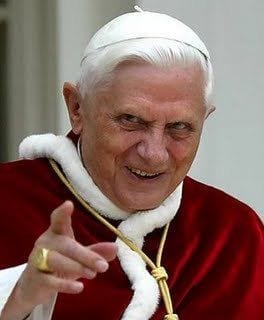
Pope Benedict

Why Benedict?

The mysterious figure who was the first pope to step down since the 14oo’s, Pope Benedict continued to remain in the shadows until his alleged death. Some wonder if Benedict faked his death and instead stepped aside from the public eye to setup Francis as his front made so he could implement his plans in secret? If he is still alive could Benedict be the Antichrist or The Beast’s Second Helper?

Dr. Anthony Fauci

Why Dr. Fauci?

Conspiracy theorists believe he is one of the lead men behind the Covid-19 plandemic or as least the patsy who did the dirty work for his masters. Some suggest that Dr. Fauci has toiled on behalf of his evil masters for most of his career with the goal being to enslave humanity in a totalitarian society of never-ending healthy and safety regulations that see the world’s people living a ‘lockdown life’ forever. Some believe Dr. Fauci had a hand in The Swine Flu, AIDS, the Bird Flu, and similar mysterious epidemics. Although probably not charismatic enough to be the Antichist (much to his chagrin), Dr. Fauci may well be the Second Helper.

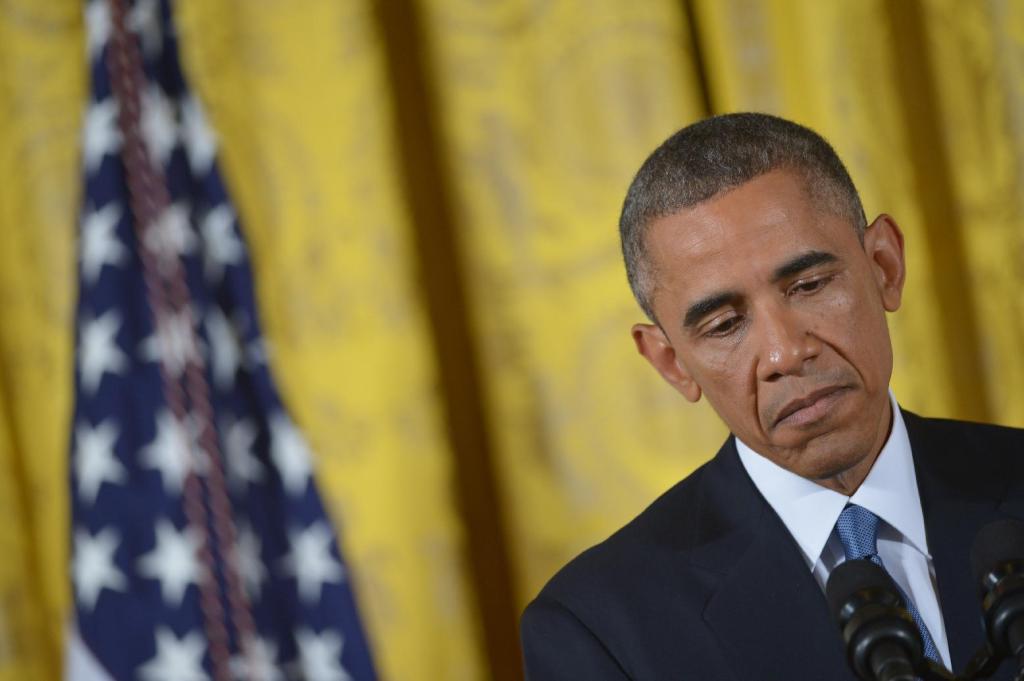
Hussein Barack Obama

Why Obama?

The internet is filled with stories of Obama as the Antichrist. Given his openly anti-American agenda as President and his actions during his de facto third team as the true man in power behind the Harris-Biden administration, it’s not hard to see why many name Obama as The Antichrist.

Klaus Schwab

Why Klaus Schwab?

Although not as well-known as other figures on our list, Klaus Schwab has forced himself into the conversation. While he looks like the perfect Bond villian, he’s actually the Head of the World Economic Forum and Schwab literally wrote the book on The Great Reset – a globalist plan to ‘reset’ the world away from capitalism and set up a one-world government of non-elected officials who will own all property while they graciously advise the rest of us how to live in a sustainable manner. A big part of Schwab’s plan includes requiring all people to be implanted with microchips so that we can be continually monitored for our own health and safety. Could Klaus Schwab be the Antichrist? He certainly looks the part, right?

Bill Gates

Is Bill Gates the Antichrist?

Our last modern-day candidate is Bill Gates – the man who has humbly proclaimed himself to be the world’s savior. How could the man behind The Gates Foundation’s never-ending philanthropic works be considered The Antichrist? Perhaps because he’s on record for saying he wants to DEpopulate the planet? Or maybe it’s because some people believe he helped Dr Fauci orchestrate The Covid-19 Plandemic as part of a plan to vaccinate the world with DNA-changing mRNA vaccines they both helped develop? Or maybe it’s because some claim he’s trying to control the global food chain and food supplies in order to replace them with GMO-food and fake meats. Or maybe it’s because of his plan to block out the sun in order to ‘protect us’ from Climate Change. Or maybe its any number of other sinister plans Gates is rumored to be behind. Of all the people on our list, Mr. Gates may fit the bill for Antichrist better than anyone else. Then again, maybe he really is just a misunderstood Good Guy? Who wants to bet on that one?


What do all the DEAD Antichrists Have in Common?

Why talk about men whom History has proved NOT to be Antichrists? 

After all, even if we once thought they were The Beast, events have proven otherwise, right? 

Ah, but what if we were NOT wrong about all those men — what if ALL of them really were Satan’s Son?

How could that be — they all died, right? And they all departed from History and stopped causing problems, right? 

Yes, but in every case, there was always some mystery that shrouded their death.

Consider Nero’s demise.
A supposed suicide in which he drove a dagger into his own throat – albeit with the aid of his personal secretary Epaphroditos. We should feel confident about that kind of death, right? Maybe. Maybe not. There’s no shortage of mystery around his freedman Epaphroditos and the subsequent quick burning of Nero’s body have always caused me to wonder.

“Wonder about what?” You say. “That seemed like a pretty convincing death to me.”

Ah, but was it really Nero who died? Or did Nero perhaps switch places with one of his aide and disappear himself?

I’m not alone in this belief – check out the “Nero Redivivus Legend” for more on the story.

Next there was Attila.
His demise is still the subject of controversy: was it internal bleeding by years of heavy drinking, or did he die at the hands of his wife Gudrun?

“What does it matter?” You reply. “Either way, he DID die and furthermore, Attila was buried in a triple coffin made of gold, inside of silver, inside of iron – to make sure he’d never escape!”

That’s true, and that same legend also says that his loyal men then diverted a section of the river Tisza in order to bury Attila’s coffin under the riverbed. BUT, did you know that all those men were later be killed by Attila’s son Ellac in order to keep the exact location of the grave site a secret. 

Why? 

Could it be that Attila escaped his grave? Or that he never really died at all?

What about Archbishop Arnulf of Rheims. 
His death is still a mystery – only Vatican cardinals ‘witnessed’ it and their reliability for honesty at this time period remains highly in question. 

And the same goes for Adam Weishaupt.
Did he really die, did Weishaupt assume the persona of America’s Founder George Washington, or has he somehow been preserved to this day by the Illuminati?

Adolf Hitler – another mystery.
April 30, 1945 – the day Hitler shot himself. Or did he? 

Most people never saw Hitler’s remains, and for those who did, everyone said his body was unrecognizable after his own men burned it. 

And remember — nobody actually saw Hitler get shot. So while some few did see a charred corpse – what we were told was his body – how could we know for certain?

Here’s a Shocker – What if All of These Men Were The Same Man?

Consider this for a moment with me…

What if The Beast was Nero to begin with, but for whatever reason, the Evil One determined that the timing for his rise was not right? 

What if, on each of the occasions the Antichrist’s spirit did inhabit the body of these men, but do to some unexpected turn of events Satan chose to stop The Beast’s pursuit of Armageddon at that time and instead delay his rise to ensure he would be victorious? 

“And yet, none of them fulfilled the destiny of The Antichrist.” You might rebutt.

True. But they did cause problems for the world. They did do much evil. And again I say that perhaps Satan himself called for a delay. After all, what is a few hundred or even a couple thousand years to an immortal being like Him? 

Let’s not forget, Lucifer is a master manipulator.
For something as important as this, for the rise to power of his son and his own subsequent release from the prison of Hell, why surely, if he felt for even a moment that everything wasn’t going exactly as planned, he would pull the plug and start over later, right?

“Hmmm.” You agree, “Well, are correct on that. After all, experts believe that once The Antichrist attempts The Armageddon Rite, he will have one chance at it – just ONE. 

This was the apparent agreement that Satan worked out with God — although why The Lord would allow Himself to be bound by such a possibility who can say?

Be that as it may , don’t you agree that this theory just might have something to it?

Care to find out? Go ahead, ask The Antichrist yourself – I’m sure he’d be thrilled to hear from you…

Does the Antichrist walk among us Today?

What if I told you that the events the Apostle John wrote about in the Book of Revelation were occurring NOW?

Given the unprecedented events that started back in 2019 and continue to this day, it’s not so hard to believe anymore is it?

But if you thought it was bad new, you ain’t seen nothing yet. Because what you may not know is…

The Antichrist is here and when he completes his rise to power, our world will be forever doomed.

Can anyone save us?

Find out by reading The Last Temptation of John trilogy!

A Guide to Alchemy – The Science, Symbols, Elements, Books, and More

Alchemy – is it a science, a religion, a philosophy, or… something more?

In this Guide to Alchemy, we’ll explore the definition of Alchemy and talk about alchemy’s influence on science, religion, medicine, and beyond. We’ll also look at some of more popular symbols of alchemy, the Alchemical Elements, and review books about alchemy by famous alchemists. Finally we’ll review how alchemy fits into the world created by author John Salom’s for his Last Temptation of John books.

1. Alchemy Definition

Definitions of Alchemy are as varied as the concept itself. Here are some of the more popular ways to define alchemy.

1-Cambridge defines alchemy as “a type of chemistry, especially in the Middle Ages, that dealt with trying to find a way to change ordinary metals into gold and with trying to find a medicine that would cure any disease.” It’s interesting that such a prestigious organization would give us the most basic of definitions – one wonders, is the renowned university misdirecting us from the real purpose of Alchemy? 🙂

2. Miriam Webster takes things a bit further, giving the definition of alchemy as “a medieval chemical science and speculative philosophy aiming to achieve the transmutation of the base metals into gold, the discovery of a universal cure for disease, and the discovery of a means of indefinitely prolonging life. Alchemy is also a power or process that changes or transforms something in a mysterious or impressive way (or) an inexplicable or mysterious transmuting.” 

3. Wikipedia gives us even more nuance: “Alchemy (from Arabic: al-kīmiyā) was an ancient branch of natural philosophy, a philosophical and protoscientific tradition practiced throughout Europe, Africa, and Asia, originating in Hellenistic Egypt (primarily Alexandria) between the 4th and 3rd centuries BCE. It aims to purify, mature, and perfect certain objects.” Keep in mind that the ‘objects’ that were sought to be perfected could be the human body, mind, and spirit.

Interesting Note: In the Last Temptation of John Books, the character John claims to have studied alchemy for over 1,700 years.

2. Origins of Alchemy

When readers from the Western World think about Alchemy it’s typically the branch of alchemy that was practiced during the Medieval Age of European History – the branch usually associated with the alchemical goal of using the Philosopher’s Stone to try to turn lead into gold. And yet, the origins of alchemy go back MUCH farther and the goals are much deeper. 

In fact it is suspected that there are at least THREE different branches of alchemy that (allegedly) developed independently across the globe – in China, in India, and in the Mediterranean areas of the Middle East and Europe. I say ‘allegedly’ developed independently because when you delve deeper into the respective goals of each of these branches certain similar threads start to become apparent which causes one to at least have to wonder if perhaps there is a connection to a common source for the true origin of alchemy for all branches – AKA the roots of an Alchemy Tree that produced the various branches of alchemy we know today. 

Alchemy in China

Numerous sources point to the beginning of alchemy in China around the 4th or 5th century BC. Whereas the overt purpose of Western Alchemy was the transmutation of base metals into gold, Chinese Alchemy is reported to have been more focused on the overt goal of finding the Grand Elixir of Immortality. And while Chinese alchemists did apparently seek ways to turn base metals into gold, but it wasn’t necessarily to use the gold for wealth, instead they used the gold as part of their quest for immortality by INGESTING the metal. In fact, Chinese alchemists and their followers ingested various metals, stones, and other substances (mercury, jade, cinnabar, sulpher, arsenic, etc) in an attempt to find the long sought after Elixir of Immortality – drinkable gold was high on their desired list because it was a non-tarnishing material that was believed to keep the body in a pure state. As you might imagine, drinking all these toxic substances led to numerous cases of “Chinese Alchemical Elixir Poisoning” and as such the practice eventually faded from the main stream of the science. 

Chinese alchemy developed deep roots with Taoism and the mastery of the Qi energy source as well as the obvious associations with Chinese medicines. 

Chinese alchemists are credited with having a hand in the development of black powder (i.e gunpowder), fireworks, and associated with acupuncture and moxibustion, in addition to the ever continuing quest for longevity. 

Alchemy in India

It’s harder to pinpoint when alchemy originated in the Indian subcontinent of Asia – with some sources pointing as far back as 1500 BC, others to the 4th Century BC and others not until the Common Era, but most tend to agree that alchemy in India was closely tied to the Hindu Religion, the concept of Rasa (fluid, juice, essence/sap of life), and a focus on transmuting various substances in order to ingest them as forms of Elixers of Life in order to purify the mind and body via the concept of Rasayana (the path of the essence of life).  There are deep connections to the Sanskrit and the god Shiva and goddess Devi. Mercury, sulfur, and gold were part of the Indian alchemy system along with many other substances and compounds. 

Alchemy in the Mediterranean (Middle East and Europe) – AKA “Western Alchemy”

Most people reading this will probably be familiar with Western Alchemy since that has featured prominently in western literature. This form of alchemy is said to have originated in Babylonia or Egypt around 2,000 BC, or perhaps Greece in the 6th Century BC or Hellenistic Egypt in the 4th century BC and that it then spread outward to the Middle East and Europe (with some speculation that this form also spread to India and Asia as well as the root form but others that alchemy in India and Asia developed independently of the Greek/Egyptian form). Regardless of when it originated (which I believe was even earlier than 2,000 BC because of various conspiracy theories I buy in to), Western Alchemy continues to captivate us. 

With a deep connection to Hermeticism and that philosophy’s focus on the relationships between the Divine, the Cosmos, the Mind, and Nature, Western Alchemy is most often associated with Metallurgy, the manipulation of the Classical Elements (Earth, Air, Fire, Water, and Aethyr), the use of the Philosopher’s Stone to trasmutate base metals into gold (although I believe this was a ruse to divert attention away from the true goal of the Philospher’s Stone), and the pursuit of perfecting the Magnus Opum (connecting the Soul to the Divine). 

In the Last Temptation of John books, we know John lived all over the world under a variety of (famous) alchemy identities. This also includes spending over 200 years in India during one of the peaks of that country’s highest highs in alchemy knowledge. Although we don’t know about the identities John lived under in India or China, we do know about those personas he assumed in and around the Mediterranean alchemy world – see below to learn more. 

3. Alchemy as a Science

Alchemy can be seen as a science for numerous reasons. To begin with many of the world’s first chemists, doctors, and philosophers were also alchemists.  Numerous references consider alchemy as the precursor to modern chemist (remember alchemy had it’s own periodic-style chart of elements), as a form of protochemistry (alchemy was one of the first sciences to consistently use laboratory experiments working with chemical substances), and as being focused on the quest for purity (for example the transmutation of lead into gold) via the use of the scientific method of experimentation. 

4. Alchemy as a Philosophy

As already mentioned, many of the ancient and medieval world’s best philosophical minds were also keenly interested in alchemy. For example, as relates to Hellenistic Alchemy, the Greek philosophies of Pythagoreanism, Platonism, Stoicism and Gnosticism all played a role in the development of the branch of Western Alchemy that developed in Egypt.   

Aristotle was reputed to believe that “all things in the universe were formed from only four elements: earth, air, water, and fire” and “each element had a sphere to which it belonged and to which it would return if left undisturbed.” From a philosophical sense, it’s important to understand that while the Greek elements were concerned with the physical nature of these elements, in alchemical philosophers “never regarded earth, air, water, and fire as corporeal or chemical substances in the present-day sense of the word…[but instead as] amorphous substances of all bodies” that could be purified back to their divine form. 

5. Alchemy as a Religion

If science is the focus on the ‘body’ of alchemy, and philosophy is its spirit, then the religion of alchemy is its soul. Those who took the philosophy of alchemy to the next level, made alchemy their de facto religion – seeking to use alchemy not just to reach their highest potential, but to become and, dare I say, even to absolve themselves of the stain of Original Sin. Alchemists often talk of the soul having been divided by the Fall. One sources claiming that alchemists believed that “only by purifying [oneself] could he find that divine spark within oneself and accepting it as a part of their existence [and] be reunited with God.” 

In fact it’s suspected by some that the popular belief that alchemy’s main goal was to turn lead into goal was in fact nothing more than a ruse to protect alchemist’s from their true goal – “the  transformation of man from his natural evils into a partaker of the Divine.” Why the ruse? Remember, for Western Alchemy at least, much of the area and era during which they lived was controlled by the Catholic Church – an entity that jealously guarded its control over the hearts and minds of the people that made up their congregations and often viciously persecuted anyone who threatened their jurisdiction (see. The Inquisition of Alchemists) – by using a bit of misdirection and making The Church believe they were trying to merely turn lead into gold (and undoubtedly promising to donate a portion of the proceeds), alchemists deflected spying eyes from their true purposes. 

Interesting Note: In the Last Temptation of John books, the main character is none other than the Apostle John who has been ‘cursed’ (his words) with immortality. John has lost his original faith (Judaism) and worked through many others (Christianity, Catharism, etc), only to be continually disappointed. During his long life, John has worked the craft of Alchemy for over 1700 years – exploring its many facets as a philosophy, science, and ultimately as his religion – although his goals involving the ‘higher concepts’ of alchemy are a bit different than what you’ve read about here…

6. Key Concepts in Alchemy

I. Hermeticism (AKA “Hermetism”)

Earlier we asked the question about Alchemy – “is it a religion, a philosophy, or something else?” and the same could be said of Hermeticism. We’ll called it a theology since its followers called it the “Prisca Theologia” (claiming that Hermeticisism is one true theology which threads through all religions, and that it was given directly by God to ancient man”). Hermetism is based on the teachings of the mystical Hermes Trismegistus, a figure whose history is just as mysterious as the theology he started – is Hermes Trismegistus a mortal man, a god, a combination of god + man, a combo of multiple gods (namely the Greek God Hermes and the Egyptian god Thoth), or something altogether different (ancient alien perhaps? Haha)? There is no clear answer to that question and we don’t really know when Hermes Trismegistus even lived (some claiming that he was a contemporary or even a teacher of the Jewish Patriarch Abraham which, if true, would date him about 2500 years before Christ). 

Regardless of these mysteries, let’s focus on the teaching of Hermes Trismegistus that became the pillars of the hermetic theology. Hermeticism is a vast expanse of knowledge but for our purposes we’ll hone in on this overarching concept…

There is a transcendent God, or Absolute, in which we and the entire universe participate” and that man can learn how to purify nature (and thereby himself) such that he can become one with “The All.”

A complete discussion of Hermeticism is clearly beyond the scope of this article (after all Hermes Trismegistus is credited with over 10,000 texts to his name!), but as relates to Hermetic Alchemy we should touch on a few more key concepts:

a. The Emerald Tablet: (AKA “Tabula Smaragdina”) reported to be the source of the philosophical phrase “As Above, So Below…”

The Emerald Tablet (as translated by Sir Isaac Newton) reads:

Tis true without lying, certain & most true.
That which is below is like that which is above & that which is above is like that which is below to do the miracles of one only thing
And as all things have been & arose from one by the meditation of one: so all things have their birth from this one thing by adaptation.
The Sun is its father, the moon its mother, the wind hath carried it in its belly, the earth is its nurse.
The father of all perfection in the whole world is here.
Its force or power is entire if it be converted into earth.
Separate thou the earth from the fire, the subtle from the gross sweetly with great industry.
It ascends from the earth to the heaven & again it descends to the earth & receives the force of things superior & inferior.
By this means you shall have the glory of the whole world
& thereby all obscurity shall fly from you.
Its force is above all force. For it vanquishes every subtle thing & penetrates every solid thing.
So was the world created.
From this are & do come admirable adaptations whereof the means (or process) is here in this. Hence I am called Hermes Trismegist, having the three parts of the philosophy of the whole world
That which I have said of the operation of the Sun is accomplished & ended.

b. Corpus Hermeticum

An 18-chapter sacred text of the Hermetic Religion – it is purported to document a dialogue between God and Hermes in which God shares His wisdom with Hermes who in turn shares it with his followers.

c. The 3 Parts of the Wisdom of the Universe

A hermetic practitioner seeks to learn how to perfect 3 “crafts.” These are:

  1. The Craft of Alchemy (the operation of the Sun).
  2. The Craft of Astrology (the operation of the Stars).
  3. The Craft of Theurgy (the operation of the gods AKA ‘magic’).

The perfection of these three crafts is thought to grant the hermetic all the wisdom of the universe, which, when known is believed to open the door for the practitioner to attain a higher consciousness and ultimately achieve a Oneness with The Divine.

Such is the ultimate goal of The Great Work (see below). 

Interesting Note: In the Last Temptation of John books, we know John has used The Emerald Tablet, but not much is said about Hermes Trimegistus, the Corpus Hermeticum, or the Wisdom of the Universe. 

II. The 3 Alchemic Agents

1. The Philosopher’s Stone

There is perhaps no more popular (and misunderstood) concept in alchemy than the famed Philosopher’s Stone – that mythical substance (?) reputed to be capable of turning lead into gold. This transformation was achieved by heating the base metals in a pear-shaped glass crucible (a Hermetic Tube, AKA The Philosopher’s Egg). As the process contained the base materials changed color:  “black indicating the death of the old material preparatory to its revitalization; white, the color required for change into silver; and red, the highest stage, the color required for change into gold.”

Or so the legend goes – but is there really more to the Philosopher’s Stone than just the promise of untold riches?

Consider for yourself…


The Philosopher’s Stone was also known as The Stone of the Philosopher’s, Materia Prima, Lapis Philosophorum, The White Stone by the River, Chrysopoeia, Magisterium, Spiritus Mundi, Stone of the Wise, Diamond of Perfection, and even The Sword in the Stone.

It’s true that the Philosopher’s Stone was most famous for it’s supposed function of turning BASE metals (lead, iron, tin, copper, mercury) into PRECIOUS metals (silver and gold) – at least that’s what alchemists told non-alchemists.

Remember, many alchemists (particularly in Europe during the Middle Ages) practiced their craft under the baleful eye of The Catholic Church. Telling the ever-hungry-for-money Church that they could one day offer them untold amounts of silver and gold allowed alchemists to pursue their experiments (and hide their possible true intention for using The Stone). 

In fact, many people now suspect that the real purpose of the Philosopher’s Stone was to…

a. Create the Elixir of Life to  achieve immortality.

b. Obtain Perfection of The Self – AKA Complete Enlightenment and heavenly bliss as part of The  Magnum Opus (see below).

c. To obtain the Knowledge of Creation – i.e. man’s final inner transformation (of his “base” self) into his higher (precious or divine) self. 

To learn even more about The Philospher’s Stone, here is a treatise on the topic from Dennis Hauck, Project Curator of the Alchemy Museum.

Featured here is Mr. Hauck’s drawing of the alchemist’s workshop in which the Philosopher’s Stone is setup. 


Meanwhile, if you’re interested in trying to create the Philosopher’s Stone for yourself, here is a copy of Isaac Newton’s manuscript on the topic. (BTW, you knew Isaac Newton was an alchemist, right?)


Interesting Note: In the Last Temptation of John books, the main character (John the Apostle) gives a rather extended dialogue about the real purpose of the Philosopher’s Stone – confirming some of the details above, while dispelling other myths. On one hand, John’s use of the Philosopher’s Stone has filled his coffers with untold riches, and yet he has continued to remain disappointed in it to this day. 

2. Alkahest vs Azoth

Although sometimes taken to mean the same thing, a closer look reveals that Alkahest and Azoth are in fact quite different alchemical agents. 

Alkahest
Alkahest was the ‘universal solvent’ used in alchemy. The purpose of alkahest was that is had the power to DISSOLVE any other substance – including gold. 

Key contributors to the development of the use of alkahest within alchemy were Paracelsus (legend has it that Paracelsus came up with the term “Alkahest” and who is said to have believed that alkahest was actually the Philosopher’s Stone) and his successor Franciscus Mercurius van Helmont (who developed the concept of Liquor Alkahest). 

The challenge with trying to make an alkahest was that most versions of it turned out to be such powerful solvents that they apparently dissolved everything – which was a problem… at least for amateur alchemists.

The mystery surrounding alkahest (and perhaps it’s true key to alchemy’s higher goals) lies in this: from the chemical standpoint, the true ‘universal’ solvent was purported to be WATER (since, over time, it can dissolve anything back to it’s base form)  and from a metaphysical standpoint, there is an alkahest (substance only known to alchemy masters) which can dissolve the body’s ailments and deliver eternal life (AKA The Elixir of Life).

Azoth
Not to be confused with Alkahest, Azoth is in fact far different. Although it’s true that both were reported to be universal medications, the process by which they accomplished this goal is the  key to understanding their differences. Whereas alkahest was the universal SOLVENT, azoth was the universal TRANSFORMER. 

Azoth (nee Azoc) is closelly associated with mercury (a key alchemical substance held by ancient alchemists to be “the animating spirit hidden in all matter that makes transmutation possible“).


A discussion of azoth goes far deeper into metaphysics than alkahest. Like the latter, azoth is also associated with the Philosopher’s Stone and the Elixir of Life, but unlike alkahest, azoth has a far richer history (dating back to the time of the early alchemists like Zosimos of Panopolis and Mary the Prophetess). 

Azoth is in fact associated with all of these higher goals in alchemy:

a. The Kaballah concept of Schamayim (שמים) which is “the first outflow of the Word of God” that becomes the Water of Life (AKA Azoth) which in turn “pours itself into the Four  Elements.” Of these elements, Edem (vaporous essence or mist) is “the intangible dust out of which God formed Adam” thus making azoth the spirit of life.

b. Azoth is believed to be not only “the animating energy (spiritus animatus) of the body but is also the inspiration and enthusiasm that moves the mind.”

c. Azoth is claimed by some to be “the nature or mind of God.”

Interesting Note: We learn that Azoth is a core concept for the character John in the Last Temptation of John books. In fact, during the climax of the book in which John is working on his Magnus Opus, we discover that John actually calls himself “Azoth” and instructs another character to only refer to him by that name during the experiment. 

3. Elixir Vitae

As we have already spent much time on topics similar to this one, we’ll be brief here. As you probably guessed by know, alchemists around the globe have continuously been intensely interested in finding a substance that would grant them eternal life or immortality – this was the famed Elixir Vitae (AKA. The Elixir of Life). 

In China, alchemists experimented with mixing and ingesting numerous elixirs made with jade, cinnabar, hematite, and even gold. Although we don’t know if any of them achieved immortality, we do know that many died of Chinese Alchemical Elixir Poisoning – yikes!

Alchemists in India were focused on finding an elixir made from the nectar of the gods which they called Amrita. Depending on the form of religion they followed (Hindu, Buddhism, Sikhism, etc) the method of finding Amrita varied. 

In Europe, the quest to create an Elixir Vitae was part and parcel to the use of the Philosopher’s Stone discussed above.

Whether any of them found their Holy Grail we don’t know. 

A Paradox? In the Last Temptation of John books, the main character John was made immortal by Christ. During the course of his long life, John repeatedly turned to alchemy to find Life’s answers since world religions were not accomplishing that task for him. Although John became an alchemy master many times over, one thing he didn’t seek from the craft was the Elixir of Life – if anything, John quested for the Elixir of Death – the one thing that the craft would never delivery to him!

III. The 14 Keys of Alchemy

Samuel Norton was an English Alchemist who lived in the 1500’s. Among his works, he wrote about the 14 Keys to Alchemy which describes the processes through which the alchemical substances pass from the time they are first placed in the test tube until ready for harvesting/use in higher level alchemical experiments. This list was published in 1577.

  1. Solution, the act of passing from a gaseous or solid condition into one of liquidity.
  2. Filtration, the mechanical separation of a liquid from the undissolved particles suspended in it.
  3. Evaporation, the changing or converting from a liquid or solid state into a vaporous state with the aid of heat.
  4. Distillation, an operation by which a volatile liquid may be separated from substances which it holds in solution.
  5. Separation, the operation of disuniting or decomposing substances.
  6. Rectification, the process of refining or purifying any substance by repeated distillation.
  7. Calcination, the conversion into a powder or calx by the action of heat; expulsion of the volatile substance from a matter.
  8. Commixtion, the blending of different ingredients into new compounds or mass.
  9. Purification (through putrefaction), disintegration by spontaneous decomposition; decay by artificial means.
  10. Inhibition, the process of holding back or restraining.
  11. Fermentation, the conversion of organic substances into new compounds in the presence of a ferment.
  12. Fixation, the act or process of ceasing to be a fluid and becoming firm; state of being fixed.
  13. Multiplication, the act or process of multiplying or increasing in number, the state of being multiplied.
  14. Projection, the process of turning the base Metals into gold.

In the Last Temptation series, John’s work with the Magnus Opum takes place after these processes and add more levels to mix (see Magnus Opum below)

IV. The Magnus Opus – The Great Work

In alchemy, it all leads to this – the completion of the Great Work and the End of the Matter. Over the centuries, different alchemists throughout the world seemingly had different definitions of the Magnus Opum…or so we are led to believe.

Regardless of the professed goals for the Magnus Opum, most text appear to agree that the stages of the Great Work involved…

  • nigredo, in a basic sense this is the stage involving “a blackening,” but in a higher sense, this is  also called “The Shadow Stage” in which the material being worked on ‘loses one’s self’ via destruction of self, confession, or cartharsis. 
  • albedo, at the most basic level, this is “a whitening” in which consciousness begins to emerge. This is the stage of Illumination of Self, Full Consciousness, and a connection to one’s inner being. 
  • citrinitas, often overlooked, (a critical error which leads to failure of the Magnus Opum), this stage involves a “yellowing” which seems odd after the illuminating power that was achieved during the Albedo, and yet, if performed, the Citrinitas provides further illumination regarding the external world. 
  • rubedo, at the basic level, this is a reddening” but going deeper, rebedo was associated with the concepts of tapping into one’s “Personal Myth — and understanding how one’s essence and purpose to the world.”

In the Last Temptation books, after centuries of work, John completes his Magnus Opum and finally achieves Rebedification… only to discover the results of his alchemy (and his life’s purpose) were far different than he ever imagined. 

7. The Elements of Alchemy

Throughout the world, alchemists have historically quested to ‘know all there was to know’ about the elements that make up our world. Consider the variances and similarities among these cultures and what they considered the base elements from which all other matter is built…

  • Greeks: Earth, Air, Fire, Water, Aether
  • Chinese: Wood, Fire, Earth, Gold, Water
  • Babylonia: Sea, Earth, Sky, Wind
  • India/Hindi: Earth, Water, Fire, Air, Space, The Void
  • Buddhism: Earth, Air, Fire, Water

Although these elements appear to be linked to their physical meaning, it’s suspected that alchemists in these countries used these terms to mean beyond just their basic definition. For example, in China, Wood, Fire, Earth, Gold, and Water were the alchemists terms for various types of ENERGY that was in a “constant state of interaction with each other and a state of change” and referred to them collectively as the Wu Xing (“Five Changes”). In Buddhism “the four elements are a basis for understanding suffering and for liberating oneself from suffering.”

As we are most focused on the medieval alchemists for this article, let’s turn our attention to the Mediterranean Alchemists Elements of Alchemy…

Tracing a path back to the origins of the universe (Chaos) and then beyond to a connection to Divinity (Quintessence), alchemists like Jābir ibn Hayyān and Paracelsus added to the classic 4 elements of Earth, Air, Fire, and Water on both the front and back ends of the spectrum. 

From Chaos come Matter & Energy, which are then influenced by either Passive (Magnetic) or Active (Electrical) Forces to follow paths governed by Salt (which leads to Earth & Water) or Niter (which leads to Air & Fire). 

It was Jābir ibn Hayyān who allegedly identified Sulphur (AKA sulfur as “The stone that burns”) and Mercury (the element so important to much of alchemy) as having key roles to play in terms of enabling an alchemist to ‘manipulate’ the 4 base elements in their experiments – claiming that both Sulpur and Mercury were ‘irreducible’ elements. 

Paracelsus took Hayyān’s work further and added in Salt to the mix to create the 3 Metallic Principles which are:

  • Sulphur: flammability
  • Mercury: both volatility and stability
  • Salt: solidity

Paracelsus named these irreducible elements as The Tria Prima and claimed they could be used to unlock Quintessence.

What is Quintessence?

Now we’re getting somewhere! Quintessence is another of the mystical goals of the alchemist’s quest. Quintessence is given many definitions, including:

Interesting Note: In the Last Temptation of John books, John talks about Quintessence during his pursuit of The Magnus Opus – explaining its importance to The Great Work. 

8. Symbols of Alchemy

The symbols of alchemy have fascinated us for millennia. Here are two of the more classic examples of alchemy symbols that depict the Elements of Alchemy, the Zodiac Planets, various alchemical processes, and more. 

The second image comes from alchemist Basil Valentine – a 15th century Franciscan monk who was also a renowned alchemist. 


9. Famous Alchemists

Here is a list of the world’s most famous alchemists, however I’d recommend you keep in mind that just because these alchemists were famous does not necessarily mean they were the most successful – after all isn’t it possible that the alchemists who achieved the highest goals are not listed here because they didn’t want fame or fortune?

This list is compiled from research exploring numerous sites and texts (see references below for more info). A special thanks to the site CrystalLinks for it’s outstanding research on this topic. 

Agathodaemon

Agricola, Georg (1494-1555)

Al-Farabi, “Alfarabi” (870 – 950/951)

Al-Tughrai (1061–1121)

Artephius (c. 1150)

Avicenna – Abu Ali al-Husain ibn Abdallah ibn Sina (985-1037)

Bacon, Roger (1220- 1292)

Bernard of Treves (1406–1490)

Bohmen, Jacob (1575 – 1624)

Brahe, Tycho (1546-1601)

Charnock, Thomas (1516–1581)

Chymes

Cleopatra the Alchemist

de Cagliostro, Count Alessandro AKA “Guiseppe Balsamo” (1743-1795)

de Lille, Alain (Born from 1115 to 1128 – died in 1202(1203?))

de Meung, Jean (c.1250 – c.1305)

de Rais, Gilles  (1401–1440)

de Roquetaillade, Jean (Johannes de Rupescissa ) (d. 1336)

Dee, John (1527-1608)

Demosthenes – The Alchemist God

Dhul-Nun al-Misri (b. 796)

Flamel, Nicolas & Perenelle (1330-1418)

Fulcanelli (Late 19th century – early 20th.)

Ge Hong (Ko Hung, 283—343 C.E.)

Hermes Trismegistus

Jabir ibn Hayyan (AKA “Geber”) (721-815)

Kanada, (6th century BC)

Kelley, Edward (1555-1595)

Khalid ibn Yazid, “Calid” (d. 704)

Khunrath, Heinrich(1560-1605) 

Kirchweger, Anton Josef  ((d.1746))

Magnus, Albertus (1193-1280)

Mary the Jewess

Moses of Alexandria

Muhammed ibn Umail al-Tamimi, “Senior Zadith” (c. 900–960)

Muhammad ibn Zakarīya Rāzi, “Rhazes” (864 – 930)

Nagarjuna

Newton, Isaac (1642 -1727) 

Norton, Samuel (1548–1621)

Norton, Thomas (c. 1433-c. 1513)

Olympiodorus of Thebes (c. 400)

Ostanes, the Persian

Paphnutia the Virgin (c. 300)

Paracelsus (1493-1541]

Pseudo-Aristotle

Pseudo-Democritus

Reidel, Dr. Albert (AKA “Frater Albertus”) (1911–1984)

Ripley, George (15th century)

St. Germain, Count(18th Century) 

Saint-Yves d’Alveydre, Alexander (1842-1909)

Sędziwój, Michal (1566–1636)

Stephen of Alexandria

Tamil, Siddhar 

Thomas Aquinas (1225-1274)

Valentine, Basil (1394-1450)

Villanovanus. Arnaldus (1240-1311)

Wei Boyang

Weigel, Valentin(1533-1588)

Zhang Guo the Elder (c. 600)

Zosimos of Panopolis (c. 300)

Additional Bio’s about Alchemists can be found at these links:

Editor’s Note: In the Last Temptation of John books, John claims to have lived portions of his life under the pseudonyms of famous alchemists – including Zosimos, Paracelsus, and Fulcanelli – a trio of heavy hitters in the world of alchemy!

10. Alchemy Books of Important Significance

Although we can’t touch on every alchemy volume ever written (there are untold thousands of texts), let’s look as some of the most famous ones. 

Artephius

Avicenna

  • Liber Aboali Abincine de Anima in arte Alchemiae
  • Declaratio Lapis physici Avicennae filio sui Aboali
  • Avicennae de congelatione et conglutinatione lapidum
  • Avicennae ad Hasan Regem epistola de Re recta

Bacon, Roger

  • Opus Maius
  • Opus Minus
  • Opus Tertium
  • Letter on the Secret Workings of Art and Nature and on the Vanity of Magic (Epistola de Secretis Operibus Artis et Naturae et de Nullitate Magiae)
  • The Mirror of Alchimy (Speculum Alchemiae)

Dee, John

Flamel, Nicolas

Fulcanelli

  • Le Mystère des Cathédrales (The Mystery of the Cathedrals)
  • Les Demeures Philosophales (Dwellings of the Philosophers) 
  • Finis Gloriae Mundi (End of the World’s Glory)

Geber

Hermes Trimestigus

Among the thousands of books attributed to him, perhaps the most influential books by Hermes Trimestigus were:

Magnus, Albert

  • Metals and Materials
  • Theatrum Chemicum

Mary the Jewess

Paracelsus

Valetine, Basil

Zosimos of Panopolis

References:

  1. Sacred Text Archive – an amazing resource for lost tomes from ancient archives the world over!
  2. Forgotten Books – a treasure trove of alchemy wisdom. 
  3. Levity – a giant list of alchemy books post 16th-century.
  4. Alchemywebsite.com – over 300 alchemy books post 16th-century

11. Alchemy & The Last Temptation of John Books

Although the trilogy known as the Last Temptation of John is not solely focused on alchemy, the craft plays an important role in the series because the main character (St John the Apostle) is an unhappy immortal whose primary goal in life is to find a way to die. Unable to discover a normal way to die, John turns to alchemy to find a solution. His curious quest takes him on a journey that involves The Philosopher’s Stone, Quintessence, Azoth, and of course The Magnus Opus. Will he successfully complete his alchemical goals? 

Read The Last Temptation of John to find out..


You May Also Like


Mary Magdalene – Saint, Sinner, or Something More?

This is a comprehensive guide about Mary Magdalene that attempts to tackle the many issues associated with life and legacy of this importance figure in the Christian Faith. Beyond just the typical biography of Mary, we’ll attempt to separate which “Mary” she was/was from a Biblical perspective, talk about the apocrypha literature that features her (for example The Gospel of Mary and other early Christian texts), search for Mary’s tomb and relics, and delve into some of the conspiracies that involve her (did she journey to France, is she the Holy Grail, is she immortal, etc). It promises to be a wild ride so let’s get started!

1. Mary Magdalene – Biography

To say that Mary Magdalene’s name is controversial is an understatement – there is perhaps no more controversial figure in all of The Bible. For most of history (both during the time she was living and for centuries afterward) Mary Magdalene was at the center of numerous conspiracy theories surrounding her relationship with Jesus:

  • Was Mary simply one of many disciples of Jesus?
  • Was she a de facto apostle with her own ideas about how to spread Christ’s message and thus a threat to the more well-known apostle’s power?
  • Was Mary a financial backer of Jesus?
  • Was Mary Magdalen Jesus’ lover or possibly even the mother of Jesus’ child?

These questions and more cloud Mary Magdalene’s name and perhaps have made it impossible to know who she really was (after all, we must remember that the ‘history’ of Mary Magdalene as we know it over 2,000 years later is only what we are able to read by those who wrote that story – and as we well know by living in the age of Fake News or remembering Orwell’s epic 1984, just because something is written or said, does not make it true). 

Sadly we may never know the real story of exactly who Mary Magdalene was, but we can perhaps piece together a few of the “likely-to-be-true” tidbits about her life. 

It would appear fairly safe to conclude that Mary Magdalane was indeed…

  1. From the village of Magdala (a fishing village on the Sea of Galilee).
  2. Jewish – although we don’t know this for certain. 
  3. Was also called simply “Magdalene.”
  4. Was a follower of Jesus who traveled around with his disciples.
  5. Had a close relationship with Jesus since she was present at Jesus’ crucifixion and at Jesus’ resurrection – even when most of Jesus’ other disciples had deserted him. 
  6. Was an important figure among Jesus’ disciples because she is mentioned no less than 12 times in The Bible (more than most of the 12 apostles).

These statements about Mary seem relatively safe to rely on, HOWEVER as to the beliefs that Mary Magdalene was a prostitute, the famous adulteress of John’s Gospel, Jesus’ lover or even the mother of his child, we’ll likely never know – although we’ll explore all of these controversies and more in the rest of this article. 

For additional biographies of Mary Magdalene see also:

  1. The Smithsonian
  2. Bible Odyssey
  3. Wikipedia
  4. Biography.com

2. Mary Magdalene and The Bible

A. Where is Mary Magdalene mentioned in The Bible?

Mary Magdalene is specifically mentioned by name 12 times in the Bible in the following verses…

  • Matthew 27:55-56:  Many women were there, watching from a distance. They had followed Jesus from Galilee to care for his needs. Among them were Mary Magdalene, Mary the mother of James and Joseph, and the mother of Zebedee’s sons.
  • Matthew 27:59-61: Joseph took the body, wrapped it in a clean linen cloth, and placed it in his own new tomb that he had cut out of the rock. He rolled a big stone in front of the entrance to the tomb and went away. Mary Magdalene and the other Mary were sitting there opposite the tomb.
  • Matthew 28:1: After the Sabbath, at dawn on the first day of the week, Mary Magdalene and the other Mary went to look at the tomb.
  • Mark 15:39-41: And when the centurion, who stood there in front of Jesus, saw how he died, he said, “Surely this man was the Son of God!” Some women were watching from a distance. Among them were Mary Magdalene, Mary the mother of James the younger and of Joseph, and Salome. In Galilee these women had followed him and cared for his needs. Many other women who had come up with him to Jerusalem were also there.
  • Mark 15: 46-47: So Joseph bought some linen cloth, took down the body, wrapped it in the linen, and placed it in a tomb cut out of rock. Then he rolled a stone against the entrance of the tomb. Mary Magdalene and Mary the mother of Joseph saw where he was laid.
  • Mark 16: 1-8: When the Sabbath was over, Mary Magdalene, Mary the mother of James, and Salome bought spices so that they might go to anoint Jesus’ body. Very early on the first day of the week, just after sunrise, they were on their way to the tomb and they asked each other, “Who will roll the stone away from the entrance of the tomb?” But when they looked up, they saw that the stone, which was very large, had been rolled away. As they entered the tomb, they saw a young man dressed in a white robe sitting on the right side, and they were alarmed.  “Don’t be alarmed,” he said. “You are looking for Jesus the Nazarene, who was crucified. He has risen! He is not here. See the place where they laid him. But go, tell his disciples and Peter, ‘He is going ahead of you into Galilee. There you will see him, just as he told you.’ ” Trembling and bewildered, the women went out and fled from the tomb. They said nothing to anyone, because they were afraid. (Interesting tidbit: it should be noted that the earliest versions of Mark’s Gospel ended at this verse).
  • Mark 16: 9-11: When Jesus rose early on the first day of the week, he appeared first to Mary Magdalene, out of whom he had driven seven demons. She went and told those who had been with him and who were mourning and weeping. When they heard that Jesus was alive and that she had seen him, they did not believe it.  
  • Luke 8:1-3: Soon afterward he went on through cities and villages, proclaiming and bringing the good news of the kingdom of God. And the twelve were with him, and also some women who had been healed of evil spirits and infirmities: Mary, called Magdalene, from whom seven demons had gone out, and Joanna, the wife of Chuza, Herod’s household manager, and Susanna, and many others, who provided for them out of their means.
  • Luke 24: 9-11: When they came back from the tomb, they told all these things to the Eleven and to all the others. It was Mary Magdalene, Joanna, Mary the mother of James, and the others with them who told this to the apostles. But they did not believe the women, because their words seemed to them like nonsense.
  • John 19:25: Near the cross of Jesus stood his mother, his mother’s sister, Mary the wife of Clopas, and Mary Magdalene. 
  • John 20:1-2: Early on the first day of the week, while it was still dark, Mary Magdalene went to the tomb and saw that the stone had been removed from the entrance. So she came running to Simon Peter and the other disciple, the one Jesus loved, and said, “They have taken the Lord out of the tomb, and we don’t know where they have put him!” 
  • John 20: 11-18: Now Mary stood outside the tomb crying. As she wept, she bent over to look into the tomb and saw two angels in white, seated where Jesus’ body had been, one at the head and the other at the foot. They asked her, “Woman, why are you crying?” “They have taken my Lord away,” she said, “and I don’t know where they have put him.” At this, she turned around and saw Jesus standing there, but she did not realize that it was Jesus. He asked her, “Woman, why are you crying? Who is it you are looking for?” Thinking he was the gardener, she said, “Sir, if you have carried him away, tell me where you have put him, and I will get him.” Jesus said to her, “Mary.” She turned toward him and cried out in Aramaic, “Rabboni!” (which means “Teacher”). Jesus said, “Do not hold on to me, for I have not yet ascended to the Father. Go instead to my brothers and tell them, ‘I am ascending to my Father and your Father, to my God and your God.’ ” Mary Magdalene went to the disciples with the news: “I have seen the Lord!” And she told them that he had said these things to her.

B. Was Mary Magdalene the Adulteress from John’s Gospel?

There is no concrete evidence that Mary Magdalene is the famous adulteress from the Gospel of John 8:3-11. The name of the adulteress in these verses is actually not given so we have no way of knowing who the woman was. It could have been Mary Magdalene…or pretty much any other woman alive at the time who lived there.

The notion that the adulteress was Mary Magdalene traces back to (at least) the early 6th century when Pope Gregory I officially proclaimed her to be the adulteress from John 8 (as well as Mary the sister of Martha and Lazarus AND the woman with the sinful past who washed Jesus’ feet with her tears and/or the alabaster jar of perfume in various gospels). The apparent basis for Pope Gregory’s decision relates to Luke 8:2 where Mary Magdalene is specifically named as having been cured of “7 demons” by Christ – and yet although Mary Magdalene is clearly the “Mary” of Luke 8, one is left to wonder why this makes her the adulteress, or Mary the sister of Martha, or the penitent woman with the perfume?

  • Mary was one of the most common names among the people of this time in Israel (even Jesus’ mother was named Mary), so just because a “Mary” is mentioned in the Bible that doesn’t mean it must be Mary Magdalene, right?
  • In every other Biblical story that references Mary Magdalene, she is called by her full name at some point in the story so why would have be different in these stories? If any of these other women were in fact Mary Magdalene, why didn’t the gospel writer give her full name as was the case elsewhere?
  • We may never know why Pope Gregory made this decision (although see Section 6 – Conspiracy Theories for more), but it should be noted that while the Catholic Church held this view from the 6th century onward, it was officially reversed in 1969 by Pope Paul VI (although without much fanfare). 


C. Was Mary Magdalene a prostitute?

There is no concrete evidence to suggest that Mary Magdalene was a prostitute. As with the discussion about her being the adulteress from John 8, the case for Mary being a prostitute is thin here too. When she is mentioned by name in the Bible the only ‘disparaging’ remark ever noted concerning Mary Magdalene is that she was ‘cured of seven demons’ but we never learn exactly what those demons were. In the time period she lived (2,000 years ago), people in the Middle East allegedly attributed numerous physical, mental, and emotional ailments to ‘demons’ so it’s possible Mary’s demons were from some or all of these categories – Christ may have cured her of various physical sicknesses or perhaps he saved her from life as a wayward woman – we just don’t know. As with John’s adulteress, we have Pope Gregory I to thank for suggesting that Mary Magdalene was a woman of ill repute who repented at Jesus’ feet, but in fact the Bible never specifically says this about her and again the Catholic Church officially reversed this view of her in 1969. 

This being said, in an effort to give fair balance, it should be pointed out that Magdala may also derive from a Jewish Talmudic expression meaning “curling women’s hair” — implying a woman of loose moral character. If so, it’s possible Mary Magdalene was a prostitute at one time – even if she was a different person than Mary of Bethany or John’s adulteress. 

D. Was Mary Magdalene possessed?

This answer is a bit more of a slippery slope. The evidence to support Mary Magdalen being possessed is Luke 8:2 which reads “…some women who had been healed of evil spirits and infirmities: Mary, called Magdalene, from whom seven demons had gone out…” If we take this at face value, then we could conclude that Mary Magdalene was at one time possessed by demons and that Christ cured her of these evil spirits. But again, it’s also possible that either the translation itself isn’t quite accurate or more likely that the ‘demons’ were in fact simply various physical, mental, or emotional ailments whose symptoms were attributed to demonic beings as was often the case during this time period.  Whatever the case may be, of all the negative connotation questions in this section (B-F), this one has the highest likelihood of being true based on the evidence available. 

E. Was Mary Magdalene the woman named “Mary of Bethany” who was the sister of Martha and Lazarus?

The Mary of Bethany who was the sister of Martha and Lazarus was a close friend of Jesus based on what we read in the Bible in Luke 10:38-42 (Jesus at the home of Mary and Martha) and John 11: 1-44 (Lazarus Death and Resurrection) and John 12: 1-11 (Mary anoints Jesus at Bethany). Based on Mary of Bethany being the sister of Martha and Lazarus, we can also identify Mary of Bethany in these Bible verses too (all of which tell a version of a woman anointing Jesus with perfume and/or cleaning his feet with her tears/hair): Matthew 26: 6-13, Mark 14:3-9, Luke 7: 36-50

While this is all well and fine, there is little evidence to suggest that Mary of Bethany is Mary of Magdala (AKA Mary Magdalene). As already discussed, it was Pope Gregory I (AKA Gregory the Great) who officially connected these two Mary’s – however the Catholic Church reversed this decision in 1969 and it should be noted that the Eastern Orthodox Churches never connected the two

F. Did Mary Magdalene wash Jesus’s feet with her hair?

This is another question that refers to the Bible verses from Matthew 26: 6-13, Mark 14: 3-9, and Luke 7: 36-50 that relate to the story about the penitent woman who anoints Jesus with perfume and/or washes his feet with her fair. We already know this woman was Mary of Bethany because the event is also described in John 12: 1-11 in which Mary of Bethany is named. Since we also know there is little evidence to suggest that Mary of Bethany is Mary of Magdala we can realistically conclude that Mary Magdalene is not the woman who washed Jesus’ feet with her hair… at lest in these specific Bible references.

Then again, we don’t know what Mary Magdalene and Jesus’ full relationship was so it’s possible she may have washed his feet with her hair in a non-recorded event. 

G. Where did Mary Magdalene go after the events of the Gospels?

There is no definitive answer to this question. One of the more popular legends is that, while Peter and Paul ended up in Rome, Mary Magdalene took her mission to France. We’ll delve more into this legend in the “Conspiracies” section below. 

3. What is the Gospel of Mary Magdalene?

The Gospel of Mary is a powerful and controversial document. It is not part of a standard canon Bible translation and is instead classified as an apocryphal text. It is however a clear work of Gnostic literature and what remains of the text can be found in the Gnostic Bible – an excellent resource for ‘lost’ Bible codices. 

What is the Gospel of Mary about?

As a work of the Gnostic genre, the Gospel of Mary presents a far different picture of Jesus’s mission – wherein he “teaches that the inner self is composed of soul, spirit/mind, and a third mind that is between the two which sees the vision.” More importantly as scholar Karen King noted “The Gospel of Mary presents a radical interpretation of Jesus’ teachings as a path to inner spiritual knowledge and rejects Jesus’ suffering and death as the path to eternal life.” 

In addition to Christ, well-known apostles are present (namely Peter, Andrews, and Levi AKA Mathew), but the star of the show is “Mary” – a woman who takes center stage: sharing private wisdom that Jesus told her about and even engaging in a power struggle with Peter and his brother for control of the disciples. 

For an excellent discussion about The Gospel of Mary see this backgrounder from Karen King

When was the Gospel of Mary written?

This is an ancient text was lost to history for many centuries. In 1896 it was discovered as part of a collection of apocryphal books identified as Papyrus Berolinensis 8502 (also known as the Akhmim Codex) – a group of 5th century texts written on papyrus that also contain the Apocryphon of John, the Sophia of Jesus Christ, and a summary of the Act of Peter. While the 5th century texts were a significant find, scholars suggest that the Gospel of Mary was originally written in Greek in the 2nd Century, and some trace its lineage back to the time of Christ. 

Which “Mary” was the Gospel of Mary about?

It should be noted that correct name of this text is actually The Gospel of Mary, that not all scholars agree that the Mary of this gospel is Mary Magdalene (some suggest it is Jesus’ mother Mary), and that Mary Magdalene is not specifically named in any of the surviving portions of this text. HOWEVER, because of the connections between stories in the Gospel of Mary and other ancient texts either written or discovered at the same time, many have concluded that this gospel tells the tale of Mary Magdalene. The evidence is as follows:

  • Mary Magdalene was identified as a prominent follower of Jesus in the official Bible – written about no less than 12 times in the various canonical gospels, she was present as Christ’s crucifixion, and she was the first person (not just first woman but first person) to see Jesus after his resurrection – clearly she was an important member of Christ’s clan.
  • Mary Magdalene was the star of other early Christian apocryphal literature which presented her as a leading figure among the disciples.
  • Specific ‘scenes’ which occur in the Gospel of Mary also occur in the Gospel of Thomas, Pistus Sophia, and the Gospel of Philip – and in the other text the Mary in question is specifically named as Mary Magdalene. 

How can I buy a copy of The Gospel of Mary?

4. Is Mary Magdalene a Catholic Saint?

Mary Magdalene IS held to be a ‘saint’ by the Catholic Church – although we don’t know exactly who canonized her (whether it was a Pope or a local bishop) because the only (public) Vatican records about Mary Magdalene’s sainthood list the date of her canonization as ‘pre-congregration’ – a catch-all term used when a person was sainted “prior to the institution of the modern investigations performed by the Congregation for the Causes of Saints” which didn’t formally begin recognizing saints until 1508.  

When is the Feast Day of Mary Magdalene?

July 22 is the official day of Mary Magdalene’s Feast Day.

She is also celebrated on March 1 in Switzerland and on Mary 19 among the Eastern Orthodox Church (certain relics of Mary Magdalene are stored in Constantinople). 

BONUS: Churches dedicated to Mary Magdalene

Did you know there are no less than 60 churches dedicated to Mary Magdalene? They span the globe from Europe to the Middle East to North America and even the Philippines. In the United Kingdom alone there are 37 churches devoted to her! (9 are in London). 

Here are some of the most famous churches dedicated to Mary Magdalene:

  1. The Church of Mary Magdalene is a Russian Orthodox church located on the Mount of Olives, near the Garden of Gethsemane in East Jerusalem, Israel.
  2. The Sainte-Madeleine Church is a Catholic church in Strasbourg, France.
  3. La Madeleine is a Roman Catholic church in Paris, France. 
Jerusalem

Strasbourg

Paris

5. Paintings that feature Mary Magdalene

It would take a massive tome to showcase all of the artwork that features Mary Magdalene (which again is a testament to how important her figure was throughout the history of Christianity). Here are a few of my favorites. 

St Mary Magdalene by Piero della Francesco
The Penitent Magdalene by Bartolome Murillo
Christ Mourned by the 3 Maries by Carracci
Pisa Crucifixion by Massaccio
Noli Me Tangere by Correggio
Noli Me Tangere by Giotto
Noli Me Tangere, Fra Angelico
The Morning after the Resurrection by Edward Burne-Jones
The Risen Christ Appearing to Mary Magdalene by Rembrandt
Magdalene in Cave by Pompeo Batoni
Repentant Magdalene by Gerard Seghers
Magdalene with the Smoking Flame by Georges de la Tour

6. When did Mary Magdalene Die?

We have no clear answer to exactly when Mary Magdalene may have died (or if she ever did?!?) but there are numerous theories.

The three most popular are that…

a. Mary accompanied St John the Evangelist to Ephesus (Turkey) to help spread Christ’s message and that she ultimately died there. 

b. Another theory says that she escaped persecution in the Holy Land and fled with a group of refugees to France and then lived as a hermit in a cave in the French mountains for another 30 years before her death. 

c. Mary Magdalene never died because Christ made her an immortal (like Lazarus) and she and other immortals are carrying on a secret mission to this very day. 

We’ll explore all of these in the Conspiracies sections below. 

Where is Mary Magdalene’s Tomb?

Since we don’t exactly know WHEN Mary Magdalene died, we also don’t know WHERE she died either – was it in Turkey, France, or anywhere at all. Various locations claim to have relics of Mary Magdalene, let’s see where they are…

Bonus: The Famous Relics of Mary Magdalene

Location: Saint-Maximin-La-Sainte-Baume, France

Relics: The skull of Mary Magdalene on display at the Saint-Maximin-la-Sainte-Baume basilica.

For more on this story see: CultoftheWeird.com

Location: Saint Baume mountains – about 15 miles outside Saint-Maximin-La-Sainte-Baume, France. 

Relics: bones of Mary Magdalene reside in a niche beneath her statue in the Grotto of Saint Mary Magdalene. 

For more on this story see: Atlasobscura.com

Location: Rome, Italy

Relics: remains of Mary Magdalene’s foot at the San Giovanni Battista dei Fiorenti (a small church near the Vatican). 

For more visit Roman Despatches.com.

To learn even more about the relics of Mary Magdalene, visit “Saints in Rome & Beyond” 

7. Conspiracy Theories about Mary Magdalene

A. Did the apostles of Jesus and/or The Catholic Church intentionally disparage Mary Magdalene’s reputation because they feared she would become too powerful?

Before you dismiss this remark as unlikely, you may want to think about it with an open mind. 

Remember what we think we know about Mary Magdalene with relative certainty…

  1. Mary Magdalene a close relationship with Jesus since she was present at Jesus’ crucifixion and at Jesus’ resurrection – even when most of Jesus’ other disciples had deserted him. 
  2. Mary Magdalene was an important figure among Jesus’ disciples as evidenced by the fact that she is mentioned no less than 12 times in The Bible (more than most of the 12 apostles).

These ‘facts’ are attested to by the canonical Gospels – the texts attributed to the founding fathers of the Christian Faith: Apostle Matthew, Apostle Peter (via Mark), Evangelist Paul (via Luke), and Apostle John. That they wrote about Mary Magdalene so much and described her close/constant relationship with Jesus is a testament to Mary’s significance among the group – this, in spite of the fact that she was a woman living in a man’s world in the Jewish society of that time period. 

And yet, one has to wonder – why did Mary disappear from The Bible after Jesus’ death? Did she merely fade out of society or was she intentionally phased out of power? 

On the one hand, there is a theory that Mary Magdalene fled persecution in Palestine following Christ’s death and left the area (possibly to France as noted below). If this is true, then the question is who was accosting her?

  • Was it Jewish authorities trying to root out the troublesome Christian factions infiltrating their synagogues? It’s possible this could be true — since we know the early church leaders were under duress (as evidenced by Apostle James allegedly martyred by the Jewish King Herod, St Stephen being martyred by Saul and the Pharisees, etc). If Mary was escaping a similar fate she may have taken herself out of the picture. 
  • On the other hand, numerous scholars suggest that Mary had her own ideas on how to carry on Christ’s mission after his death and that she repeatedly clashed with Peter and the early church leaders on this topic. It’s possible that Peter and his colleagues tried to decrease Mary’s power by tarnishing her reputation among early Christian followers – particularly as the faith spread and early followers only had word-of-mouth and written texts to go by as they learned the faith. 

Again, we are fairly certain that Mary Magdalene was prominent in Christ’s mission – she supported him financially, she was ever-present with him, The Gospels talk about her often and she is mentioned in all four Gospels, and she is a prominent figure in other non-canonical early Christian writings. This last point is worth exploring further and for more I’d encourage you to read any of the following texts where you’ll see Mary Magdalene in a new light:

All of these texts were popular among early Christian societies in the days before there was a formal Bible. More importantly, in these documents we’re presented with a Mary Magdalene who speaks with authority and often details her ideas for what Christ’s message was (which appears to be divergent from typical Christian focus and instead crosses into the Gnostic realm). 

If Mary Magdalene attempted to become a leader among early Christians and clashed with Peter and other apostles over the ‘correct’ direction of the faith, then a power struggle would have taken place. If there was such a struggle Peter and Paul clearly won out — since much of the New Testament features Paul’s work and both Peter and Paul became the recognized leaders of early Christianity. Since Peter, Paul, and the early Church Fathers who followed them controlled the messaging, they were the ones who also controlled history as relates to Mary Magdalene. Let’s not forget the rather infamous words of author George Orwell, 

“Who controls the past controls the future. Who controls the present controls the past.”

If there was indeed a power struggle and if Peter and the early Church Fathers wanted to discredit Mary Magdalene, they had both the means and motive to do it. It’s possible this is why Mary’s reputation was intentionally sullied by naming her as the adulteress in John 8, or saying she was a prostitute, or the woman of ill-repute who washed Jesus’ feet with her hair/perfume. That this campaign was effective is without question – since so many people were brought up believe these unproven claims about Mary…for over 1,000 years! And casting her in this light clearly worked – since Peter, Paul, and their mates gained control of the church and never looked back. 

If this topic interests you, Professor Bart Ehrman has written extensively on the subject. Check out these books to learn more. 

B. Was Mary Magdalene Jesus’ Lover? Did Mary Magdalene have Jesus’ baby?

This is the famous “Holy Blood, Holy Grail” conspiracy theory has has been around for ages but gained popularity in our times thanks mostly to the work of author Dan Brown and his book The DaVinci Code.

At its most basic level, the legend here is that Jesus and Mary had children and their bloodline has continued through to this day – thus making Mary Magdalene the Holy Grail since her womb has de facto produced ‘everlasting life’ of Jesus’ divine bloodline.

Conspiracy theorists throughout history have taken this legend further by claiming that Mary and/or her children at some point migrated to France where they then married into various noble families and ultimately gained prominence (and power) as the famous Merovingian dynasty But it doesn’t stop there, since another level of this conspiracy is that the Merovingian’s were protected by a secret society called the Priory of Sion — an “esoteric Christian chivalric order, whose members were people of influence in the fields of finance, politics and philosophy, devoted to installing the Grand Monarch on the French Throne (a kind of French Messiah King prophesied by Nostradamus).” When viewed in this light, The Holy Grail is BOTH the womb of Mary Magdalene and the royal bloodline itself. 

If these legends interest you, check out the following books and videos:

C. Did Mary Magdalene and Lazarus journey to France?

This conspiracy is potentially part of the Holy Blood, Holy Grail theory, and yet also has multiple standalone legends.

  1. As we saw already, there is a belief that Mary Magdalene and/or her alleged children with Jesus were part of the lineage of the Merovingian kings of France.
  2. Alternatively  a not-as-far-fetched story is that Mary Magdalene left Palestine after Jesus’ death and migrated to France where she simply lived out the remainder of her days. One version of this legend states that Mary lived as a hermit for 30+ years in a cave in the vicinity of the Saint Baume mountains. 
  3. Another version is that Mary AND Lazarus traveled together by boat and migrated to France to escape the persecution of early Christians by the Jewish Pharisees who were trying to root them out and exterminate them (recall that Saul of Tarsus was one of the rapid persecutors of this era). 
  4. Yet another version of the ‘boat’ conspiracy is that Lazarus and Mary Magdalene AND Mary the mother of Jesus AND Martha AND an Egyptian servant named Sarah all traveled by boat to France. Some versions add that the boat had no sails and no oars and that it landed in southern France by the grace of God. Keep in mind that in this legend Mary Magdalene is essentially Mary of Bethany since the latter Mary is the sister of Lazarus and Martha. There is even a special French name for this legend and it’s called “Saintes Maries-de-la-Mer” (AKA “The Holy Marys of the Sea) and there are numerous tours you can take to visit Mary’s stops along the journey. 

As to what is fact and what is fiction among this crop of legends who can say? What IS true is that Mary Magdalene is revered throughout France so something must have happened in that country to make her name grow into such prominence there, right?

The possibility that Mary Magdalene at least journeyed to France after Christ’s death is not far fetched at all when we consider: 

  1. Jewish authorities in Palestine were violently opposing the spread of Jesus’ message in Israel;
  2. Many of the other apostles spread far and wide after the events of the gospels;
  3. Mary Magdalene appears to have been a woman of some financial means and if so could have paid for such a journey;
  4. Mary may have clashed with Peter and wanted to spread her own version of Jesus’ message in an untapped market.

Whether she made the trip to France with Lazarus and anyone else is harder to answer. What do YOU think about this one?

D. Is Mary Magdalene still alive?

This is a lesser known conspiracy that has numerous threads:

  1. There is the version that Mary Magdalene and Jesus were lovers and because she received the holy seed of Jesus into her body she gain eternal life in the process. 
  2. There is another theory that, although she was not Jesus’ lover and had no sexual connection with him, Christ gave her the gift of immortality so that Mary could survive until The Second Coming – for more on this conspiracy see Topic #9 below and read the book that features Mary Magdalene in a prominent role opposing the Antichrist. 

8. Movies about Mary Magdalene

There have been at least 7 movies and 1 theatrical play that focused on Mary Magdalene as the main character. They are:

  1. Mary Magdalene (play), a play from 1910 by the Belgian playwright Maurice Maeterlinck;
  2. Mary Magdalene (1914 film), a silent film adaption of Maeterlinck’s play starring Constance Crawley;
  3. Mary Magdalene, Close to Jesus (2000, Film): Employed as a spy and given the task of investigating the threat posed by John the Baptist, Mary Magdalene is overwhelmed by John’s powerful message of the coming of the Messiah. Gazing into John’s eyes before he dies, Mary is left with the certainty that her place is at the side of this great man, Jesus Christ.
  4. Mary Magdalene & The Holy Grail (2005, Film): The legendary search for the Holy Grail continues in this doc. An investigation into Mary Magdalene’s true identity and whether or not the Holy Grail was truly found begins with controversial theories and ends with startling discoveries;
  5. Something about Mary Magdalene (2007, Documentary): A Christian icon for two thousand years and the Church’s most legendary sinner-turned-saint, Mary Magdalene’s underestimated role in Christianity is finally coming to light. With compelling evidence, this revealing program tackles the myths about the infa
  6. The Murder of Mary Magdalene (2015), a documentary;
  7. Scarlet Woman (2017 film), a documentary;
  8. Mary Magdalene (2018 film), a biblical drama film starring Rooney Mara as the title character.

9. Mary Magdalene – the character from The Last Temptation of John Trilogy

The book series titled The Last Temptation of John is a work of fiction that features Mary Magdalene as one of the main characters. 

The book synopsis is as follows…

What if the events detailed in The Book of Revelations were about to occur… this year?

Could anyone save us from certain death? The answer is YES. Hard as it may be to believe, St. John the Apostle, Mary Magdalene, and Lazarus are all still alive today – having been blessed with the Gift of Immortality so that they could survive to fight against the coming of The Antichrist. Unfortunately, over the course of the last 2,000 years, John has lost his faith and is no longer willing to help his partners – that’s a problem because the Antichrist is here..now!

Can Mary and Lazarus help John recover his faith in time to stop Armageddon or will Satan’s Son achieve Ultimate Victory? The answer to that question and many more will be revealed in the thrilling new book series The Last Temptation of John.

Read it the trilogy today… if your faith is strong enough.


Mary Magdalene – What’s YOUR Take?

Was Mary Magdalene a Saint or was she a sinner?  

We may never know the answer for sure and it’s likely we’ll never collectively agree on what’s true or not, but one thing is certain, there’s definitely MORE to Mary Magdalene than anyone will ever know. 

Where do you stand on the topic?

You May Also Enjoy


Timeline of Saint John’s Life

Saint John’s Life – Numerous sources (both secret and otherwise) suggest that the Apostle John did not die. The topic became so engrossing for me that I wrote a series of book about it called “The Last Temptation of John.” 

During the writing of The Last Temptation of John novels and my (alleged) conversations with the immortal St John, the as-yet-very-much-alive apostle gave me this timeline of his life – it’s fascinating stuff!

Timeline of St John's Life

Editor’s Note:

We explored this topic in the article “Is St. John Still Alive” which you can read more about here:

https://temptationofjohn.wpmudev.host/john-still-alive/

Apostle John’s Immortality – A Timeline of Saint John’s Life

This is the timeline of Saint John’s life as featured in The Last Temptation of John trilogy…

(All years given as “AD”)

31 to 33:    With Jesus Christ’s mission

33-51:        Building The Way within Jerusalem and Asia Minor

51:              Member of Apostolic Council in Jerusalem

51-81:        Traveled to Ephesus and then to Rome (attempts to martyr him fails)

– wrote Gospel of John and Epistles of John

–(68) helped to orchestrate Nero’s death (Nero was a presumed Antichrist)

81-96:        Banished to Patmos Roman Emperor Domitian

— wrote Revelations

96-185:       Wandered around the countries surrounding The Mediterranean

–wrote Apocrypha of John.

185-300         Dark and desperate years: sadness…fear….resentment…anger!

300-350         Lived under the name “Zosimos of Panopolis

-First joined Brotherhood of the EArth

– (327) experienced his Brotherhood Third School initiation in a secret chamber of the Great Sphinx

– Zosimos provided one of the first definitions of alchemy

380-410:        Lived under the name “Ambrosius” (Roman Biological Weapons Experimenter for The Brotherhood)

–(410) The Destruction of Tower Bay; and ‘death’ of Ambrosius

453:                Helped to bring down Attila the Hun – a presumed Antichrist

490-540:        Lived under the name “Merlin” in England

-Got trapped in a cave by The Lady of Lake, stayed there for 3 centuries (until 850)! Finally realized he was NOT dead and emerged from the cave

850-950         Studied Gnosticism again – searching for answers about his life/immortality/etc.

960’s              Lazarus ‘recruited’ John to join The Brotherhood again (not realizing John was a long-time member)

Late 990’s:    Brought down Archbishop Arnulf of Rheims (another presumed Antichrist)

1050-1235    Lived as a leader of Cathar religion in Italy and France

-wrote a number of Cathar texts including The Gospel of the Secret Supper

1235-1450    Disappeared to India; eventually back to Europe in 1450

1493-1541:   Lived under the name “Paracelsus” in Switz/Austria – became Alchemy master

–wrote a number of books on alchemy and medicine, including Alchemical Catechism

–Early 1500’s: helped save Martin Luther (he was labeled an Antichrist by The Vatican)

1540-1780:   To England and then to North America

1790-1830:   Helped bring down Adam Weishaupt (a presumed Antichrist)

1839-1953:    Lived under the name “Fulcanelli” (a French alchemist)

–wrote The Mystery of the Cathedrals, Dwellings of the Philosophers, and End of the World’s Glory (all blockbuster works about Alchemy)

1940-45:        Brought down Hitler (a presumed Antichrist)

1954-present  Lives under the name “John Salom

–also uses the name “Baron Von Bodenwerner” (Brotherhood identity

Read the Books and Learn Even More about John’s Life