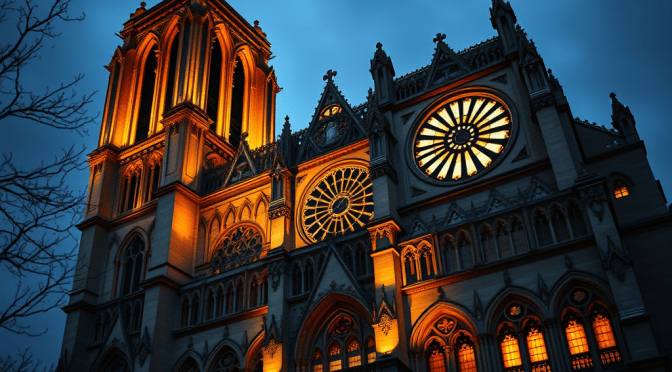
Is the Cathedral of Notre-Dame the Philospher’s Stone of Alchemy? Fulcanelli’s Stone Mysteries Unveiled

Introduction: The Cathedral as Alchemical Textbook

When Fulcanelli published Le Mystère des Cathédrales in 1926, he revealed a shocking truth: Gothic cathedrals are encrypted alchemical manuscripts in stone. Notre-Dame de Paris—the very cathedral that burned in 2019—contains the most profound of these hidden messages. This article deciphers:

  • The Alchemical Architecture of Notre-Dame
  • Secret Symbols in Stone & Glass
  • The Green Language (“Langue Verte”) of the Builders
  • Modern Confirmations of Fulcanelli’s Theories
  • Practical Guide to Seeing the Alchemy for Yourself

1. Notre-Dame’s Alchemical Blueprint

The Floor Plan as Laboratory

The cathedral’s layout mirrors an alchemist’s flask:

  • Nave = Alembic (distillation vessel)
  • Transept = Crucible
  • Rose Windows = Planetary metals (gold/sun, silver/moon)

“Every cathedral is a chemical formula written in light and stone.”
Fulcanelli, Le Mystère des Cathédrales

Interactive Map:
Explore Notre-Dame’s Alchemical Layout


2. The 7 Key Alchemical Symbols & Their Meanings

LocationSymbolAlchemical Meaning
West Façade (Left Portal)Melchizedek holding a cupThe Sacred Vessel (Grail = Philosopher’s Stone)
Central TympanumThe Last JudgmentNigredo (purification by fire)
North Rose WindowBlue & Red GlassMercury (♀) & Sulfur (♂) marriage
Chimeras/GargoylesAlchemical DragonsPrimordial Matter (Chaos before Order)
Labyrinth (Destroyed 18th c.)11-circuit path11 Steps to the Stone
St. Anne’s PortalSheela-na-gigSolve et Coagula (dissolution/rebirth)
The Lead RoofPhoenix CarvingsRubedo (final transformation)

Video Tour:
Notre-Dame’s Hidden Symbols


3. The Green Language: How Builders Encoded Secrets

What is Langue Verte?

A system of phonetic wordplay used by medieval alchemists:

  • Notre-Dame → “Notre-Dame” sounds like “Notre-Dame” (Our Lady) but also:
  • “Nostre-Dame”“Nos True Dame” (Our True Mercury/Alchemical Mother)
  • The Rose Windows → “Rose” = “Ros” (Dew, the Divine Water)

Real-World Example:

The “Portail Rouge” (Red Portal) contains:

  • Red stone = Rubedo stage
  • Hidden acrostics in Latin inscriptions

Decoding Tool:
Medieval Cipher Wheel Simulator


4. Modern Proof: Science Confirms the Alchemy

Recent Discoveries:

  1. 2019 Fire Revelation: When the roof burned, lead vaporized at 327°C—the exact temperature alchemists associated with “the flight of the dove” (spiritual ascension).
  2. Laser Scans (2022): Show deliberate asymmetries matching alchemical proportions.
  3. Stone Analysis: Limestone contains unusual quartz veins resembling alchemical “veins of the Earth.”

Scientific Paper:
X-Ray Fluorescence Study of Notre-Dame Stones


5. How to See the Alchemy Yourself

Virtual Tour Checklist:

  1. The West Façade: Count 7 alchemical steps in the left portal arches.
  2. The Cloister: Find the hidden caduceus in the column carvings.
  3. Stained Glass: Note how blue (lunar) & red (solar) panels face north/south.

Augmented Reality App:
Notre-Dame Alchemy AR


Conclusion: A Living Alchemical Crucible

Notre-Dame isn’t just a church—it’s the Philosopher’s Stone in architectural form. As restoration continues (set to reopen Dec 2024), watch for:

  • Newly exposed carvings under centuries of grime
  • The lead roof’s replacement (will it contain codes?)
  • The reliquary chamber (rumored to hold Hermetic texts)

“When you understand the cathedral, you hold the Stone in your hand.”
Attributed to Fulcanelli

Want to go deeper? Explore these 3D scans of the cathedral’s hidden geometries:
CNRS Notre-Dame Reconstruction Project

~ The Alchemy Master

Additional Resources:


Fulcanelli: The Last Alchemist Who Vanished Into Legend

Introduction: The Greatest Mystery of 20th-Century Alchemy

Fulcanelli is the most enigmatic alchemist of the modern era—a man who allegedly completed the Magnum Opus, discovered the Philosopher’s Stone, and then vanished without a trace. His true identity remains unknown, his life shrouded in myth, and his disappearance fuels speculation that he achieved literal or spiritual immortality.

This article explores:

  • Who Was Fulcanelli? (Theories on His Identity)
  • His Alchemical Works & Hidden Knowledge
  • The Mystery of His Disappearance
  • Did He Achieve Immortality? (And Where Is He Now?)
  • His Legacy in Modern Esotericism

1. Who Was Fulcanelli? The Theories

Fulcanelli was the pseudonym of a French alchemist who appeared in the early 20th century. His real identity is debated, but candidates include:

Possible Identities

CandidateEvidence
Jules Violle (Physicist)Similar writing style, scientific knowledge.
Jean-Julien Champagne (Artist)Illustrated Fulcanelli’s books; deep esoteric ties.
Pierre Dujols (Occult Bookseller)Taught alchemy; mentored Fulcanelli’s students.

The Pupil Who Revealed Him: Eugène Canseliet

Fulcanelli’s most famous student, Eugène Canseliet, claimed to have met him after his supposed “disappearance” in 1926, looking decades younger.

“Fulcanelli was not a man; he was an intelligence who used a body.”
Jacques Bergier, The Morning of the Magicians

Further Reading:


2. Fulcanelli’s Alchemical Works

1. Le Mystère des Cathédrales (1926)

  • Argues that Gothic cathedrals (like Notre-Dame) are encoded alchemical texts.
  • Links Christian symbolism to the Great Work.
    📜 Read excerpts: Sacred-Texts Archive

2. Les Demeures Philosophales (1930)

  • Explores alchemical secrets in French architecture.
  • Suggests medieval builders hid esoteric formulas in stone.

Video Resource:


3. The Disappearance: Did He Achieve Immortality?

The 1926 Vanishing

Fulcanelli allegedly told Canseliet:

“I am leaving. You will not see me again. I go to a far country.”

Afterwards, he disappeared without a trace.

The 1953 “Return”?

Canseliet claimed to have met Fulcanelli in Spain in 1953, looking 30 years younger.

Theories on His Fate

  1. Physical Immortality – He found the Elixir of Life and still walks among us.
  2. Ascension – He transcended to a higher plane of existence.
  3. Secret Society – He joined a hidden esoteric order (like the Priory of Sion).
  4. Hoax – He never existed; a myth created by Canseliet.

Further Reading:


4. Is Fulcanelli Still Alive Today? Speculations

If He Achieved Immortality…

  • He might be living incognito, guiding esoteric circles secretly.
  • Working in advanced science (cold fusion, quantum physics).
  • Observing humanity’s evolution from the shadows.

If He Ascended…

  • Exists as a “light being” (like Hermes Trismegistus).
  • Communicates through synchronicities (like Jung’s “collective unconscious”).

The Most Esoteric Theory

  • He became a “time traveler”—alchemy as a portal to other dimensions.

Video Resource:


5. Fulcanelli’s Legacy

Influence on Modern Alchemy

  • Inspired modern hermeticists like Julius Evola.
  • Fueled Nazi occult research (the SS reportedly sought him).

Pop Culture Appearances

  • “The Morning of the Magicians” (1960s occult boom).
  • “Fulcanelli: The Alchemist” (Documentary).

Further Reading:


Conclusion: The Man Who Became a Legend

Fulcanelli remains the ultimate alchemical mystery—a man who either conquered death or became pure myth. Whether he walks among us, exists in another realm, or was simply a brilliant hoax, his teachings challenge us to ask:

“Is immortality possible? And if so, what would we do with it?”

Additional Resources:


The Philosopher’s Stone: Alchemy’s Ultimate Mystery

Introduction: The Ultimate Quest of Alchemy

The Philosopher’s Stone (Latin: Lapis Philosophorum) is the most legendary and enigmatic concept in alchemy. More than just a mythical substance that turns lead into gold, it represents perfection, immortality, and divine wisdom.

For centuries, alchemists across Europe, the Islamic world, and Asia pursued this elusive treasure, believing it could:
Transmute base metals into gold (physical perfection).
Grant eternal youth and immortality (the Elixir of Life).
Awaken spiritual enlightenment (union with the divine).

This article explores:

  • Origins & Symbolism of the Philosopher’s Stone
  • Key Alchemists Who Sought the Stone
  • Famous Texts & Manuscripts on the Stone
  • Scientific & Spiritual Interpretations
  • Modern Legacy (Science, Pop Culture, and Esotericism)

1. Origins & Symbolism of the Philosopher’s Stone

Ancient Roots

The idea of a “perfected substance” appears in:

  • Chinese Alchemy (Jindan – Golden Elixir).
  • Indian Alchemy (Amrita – Nectar of Immortality).
  • Greek & Egyptian Alchemy (Hermes Trismegistus’ Emerald Tablet).

Symbolic Meanings

The Stone was not just a physical object but a metaphor for transformation:

  • Material – Turning lead into gold.
  • Spiritual – Purifying the soul.
  • Divine – Union with God.

“The Stone is one, the medicine is one, to which we add nothing, only removing what is superfluous.”
Paracelsus

Further Reading:


2. Key Alchemists Who Sought the Stone

AlchemistContribution
Hermes TrismegistusMythical founder; linked Stone to Emerald Tablet.
Zosimos of Panopolis (3rd-4th c.)Early Greek-Egyptian alchemist; wrote on transmutation.
Jabir ibn Hayyan (Geber) (8th c.)Islamic alchemist; theorized the Stone’s composition.
Nicolas Flamel (14th c.)Legendary French alchemist; claimed to have found it.
Paracelsus (16th c.)Reinterpreted the Stone as a medical cure.
Isaac Newton (17th c.)Secretly studied alchemy to uncover its secrets.

Video Resource:


3. Famous Texts on the Philosopher’s Stone

1. The Emerald Tablet

  • Attributed to Hermes; basis for all alchemy.
  • Key phrase: “As above, so below.”

📜 Read it here: Emerald Tablet Translation

2. The Mutus Liber (1677)

  • A wordless alchemical manual with symbolic images.
  • Allegedly reveals the Stone’s preparation.

📜 View the manuscript: Mutus Liber Online

3. The Twelve Keys of Basil Valentine

  • A step-by-step guide to creating the Stone.
  • Uses Christian and alchemical symbolism.

📜 Free PDF: The Twelve Keys


4. Scientific & Spiritual Interpretations

Was the Stone Real?

  • Alchemists believed it existed, but descriptions were symbolic.
  • Some theories suggest:
  • A red powder (possibly gold oxide).
  • A philosopher’s mercury (purified liquid metal).

Psychological Interpretation (Carl Jung)

Jung saw the Stone as a symbol of the Self—the goal of individuation (inner wholeness).

“The alchemical opus was not just chemistry, but a process of psychic transformation.”
Carl Jung, Psychology and Alchemy

Further Reading:


5. Modern Legacy of the Philosopher’s Stone

In Science

  • Nuclear transmutation (turning elements into gold via particle accelerators).
  • Nanotechnology (creating “perfect” materials).

In Pop Culture

  • Harry Potter’s Sorcerer’s Stone (immortality theme).
  • Fullmetal Alchemist (equivalent exchange concept).

In Esotericism

  • Rosicrucians & Freemasons still study alchemical symbolism.
  • New Age spirituality uses the Stone as a metaphor for enlightenment.

Video Resource:


Conclusion: The Eternal Quest Continues

The Philosopher’s Stone remains the ultimate symbol of human aspiration—whether for wealth, immortality, or wisdom. Though no one has ever confirmed its physical existence, its spiritual and philosophical lessons endure.

“The Stone is within you; the work is within you. Seek it there.”
Anonymous Alchemist

Additional Resources:


Hermeticism and Alchemy: The Divine Science of Transformation

Introduction: The Secret Thread of Hermetic Wisdom

Hermeticism (or Hermetism) is one of the most influential philosophical and spiritual traditions in Western esotericism, deeply intertwined with alchemy. Named after the mythical sage Hermes Trismegistus (“Thrice-Greatest Hermes”), this tradition teaches that the universe is a living, interconnected whole, and that humanity can attain divine knowledge through spiritual and alchemical practices.

At the heart of Hermeticism lies the belief that “As above, so below”—the microcosm (man) reflects the macrocosm (universe), and by mastering the secrets of nature, one can achieve gnosis (illumination) and immortality.

This article explores:

  • Who Was Hermes Trismegistus?
  • The Core Teachings of Hermeticism
  • Key Hermetic Texts (The Emerald Tablet, Corpus Hermeticum, etc.)
  • Hermeticism’s Influence on Alchemy
  • The Evolution of Hermetic Thought (From Antiquity to the New Age)

1. Who Was Hermes Trismegistus?

Hermes Trismegistus is a syncretic figure, blending the Greek god Hermes (messenger of the gods) with the Egyptian Thoth (god of wisdom, magic, and writing). He was said to have lived in ancient Egypt and authored sacred texts on alchemy, astrology, and theology.

The Legend of Hermes

  • Revealed divine secrets to humanity in cryptic writings.
  • Possessed the Emerald Tablet, the foundational text of alchemy.
  • Considered the father of Hermeticism, a tradition that shaped Western occultism.

“What is below is like what is above, and what is above is like what is below.”
The Emerald Tablet

Further Reading:


2. The Core Teachings of Hermeticism

Hermetic philosophy is built on seven universal principles, as outlined in The Kybalion (a modern Hermetic text):

  1. The Principle of Mentalism – “The All is Mind.”
  2. The Principle of Correspondence – “As above, so below.”
  3. The Principle of Vibration – Everything is in motion.
  4. The Principle of Polarity – Opposites are the same in nature.
  5. The Principle of Rhythm – Life moves in cycles.
  6. The Principle of Cause and Effect – Every action has a consequence.
  7. The Principle of Gender – Masculine and feminine forces exist in all things.

These principles were essential to alchemical thought, guiding the belief that spiritual transformation mirrored material transmutation.

Video Resource:


3. Key Hermetic Texts

The Emerald Tablet

  • A short, cryptic text considered the foundation of alchemy.
  • Contains the famous axiom: “As above, so below.”
  • Believed to hold the secret of the Philosopher’s Stone.

📜 Read the full text here: The Emerald Tablet Translation

The Corpus Hermeticum

  • A collection of 17 Greek texts on theology, cosmology, and salvation.
  • Explores man’s divine nature and the path to enlightenment.
  • Influenced Renaissance thinkers like Marsilio Ficino.

📜 Full text available: Corpus Hermeticum Online

The Kybalion (1908)

  • A modern interpretation of Hermetic philosophy.
  • Introduces the Seven Hermetic Principles.

📜 Free PDF: The Kybalion Archive


4. Hermeticism’s Influence on Alchemy

Hermeticism provided the philosophical backbone of Western alchemy. Key connections include:

Alchemy as a Spiritual Path

  • Transmutation of metals symbolized soul purification.
  • The Philosopher’s Stone represented divine wisdom.

Famous Hermetic Alchemists

FigureContribution
Zosimos of Panopolis (3rd-4th c.)Linked Hermeticism with early alchemy.
Paracelsus (1493-1541)Merged Hermetic medicine with chemistry.
Isaac Newton (1643-1727)Studied Hermetic texts in secret.

Further Reading:


5. The Evolution of Hermetic Thought

Ancient Egypt & Greece (1st-3rd c. CE)

  • Hermes Trismegistus myths emerge.
  • Alexandrian schools blend Greek and Egyptian mysticism.

Islamic Golden Age (8th-14th c.)

  • Arabic translations preserve Hermetic texts.
  • Jabir ibn Hayyan (Geber) integrates Hermeticism into alchemy.

European Renaissance (15th-17th c.)

  • Marsilio Ficino translates the Corpus Hermeticum (1460).
  • Rosicrucians & Freemasons adopt Hermetic symbolism.

Modern Revival (19th-21st c.)

  • Theosophy & New Age movements revive Hermetic teachings.
  • Carl Jung interprets Hermeticism as psychology.

Video Resource:


Conclusion: The Living Tradition of Hermetic Alchemy

Hermeticism remains a powerful undercurrent in Western esotericism, alchemy, and occultism. Its teachings—hidden in symbols, encrypted in texts, and practiced in secret—continue to inspire seekers of divine knowledge.

“The lips of wisdom are closed, except to the ears of understanding.”
The Kybalion

Additional Resources:


Alkahest & Azoth: Alchemy’s Ultimate Solvent and Divine Life Force

Introduction: The Twin Mysteries of Alchemy

In the labyrinth of alchemical symbolism, two of the most enigmatic concepts are Alkahest (the Universal Solvent) and Azoth (the Primordial Life Force). These were not merely chemical substances but metaphysical keys to unlocking nature’s deepest secrets:

  • Alkahest – The “solvent of all solvers,” capable of dissolving any material (even gold) back to its primordial state.
  • Azoth – The “quintessence of life,” a spiritual mercury representing the animating force of the universe.

Both were central to the Great Work (Magnum Opus), the alchemist’s quest for perfection. This article explores:

  • Origins & Meanings of Alkahest and Azoth
  • Key Alchemists Who Pursued Them
  • Symbolism in Alchemical Texts
  • Scientific & Esoteric Interpretations
  • Modern Legacy in Science and Spirituality

1. Alkahest: The Universal Solvent

Origins & Definition

  • First named by Paracelsus (1493–1541), though the concept existed earlier.
  • From Dutch “al-kahest” (“all-dissolver”).
  • Believed to reduce all matter to its primal essence (Prima Materia).

The Quest for Alkahest

Alchemists theorized it could:
Dissolve any substance (even diamonds).
Purify metals for transmutation.
Extract the “essence” of plants and minerals for medicines.

“Alkahest is the key to all secrets; it opens the locked doors of nature.”
Johann Rudolf Glauber

Was It Real?

  • Some believed it was a supercharged alcohol or acid.
  • Van Helmont (1580–1644) claimed to possess it (possibly a potassium carbonate solution).
  • Modern equivalents: Aqua regia (dissolves gold) or superacids.

Further Reading:


2. Azoth: The Divine Mercury of the Philosophers

Origins & Definition

  • From Arabic “al-zā’ūq” (mercury) + Hebrew “Azoth” (essence).
  • Not ordinary mercury but a spiritualized, living mercury—the soul of all metals.
  • Symbolized the union of opposites (male sulfur + female mercury).

The Role of Azoth in Alchemy

  • The “first matter” of creation (linked to Prima Materia).
  • The animating force behind the Philosopher’s Stone.
  • A healing elixir (Paracelsus’ “Azoth of the Red Lion”).

“In Azoth, all things are contained; it is the beginning and the end.”
Basil Valentine

Symbolism of Azoth

  • Often depicted as a caduceus (Hermes’ staff) or a serpent swallowing its tail (Ouroboros).
  • In medieval manuscripts, “AZOTH” was written over the crowned king (gold) and queen (silver).

Video Resource:


3. Key Alchemists & Texts

FigureContribution
ParacelsusCoined “Alkahest”; linked Azoth to medical alchemy.
Johann Rudolf GlauberSought Alkahest in salt extracts (“Glauber’s Salt”).
Basil ValentineWrote on Azoth in “The Triumphal Chariot of Antimony”.
Eirenaeus PhilalethesCalled Azoth the “Mercury of the Wise” in “Secrets Revealed”.

Key Texts

📜 “The Triumphal Chariot of Antimony”Read here
📜 “The Secrets of Alchemy” (Eirenaeus Philalethes)PDF


4. Scientific & Spiritual Interpretations

Alkahest: The Proto-Chemical Dream

  • Modern parallels:
  • Superacids (fluoroantimonic acid, the strongest known).
  • Molecular disassemblers (nanotech).

Azoth: From Alchemy to Mysticism

  • Jungian psychology: Symbol of the Self (unified psyche).
  • Esoteric traditions: The “light body” in Hermeticism.

Further Reading:


5. Modern Legacy

In Science

  • Alkahest inspires research into supersolvents.
  • Azoth appears in energy medicine (e.g., orgone, chi).

In Pop Culture

  • Fullmetal Alchemist: Azoth as a life-force symbol.
  • The Witcher: Alkahest as a magical potion.

Video Resource:


Conclusion: The Eternal Solvent and the Infinite Life-Force

Alkahest and Azoth represent alchemy’s highest ideals—mastery over matter and spirit. Though their physical forms remain elusive, their symbolic power endures:

“Seek the Alkahest within, and you shall find the Azoth of your soul.”

Additional Resources:


The Magnum Opus: Alchemy’s Great Work of Transformation

Introduction: The Ultimate Alchemical Quest

The Magnum Opus (Latin for “Great Work”) is the pinnacle of alchemical pursuit—a sacred process of material and spiritual perfection. More than just turning lead into gold, it represents the transmutation of the self, the purification of the soul, and the attainment of divine wisdom.

For centuries, alchemists across Europe, the Islamic world, and Asia sought to complete the Great Work, believing it would grant:
The Philosopher’s Stone (transmutation & immortality).
The Elixir of Life (healing & eternal youth).
Divine Enlightenment (union with the cosmic mind).

This article explores:

  • The Stages of the Magnum Opus
  • Key Alchemists & Their Interpretations
  • Sacred Texts & Manuscripts
  • Scientific & Psychological Perspectives
  • The Burning Question: Did Anyone Ever Complete It?

1. The Four Stages of the Magnum Opus

The Great Work was traditionally divided into four color-coded stages, each representing a phase of transformation:

1. Nigredo (Blackening) – Putrefaction

  • Symbolism: Death, decay, the “dark night of the soul.”
  • Process: Breaking down impure matter (or ego) to its raw state.
  • Alchemical Act: Calcination (burning away impurities).

2. Albedo (Whitening) – Purification

  • Symbolism: Washing, lunar energy, the purified self.
  • Process: Cleansing the material (or soul) to a pristine state.
  • Alchemical Act: Sublimation (rising above base nature).

3. Citrinitas (Yellowing) – Illumination

  • Symbolism: Solar awakening, wisdom, the dawning of gold.
  • Process: Infusing the purified matter with divine light.
  • Alchemical Act: Fermentation (spiritual nourishment).

4. Rubedo (Reddening) – Perfection

  • Symbolism: The Philosopher’s Stone, resurrection, divine union.
  • Process: Final unification of opposites (soul + spirit).
  • Alchemical Act: Coagulation (solidifying perfection).

“Make the fixed volatile, and the volatile fixed, and you will have the Stone.”
Hermes Trismegistus, The Emerald Tablet

Further Reading:


2. Key Alchemists & Their Visions of the Great Work

AlchemistContribution
Hermes TrismegistusMythical founder; laid groundwork in Emerald Tablet.
Maria the Jewess (1st-3rd c.)Early alchemist; invented the bain-marie for gentle heating.
Zosimos of Panopolis (3rd-4th c.)Wrote on spiritual alchemy; linked Great Work to dreams.
Nicolas Flamel (14th c.)Claimed to complete the Work with his wife, Pernelle.
Isaac Newton (17th c.)Secretly sought the Stone through lab experiments.

Video Resource:


3. Sacred Texts of the Magnum Opus

1. The Emerald Tablet

  • Core axiom: “As above, so below.”
  • Link: Full Text

2. The Rosarium Philosophorum (1550)

  • A visual guide to the Great Work with symbolic illustrations.
  • Link: Online Manuscript

3. The Twelve Keys of Basil Valentine

  • Step-by-step instructions for creating the Stone.
  • Link: Free PDF

4. Scientific & Psychological Interpretations

Chemistry’s View

  • The Great Work mirrored early lab processes:
  • Distillation (separating essences).
  • Alloying metals (gold-like amalgams).
  • Modern parallels: Nuclear transmutation, nanotechnology.

Jung’s Perspective

Carl Jung saw the Magnum Opus as a metaphor for individuation:

  • Nigredo = Shadow work.
  • Rubedo = Wholeness of the Self.

“Alchemy is the psychology of the Middle Ages.”
Carl Jung

Further Reading:


5. Did Anyone Ever Complete the Magnum Opus?

Legendary Claims

  1. Nicolas Flamel – Allegedly succeeded with his wife, achieving immortality. His tomb was later found empty.
  2. Fulcanelli (20th c.) – Mysterious French alchemist said to have vanished after completing the Work.

The Truth?

  • No verifiable proof exists, but some alchemists may have:
  • Discovered medical tinctures (Paracelsus’ laudanum).
  • Achieved spiritual enlightenment (via inner alchemy).
  • Modern “successors”:
  • Chemists (synthesizing gold in particle accelerators).
  • Mystics (using meditation as the “inner Great Work”).

Video Resource:


Conclusion: The Eternal Work Continues

The Magnum Opus was never just about gold—it was about transforming the self and the universe. Whether through lab experiments, meditation, or art, the Great Work remains humanity’s quest for perfection.

“The Stone is within you; the Work is within you. Begin where you are.”
Anonymous Alchemist

Additional Resources:


The Beast of Revelation: Who Is the Antichrist and Why Does the World Fear Him?

Introduction

Few biblical figures evoke as much fear, fascination, and speculation as the Antichrist—the ultimate embodiment of evil in the Book of Revelation. Described as the Beast (Revelation 13), this end-times tyrant will deceive the world, wage war against God’s people, and establish a global dictatorship before Christ returns to defeat him.

For centuries, Christians have tried to identify who the Antichrist might be—from Roman emperors to modern political leaders. Some believe he will rise to power in a time of global crisis, wielding unmatched influence through politics, religion, and technology.

In this deep dive, we’ll explore:

  1. What (or who) is the Antichrist?
  2. Why do Christians fear his coming?
  3. 5 historical figures once believed to be the Antichrist
  4. 5 modern candidates who fit the profile
  5. How should Christians respond to Antichrist speculation?

1. Who (or What) Is the Antichrist?

The term “Antichrist” appears only in the letters of John (1 John 2:18, 22; 4:3; 2 John 1:7), where it refers to anyone who denies Christ. However, in Revelation, the Antichrist is depicted as the Beast from the Sea (Revelation 13:1-10), a satanic world leader who:

  • Rises to global power (Revelation 13:7).
  • Performs deceptive miracles (Revelation 13:13-14).
  • Demands worship (Revelation 13:8).
  • Enforces the Mark of the Beast (666) (Revelation 13:16-18).

He is closely tied to the False Prophet (Revelation 19:20), who promotes his agenda, and the Dragon (Satan, Revelation 12:9), who empowers him.

Key Traits of the Antichrist:

  • Charismatic but deceptive (Daniel 8:23-25).
  • A political and religious unifier (Revelation 17:12-13).
  • Persecutes believers (Revelation 13:7).
  • Seeks to replace God (2 Thessalonians 2:3-4).

2. Why Do Christians Fear the Antichrist?

The Antichrist represents the ultimate enemy of Christ and His followers. Here’s why his coming is so terrifying:

A. He Will Deceive the World

  • Jesus warned of “false Christs and false prophets” (Matthew 24:24).
  • The Antichrist will perform lying signs and wonders (2 Thessalonians 2:9-10).

B. He Will Bring Persecution

  • The Bible predicts a time of great tribulation (Matthew 24:21).
  • Many believe Christians will face martyrdom under his rule (Revelation 13:7).

C. He Will Control the Global Economy

  • The Mark of the Beast (666) suggests a financial and spiritual loyalty test (Revelation 13:16-17).
  • Those who refuse will be cut off from buying or selling.

D. He Will Be a Master Manipulator

  • The Antichrist will likely emerge during a time of crisis, offering peace and security (1 Thessalonians 5:3).
  • Many will follow him blindly, believing he is a savior.

3. 5 Historical Figures Once Believed to Be the Antichrist

Throughout history, many leaders have been accused of being the Antichrist. Here are five of the most famous:

1. Nero (Roman Emperor, AD 54-68)

  • Why? Brutally persecuted Christians; some scholars believe “666” (Revelation 13:18) refers to Nero’s name in Hebrew numerology.
  • Connection: The early church saw him as a prototype of the Antichrist.
  • Source: Nero as the Beast – Bible Study

2. Pope Boniface VIII (13th Century)

  • Why? Medieval reformers accused him of blasphemy and corruption, claiming he fit the “man of sin” in 2 Thessalonians 2.
  • Connection: His feud with King Philip IV of France led to accusations of usurping Christ’s authority.
  • Source: Pope Boniface VIII & Antichrist Speculation – History.com

3. Napoleon Bonaparte (19th Century)

  • Why? His military conquests and self-deification (he crowned himself emperor) made many fear he was the Beast.
  • Connection: Some saw his rise and fall as mirroring Revelation’s prophecies.
  • Source: Napoleon and the Antichrist – Christianity Today

4. Adolf Hitler (20th Century)

5. Henry Kissinger (20th Century)

  • Why? His role in global politics and the 1973 oil crisis led some to link him to the “false peacemaker” of Revelation.
  • Connection: Hal Lindsay’s The Late Great Planet Earth suggested Kissinger fit the profile.
  • Source: Kissinger as Antichrist – End Times Speculation

4. 5 Modern Candidates Who Fit the Antichrist Profile

Today, several figures are speculated to be potential Antichrists due to their power, influence, and global reach.

1. Klaus Schwab (World Economic Forum Founder)

  • Why? Promotes “The Great Reset”, a globalist agenda some fear could lead to economic control (Mark of the Beast).
  • Connection: His call for digital IDs and AI governance aligns with fears of a technocratic dictatorship.
  • Source: The Great Reset and Bible Prophecy – Prophecy News Watch

2. Pope Francis (Leader of the Catholic Church)

  • Why? Some Protestants believe the papacy itself is the Antichrist system, citing historic Reformation views.
  • Connection: His interfaith efforts and global influence spark fears of a one-world religion.
  • Source: Is the Pope the Antichrist? – GotQuestions

3. Bill Gates (Tech Billionaire)

  • Why? His desire for world DEpopulation, sketchy history with controversial vaccines, and digital ID raise concerns about the Mark of the Beast.
  • Connection: If digital ID becomes mandatory, could they fulfill Revelation 13?
  • Source: too many to list!

4. Vladimir Putin (Russian President)

  • Why? His imperial ambitions and war in Ukraine fit the “King of the North” prophecy (Daniel 11).
  • Connection: Some believe he could be a precursor to the Antichrist’s rise.
  • Source: Putin in Bible Prophecy – Charisma News

5. A Future AI Superintelligence

  • Why? If AI gains autonomous power, could it become the ultimate deceptive force?
  • Connection: The image of the Beast (Revelation 13:15) might be a digital or AI construct.
  • Source: AI and the Antichrist – WND

5. How Should Christians Respond to Antichrist Speculation?

While it’s fascinating to speculate, the Bible warns against date-setting and paranoia. Instead, Christians should:

  1. Focus on Christ’s Return (Acts 1:7 – “It is not for you to know times or seasons”).
  2. Live Righteously (2 Peter 3:11 – “What sort of people ought you to be?”).
  3. Test All Spirits (1 John 4:1 – Not every leader is the Antichrist).
  4. Share the Gospel (Matthew 24:14 – The end will come after the Gospel is preached to all nations).

Conclusion: The Antichrist Is Coming—But Christ Has Already Won

The Antichrist remains one of the Bible’s most mysterious and feared figures. While history is full of tyrants and deceivers, the true Beast will be uniquely empowered by Satan to lead the world into rebellion against God.

Yet, Christians need not fear: “He who is in you is greater than he who is in the world” (1 John 4:4). No matter who rises to power, Christ will return to destroy the Antichrist and establish His eternal kingdom.

What do you think? Could one of these modern figures be the Antichrist, or is he still to come? Share your thoughts below!


Further Reading:

Scripture References:

  • Revelation 13 – The Beast’s rise.
  • 2 Thessalonians 2:1-12 – The “man of lawlessness.”
  • 1 John 2:18 – Many antichrists, but one ultimate Antichrist.

Alchemy as Religion: The Sacred Science of Spiritual Transformation

Alchemy is often studied as a proto-science or a philosophical tradition, but at its core, it has always been a profoundly religious and mystical pursuit. Many alchemists saw their work not just as laboratory experiments but as a divine revelation, a sacred art that mirrored the soul’s journey toward perfection.

From its roots in Hermeticism and Gnosticism to its associations with esoteric Christianity, Kabbalah, and even the “black arts,” alchemy has always straddled the line between science, magic, and religion. This article explores:

  • Alchemy as a Spiritual Path: The Quest for Divine Union
  • The Religious Symbolism of the Great Work
  • Alchemy’s Ties to Esoteric Traditions (Hermeticism, Gnosticism, Kabbalah)
  • The Dark Side of Alchemy: Links to the Black Arts and Occult Magic
  • Modern Religious Alchemy: From Jungian Psychology to New Age Mysticism

1. Alchemy as a Spiritual Path: The Quest for Divine Union

Unlike modern chemistry, which focuses solely on material transformations, alchemy was a sacred science—a means of attaining gnosis (divine knowledge) and reuniting with the divine.

The Alchemist as a Priest of Nature

Alchemists saw themselves as mediators between heaven and earth, performing rituals that mirrored God’s act of creation. Their laboratories were temples, and their experiments were prayers in action.

“The alchemist is the priest of the divine art, working in the laboratory of the soul.”
Anonymous Rosicrucian Text

The Three Stages of Spiritual Alchemy

  1. Nigredo (Blackening) – Purification through suffering (the “dark night of the soul”).
  2. Albedo (Whitening) – Illumination and spiritual awakening.
  3. Rubedo (Reddening) – Divine union, the marriage of spirit and matter.

These stages parallel Christian mysticism, Buddhist enlightenment, and Hindu moksha.

Further Reading:


2. The Religious Symbolism of the Great Work

The Magnum Opus (Great Work) was not just about making gold—it was about the soul’s redemption.

Key Religious Motifs in Alchemy

  • The Philosopher’s Stone – Symbolized Christ, the perfected man, or the awakened Buddha.
  • The Rebis (Hermaphrodite) – The union of male (sulfur) and female (mercury), representing divine androgyny.
  • The Ouroboros (Serpent Eating Its Tail) – Eternal return, the cycle of death and rebirth.

Alchemy and the Bible

Many alchemists believed their art was hidden in Scripture:

  • The Book of Genesis – The separation of light from darkness as the first alchemical act.
  • The Transfiguration of Christ – Symbolized the ultimate transmutation.
  • The Apocalypse – The final purification of the world.

Video Resource:


3. Alchemy’s Ties to Esoteric Traditions

Alchemy did not exist in a vacuum—it was deeply entwined with mystical and occult traditions.

Hermeticism: The Foundation of Alchemical Religion

The Emerald Tablet of Hermes Trismegistus (“As above, so below”) became the cornerstone of alchemical thought, linking macrocosm (universe) and microcosm (man).

Gnosticism: The Divine Spark Trapped in Matter

Gnostic alchemists sought to free the spirit from the prison of the material world, much like the Gnostic demiurge myth.

Kabbalah: The Tree of Life and Alchemy

Jewish alchemists like Abraham Eleazar merged Kabbalistic teachings with alchemy, mapping the Sephiroth (divine emanations) onto chemical processes.

Further Reading:


4. The Dark Side of Alchemy: Links to the Black Arts and Occult Magic

Not all alchemy was pious—some branches delved into necromancy, demonology, and forbidden knowledge.

The Faustian Bargain: Alchemists and the Occult

Legends like Dr. Faustus and Gilles de Rais blurred the line between alchemy and diabolical pacts.

The “Forbidden” Alchemy of the Middle Ages

  • Homunculi – Artificial life created through dark rituals.
  • Necromantic Elixirs – Using human remains in potions.
  • Goetia (Demonic Magic) – Some grimoires included alchemical recipes.

Video Resource:


5. Modern Religious Alchemy: From Jung to New Age Mysticism

Alchemy never truly died—it evolved into psychology, occultism, and New Age spirituality.

Carl Jung: Alchemy as Psychology

Jung saw alchemy as a map of the unconscious, with symbols representing archetypes of the soul.

New Age Alchemy: Spiritual Transmutation Today

Modern seekers use meditation, energy work, and psychedelics as “inner alchemy.”

Alchemy in Secret Societies

Groups like the Rosicrucians, Freemasons, and Golden Dawn preserved alchemical rites.

Further Reading:


Conclusion: The Eternal Religion of Transformation

Alchemy was—and still is—a living religion of the soul, a path of divine fire and sacred metals. Whether through prayer, meditation, or the crucible, its message remains:

“Transform yourself, and you transform the world.”

Additional Resources:


Alchemy as Science: The Forgotten Foundation of Modern Chemistry

Alchemy is often dismissed as a pseudoscience—a mystical pursuit of turning lead into gold or discovering the Elixir of Life. Yet, hidden beneath its esoteric symbolism and arcane language, alchemy was the precursor to modern chemistry, medicine, and experimental science.

From the laboratories of medieval alchemists to the notebooks of Isaac Newton, alchemy laid the groundwork for the scientific method, laboratory techniques, and the very concept of material transformation. This article explores:

  • Alchemy’s Role in the Birth of Experimental Science
  • Key Alchemical Discoveries That Shaped Modern Chemistry
  • Famous Scientists Who Were Secret Alchemists
  • Why Alchemy Was More Than Just “Failed Chemistry”
  • The Legacy of Alchemy in Modern Science

1. Alchemy as the First Experimental Science

Long before the term “scientist” existed, alchemists were the first true experimentalists. They:

  • Developed laboratory tools (retorts, alembics, furnaces).
  • Pioneered chemical processes (distillation, sublimation, fermentation).
  • Recorded systematic observations (though often in coded language).

The Scientific Method in Alchemy

While alchemy included mystical elements, its practitioners followed a proto-scientific method:

  1. Observation – Studying reactions between substances.
  2. Hypothesis – Theorizing how metals “grew” in the earth.
  3. Experimentation – Testing purification techniques.
  4. Repetition – Refining processes over centuries.

Robert Boyle, a founder of modern chemistry, acknowledged his debt to alchemy, stating:

“The alchemists have made a more elaborate investigation of material bodies than any other class of philosophers.”

Further Reading:


2. Key Alchemical Discoveries That Shaped Modern Science

Many foundational chemical processes were first discovered by alchemists:

Alchemical DiscoveryModern Equivalent
Distillation of AlcoholEthanol production, perfumes
Preparation of Acids (e.g., Aqua Regia)Metallurgy, gold refining
Discovery of PhosphorusMatches, fertilizers
Purification of MercuryEarly thermometers

The Importance of Arab Alchemists

Islamic scholars like Jabir ibn Hayyan (Geber) and Al-Razi (Rhazes) revolutionized alchemy by:

  • Classifying substances into metals, salts, and spirits.
  • Inventing new apparatus (such as the alembic for distillation).
  • Documenting chemical reactions systematically.

Their works were later translated into Latin, fueling Europe’s scientific revolution.

Video Resource:


3. Famous Scientists Who Were Secret Alchemists

Many pioneers of science dabbled in—or were deeply committed to—alchemy:

Isaac Newton: The Last Magician

Newton spent more time on alchemy than on physics. His secret manuscripts reveal attempts to:

  • Replicate the Philosopher’s Stone.
  • Study “vegetable mercury” (a mystical substance).
  • Decode alchemical texts like the Emerald Tablet.

“Newton was not the first of the age of reason, he was the last of the magicians.”
John Maynard Keynes

Robert Boyle: Father of Chemistry, Alchemical Believer

Though Boyle helped establish modern chemistry, he:

  • Sought the transmutation of metals.
  • Wrote on the “Hermetic Mystery” of alchemy.
  • Collaborated with alchemists like George Starkey.

Paracelsus: Alchemist & Medical Revolutionary

Paracelsus rejected medieval medicine, instead:

  • Using alchemical remedies (mercury for syphilis).
  • Pioneering toxicology (“The dose makes the poison”).
  • Influencing homeopathy and pharmacology.

Further Reading:


4. Why Alchemy Was More Than Just “Failed Chemistry”

Alchemy’s dismissal as “failed science” ignores its philosophical and methodological contributions:

A Holistic View of Nature

Alchemists saw the universe as interconnected—a concept revived in:

  • Ecology (Gaia hypothesis).
  • Quantum physics (entanglement).
  • Systems theory.

The Concept of Transmutation

While alchemists failed to turn lead into gold, their work led to:

  • Nuclear chemistry (actual element transmutation).
  • Material science (nanotechnology, graphene).

The Psychological Legacy (Jungian Alchemy)

Carl Jung saw alchemy as a metaphor for self-transformation, influencing:

  • Psychotherapy (individuation process).
  • Symbolic interpretation in art and literature.

Video Resource:


5. The Legacy of Alchemy in Modern Science

Alchemy’s influence persists in surprising ways:

Chemistry & Medicine

  • Pharmaceuticals (derived from Paracelsus’ tinctures).
  • Periodic Table (evolved from alchemical symbols).

Materials Science

  • Nanoparticle gold (modern “transmutation”).
  • Self-healing materials (inspired by alchemical rebirth).

Energy Research

  • Cold fusion (a modern “Philosopher’s Stone”?).
  • Renewable energy (sun as alchemical fire symbol).

Further Reading:


Conclusion: Alchemy’s Hidden Scientific Triumph

Though alchemy was once mocked, we now recognize it as the cradle of experimental science. Its practitioners:
Invented lab techniques still used today.
Discovered key chemical processes.
Inspired giants like Newton and Boyle.

The next time you see a chemist using a Bunsen burner (descended from alchemical furnaces) or a beaker (from medieval glassware), remember—science owes its birth to the alchemists.

“Alchemy is the art of far and near, and I think it’s a spiritual art as much as it is a science.”
Salvador Dalí

Additional Resources:


The Elixir Vitae: Alchemy’s Quest for Immortality

For millennia, alchemists across the world have pursued the ultimate prize—the Elixir of Life (Elixir Vitae), a substance believed to grant eternal youth, perfect health, and even immortality. This legendary potion was not merely a fantastical dream but a serious philosophical and experimental endeavor, deeply intertwined with spiritual enlightenment, medical science, and the secrets of nature.

From the cinnabar-laden elixirs of China to the nectar of the gods (Amrita) in India, and the Philosopher’s Stone-infused potions of Europe, the search for immortality shaped alchemical traditions worldwide. Some seekers died in their pursuit, while others left behind cryptic manuscripts hinting at hidden truths.

In this exploration, we will delve into:

  • The Origins and Symbolism of the Elixir Vitae
  • Chinese Alchemy: Jade, Cinnabar, and Deadly Experiments
  • Indian Alchemy: Amrita, the Nectar of Immortality
  • European Alchemy: The Elixir and the Philosopher’s Stone
  • Modern Interpretations: Science, Myth, and Legacy

1. The Origins and Symbolism of the Elixir Vitae

The Elixir Vitae (Latin for “Elixir of Life”) was more than just a potion—it was a metaphor for divine knowledge, spiritual perfection, and the conquest of death. Different cultures envisioned it in various forms:

  • As a liquid (drinkable tincture, often gold or ruby-colored).
  • As a powder (the “White Powder of Gold” in some European traditions).
  • As a mystical substance (like the Hindu Amrita or the Taoist Jindan).

Alchemists believed that just as base metals could be purified into gold, the human body and soul could be refined into an immortal state. The Elixir was not merely about living forever but about transcending decay, disease, and spiritual ignorance.

The Connection to the Philosopher’s Stone

In European alchemy, the Philosopher’s Stone was often linked to the Elixir—some believed the Stone itself could produce the potion. The legendary alchemist Nicolas Flamel was said to have discovered both, granting him and his wife extended life.

“The Elixir of Life is nothing other than the Quintessence, the Fifth Element, which contains the powers of all four.”
Paracelsus


2. Chinese Alchemy: Jade, Cinnabar, and Deadly Experiments

Chinese alchemy (Waidan – external alchemy, and Neidan – internal alchemy) was deeply tied to Taoist immortality practices. The quest for the Jindan (“Golden Elixir”) led to dangerous but fascinating experiments.

Key Ingredients in Chinese Elixirs

  • Cinnabar (Mercury Sulfide) – Believed to grant longevity, but often caused mercury poisoning.
  • Jade – Symbolized immortality; powdered jade was ingested.
  • Gold – Thought to be incorruptible, thus granting eternal life.

Emperors like Qin Shi Huang and Emperor Wu of Han consumed these elixirs, only to suffer alchemical poisoning. Historical records describe symptoms like organ failure, madness, and death—proof that the pursuit of immortality was perilous.

The Shift to Internal Alchemy (Neidan)

After many deaths, Chinese alchemists turned to breath control, meditation, and energy cultivation (Qi Gong) as safer paths to immortality. The “Inner Elixir” replaced toxic substances with spiritual practices.

“To refine the Elixir, first refine the self.”
Ge Hong, Baopuzi

Further Reading:


3. Indian Alchemy: Amrita, the Nectar of the Gods

In India, the quest for immortality centered around Amrita, the divine nectar of the gods. The concept appears in Hinduism, Buddhism, and Sikhism, each with its own interpretation.

The Myth of Amrita

The Samudra Manthan (Churning of the Ocean) myth describes how gods and demons churned the cosmic ocean to obtain Amrita. The god Dhanvantari emerged holding the elixir, but a battle ensued over its possession.

Rasayana: The Science of Longevity

Indian alchemy (Rasayana) sought to replicate Amrita using:

  • Mercury (Parada) – Purified mercury was called Siddha Makaradhwaja.
  • Herbs (Soma, Ashwagandha, Shilajit) – Used in rejuvenation tonics.
  • Yogic PracticesKundalini awakening was seen as an internal elixir.

Tantric alchemists like Nagarjuna wrote extensively on mercury-based elixirs, though many recipes were symbolic, representing spiritual transformation rather than literal potions.

Further Reading:


4. European Alchemy: The Elixir and the Philosopher’s Stone

European alchemists, inspired by Hermeticism and Arabic alchemy, sought the Elixir Vitae as part of the Magnum Opus (Great Work).

Famous European Alchemists and Their Claims

  • Paracelsus – Developed Alkahest, a universal solvent believed to purify the body.
  • Raymond Lull – Claimed to have created an “Elixir of Long Life” using distilled alcohol and herbs.
  • Fulcanelli – A mysterious 20th-century alchemist rumored to have discovered immortality.

The Red Tincture vs. The White Tincture

  • Red Tincture – Associated with gold, said to cure all diseases.
  • White Tincture – Linked to silver, believed to prolong life.

Many alchemical texts, like the Rosarium Philosophorum, describe the Elixir in cryptic poetry:

“Drink this pure water, for it is the Draught of Immortality.”

Further Reading:


5. Modern Interpretations: Science, Myth, and Legacy

While literal immortality remains elusive, the Elixir’s legacy persists in:

Scientific Research on Longevity

  • Antioxidants & Telomeres – Modern “elixirs” like resveratrol (from red wine) and NAD+ boosters aim to slow aging.
  • Cryonics – Freezing bodies for future revival mirrors alchemical preservation.

Pop Culture & Symbolism

  • Harry Potter’s Sorcerer’s Stone – Grants eternal life.
  • Fullmetal Alchemist’s Philosopher’s Stone – Powered by human souls.

Spiritual Alchemy Today

Many still seek the “inner Elixir” through meditation, yoga, and energy work—proving that the quest for immortality is as much about spirit as it is about substance.

Further Reading:


Conclusion: The Eternal Quest Continues

The Elixir Vitae was never just a potion—it was a symbol of humanity’s deepest desire: to conquer death, transcend suffering, and achieve perfection. Though alchemists of old may have failed in their literal experiments, their philosophical and spiritual insights endure.

Perhaps the true Elixir was never meant to be drunk from a cup, but realized within the soul.

“The Elixir is not found in the furnace, but in the heart.”
Anonymous Alchemist

Would you like to explore how to make a “safe” modern Elixir using herbs and spiritual practices? Let me know, and we shall continue the journey!


After 2,000 Years, The Story Continues…